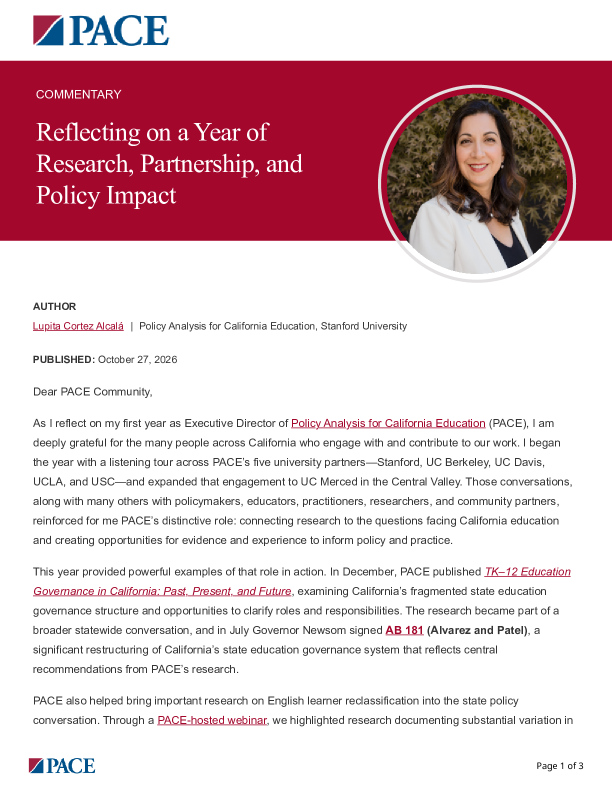
Commentary author
Publication Type
Commentary
Summary

In a reflection on her first year as PACE's Executive Director, Lupita Cortez Alcalá highlights the organization’s role in connecting rigorous research with California education policy. PACE's work helped inform two major legislative changes: AB 181, restructuring state education governance, and AB 2555, establishing more consistent and equitable English learner reclassification practices. Through its partnership with Stanford’s SCALE Initiative on Getting Down to Facts III, PACE also helped disseminate 55 technical reports and 22 policy briefs examining critical challenges facing California schools. Alongside research on literacy, mathematics, special education, and other priorities, PACE expanded opportunities for dialogue among researchers, policymakers, educators, and communities. Looking ahead to major leadership transitions and further governance reforms in 2027, Alcalá emphasizes PACE’s commitment to independent, nonpartisan research and collaborative, evidence-informed policymaking for improving opportunities and outcomes for California students.

Commentary author
Publication Type
Commentary
Summary

In response to the COVID-19 crisis, PACE Executive Director Heather Hough offers an approach involving multiple phases, transitioning from immediate action to re-entry and eventual recovery. The closure of schools due to the pandemic is expected to result in substantial learning loss, especially among disadvantaged students, necessitating a comprehensive assessment of their academic and emotional needs upon their return to school. This crisis has highlighted disparities in distance learning and accentuated existing inequalities, making it imperative to address diverse impacts and support students effectively. To address these challenges, proposing a state-level diagnostic assessment using existing resources like SBAC emerges as a unified and cost-effective means to identify learning gaps and guide resource allocation. The upcoming school term brings uncertainty, demanding clear guidelines, adaptability, and adequate resources for schools to embrace novel learning models. Immediate measures include safeguarding education funding, urging federal support, and targeting assistance for vulnerable students. Additionally, there is an opportunity to overhaul California's funding system to better reflect the critical importance of public education. This commentary is modified from testimony delivered to the California Assembly Budget Committee on April 28, 2020.

February 28, 2013 | EdSource

A collaborative of nine California school districts is submitting today a first-of-its-kind waiver seeking relief from the harshest sanctions of the No Child Left Behind law. The proposal would commit the participating districts to a new accountability system, focusing on...