Building on What Works



Summary
Calls to redesign high school in the United States have become increasingly urgent as declining student engagement, artificial intelligence (AI), and shifting labor market demands challenge long-held assumptions about the purpose of secondary education. Across the nation, policymakers and education leaders argue that the traditional model of high school—built around standardized curricula, seat-time requirements, and age-based groupings—is no longer sufficient to prepare young people for an increasingly complex and uncertain future.1 California has embraced this challenge with a growing portfolio of secondary school initiatives, including ongoing funding for community schools as well as the recent Golden State Pathways Program and California Secondary School Redesign Pilot Program.2
Amid this building momentum, however, an important question remains: How should redesign proceed? This brief argues that the next phase of California’s efforts should focus less on creating new initiatives and more on strengthening and integrating reforms that have already demonstrated promise. Specifically, I propose career pathways as a foundation for high school redesign. Research on education change suggests that durable, scalable reform rarely emerges through wholesale replacement of existing institutions but instead grows by strengthening promising innovations already embedded within schools. Drawing on our ongoing study of career and technical education (CTE) in Los Angeles Unified School District (LAUSD) as well as the broader research literature on CTE, I argue that career pathways represent one of the strongest existing foundations upon which to build broader high school redesign.
Why High Schools Must Change
The case for redesign rests on three interrelated imperatives that are reshaping expectations for secondary education: deeper student engagement, stronger durable skills (e.g., interpersonal and self-management skills), and more informed postsecondary planning and decision-making.
Student Engagement
Perhaps the strongest argument for redesign comes from students themselves. Recent survey data indicate that large proportions of high school students find school boring, irrelevant, and increasingly disconnected from their interests and aspiration.3 One in four high school students is chronically absent, nearly two thirds report that school is “boring,” and 30 percent describe it as a “waste of time.”4
It does not start out this way. Young children typically report high levels of engagement in school, but that enthusiasm fades steadily over time. Approximately three quarters of third graders say they love school, and 86 percent report that they are learning a great deal. By 11th grade, however, fewer than one third of students still say they love school, and only a little more than half believe they are learning a lot.5 In focus groups, high school students describe much of the curriculum as lacking relevance to “the real world.”6
The consequences of high school students’ disengagement are already starting to be felt. Even by traditional metrics of academic achievement, our high school students are struggling. In 2024, high school seniors posted the lowest scores ever recorded on the National Assessment of Educational Progress, with only 35 percent proficient in reading and 22 percent proficient in math.7 Moreover, according to a recent report, less than half of Generation Z Americans are “thriving,” and only 44 percent report feeling prepared for their future.8
To keep high school students engaged, schools need to foster a sense of both belonging and purpose. These mindsets allow students to connect their learning to future aspirations and ensure that they feel supported to try new things and persist when challenges arise.9 The rise of AI increases the urgency of improving students’ engagement and agency in learning, as experts predict that student will need to be lifelong learners capable of adapting as work and society rapidly evolve.10
Durable Skills for an AI-Enabled Economy
As AI assumes more administrative and other routine tasks, young people entering the workforce will be expected to contribute at a much higher level than entry-level workers of the past.11 Some observers argue that young adults entering the workforce will need to perform at the level of today’s mid-career employees: managing AI tools, exercising judgment, building relationships, and navigating complex, open-ended work from the outset of their careers.12
To succeed in this environment, students need to develop durable skills, such as communication, collaboration, leadership, adaptability, and problem-solving, and to learn to approach open-ended problems with curiosity and creativity. According to the World Economic Forum, employers predict that the most important workplace skills by 2030 will be analytical thinking, resilience and adaptability, leadership and social influence, creative thinking, and motivation and self-awareness.13 Already, these competencies are more valuable than ever. Three quarters of all job postings now request at least one durable skill, and eight of the ten most requested workforce skills fall into this category.14
State policy is beginning to respond to these shifts, with a growing number of states adopting graduate profiles that emphasize both academic knowledge and broader competencies.15 Yet most U.S. high schools remain organized around the transmission of academic content rather than the kind of experiential learning through which durable skills are developed.
Employers and hiring managers are dealing with the consequences of this mismatch. Nearly half of U.S. employers report that young adults are inadequately prepared for work, and four out of five hiring managers believe recent high school graduates are not ready for entry-level positions.16 At the same time, employers value real-world experience alongside formal education, with nearly nine in ten hiring managers reporting that experience has become more important in their hiring decisions.17
Informed Postsecondary Decision-Making
Nearly three quarters of U.S. jobs are projected to require some form of postsecondary education by 2031. The pathways to a viable career that are available to students, however, are varied and can be overwhelming. Four-year universities, community colleges, technical schools, apprenticeships, industry credentials, military service, and direct entry into the workforce can all lead to successful careers, but each carries different costs, risks, and opportunities.18
At the same time, many young people are questioning the value of college.19 Rising tuition, uneven completion rates, and uncertainty about labor market returns have made postsecondary education a more complicated investment decision than it was for previous generations.20 Students need support to understand these trade-offs and identify the educational and career pathways that best align with their interests, strengths, and aspirations. This concern is echoed in the recent report of the Commission on Purposeful Pathways, which argues that students need high-quality advising to help them navigate more complex postsecondary options and make informed decisions aligned with their goals.21
Yet many students graduate from high school having had limited opportunities to explore careers, understand educational pathways, or test their interests through authentic experiences. On national surveys and in focus groups, students report wanting more opportunities to learn about potential careers and more hands-on experiences before making important postsecondary decisions.22 In the absence of strong advising and career exploration, many students turn to social media for guidance. Forty percent of young people report actively seeking career-related information on social media, and high school students are now more likely to seek advice there than from school counselors.23
Taken together, these three imperatives suggest that redesigning high school is no longer simply a matter of improving academic achievement. Schools must also prepare students to become engaged learners, develop durable skills, and make informed decisions about an increasingly uncertain future. The question is no longer whether high schools should change, but how.
CTE as Reform Infrastructure
Calls to fundamentally rethink U.S. high schools are not new. Throughout the past century, educators and policymakers have advanced successive waves of reform, including progressive education, open classrooms, standards-based reform, and small learning communities. While many of these efforts produced important innovations, few fundamentally transformed the structure of U.S. secondary education.
In their seminal (and sobering) 1995 book Tinkering Toward Utopia,24 Tyack and Cuban synthesize a century of public school reform efforts, concluding that Americans have a long history of making dramatic demands for education reform but that actual reforms have typically been gradual and incremental. They argue that the “grammar of schooling”—institutionalized structures like age-graded classrooms, standardized curricula, and teacher-centric instruction— have consistently resisted overhauls. Radical reforms, particularly those introduced by people outside the public schools, "have often resembled shooting stars that spurted across the pedagogical heavens, leaving a meteoric trail in the media but burning up and disappearing in the everyday atmosphere of the schools."25
Tyack and Cuban recommend “adaptive tinkering” that preserves what is valuable and remedies what is not. Building on this perspective, Coburn26 argues that scaling a reform should not be understood simply as expanding a program to more schools but rather as deep organizational change that becomes owned by educators and embedded in the everyday work of schools.
Taken together, these perspectives suggest that sustainable, scalable reform rarely begins by replacing existing educational structures with entirely new ones. Instead, successful redesign is more likely to succeed by identifying promising innovations that have already demonstrated value and strengthening their implementation. From this perspective, an important question for California (and the U.S.) is not whether it needs another high school reform initiative but whether it already possesses an existing reform infrastructure capable of supporting broader redesign.
Viewed through the lens of education change, CTE is notable because it possesses an existing infrastructure with several characteristics that make it well suited to support broader high school redesign.
First, CTE is already operating at scale in U.S. high schools. More than 98 percent of public school districts report offering CTE programs, and 85 percent of high school graduates have taken at least one CTE course.27 State interest in CTE continues to grow, with 42 states enacting 152 policies aimed at boosting CTE in 2024—the highest number recorded since 2019.28
In other words, we do not need to build this infrastructure from scratch. CTE already includes experienced educators, employer partnerships, curricula, accountability systems, funding streams, and broad public support. From the perspective of education change, these assets matter because they reduce many of the implementation challenges associated with large-scale redesign. Rather than asking schools to invent entirely new organizational structures, policymakers can strengthen and extend infrastructure that already exists.
Second, CTE has already gone through a process of adaptive change. Originally established through the Smith-Hughes Act of 1917, vocational education prepared students— disproportionately lower income students and students of color—for occupations that typically did not require postsecondary education.29 Criticism of this tracking led to substantial reform over time. Modern CTE broadened its goals, integrated more rigorous academic expectations, expanded access, and increasingly emphasized preparation for both college and careers.30
Third, CTE has documented positive impacts on key student outcomes. A recent systematic evidence review found that participating in high school CTE programs can have positive impacts on a diverse range of student outcomes, including students’ academic achievement, high school completion, employability (durable) skills, college readiness, 2-year college enrollment, and employment after high school.31
Despite these strengths, the evidence also suggests that simply offering CTE courses is not enough. Programs vary substantially in their quality, coherence, and intensity. If CTE is to serve as the foundation for broader high school redesign, understanding this variation becomes essential.
Implementation Matters: Lessons from Los Angeles
Our ongoing study of CTE in LAUSD illustrates why implementation matters.32 Although CTE is widespread throughout the district, students’ experiences vary considerably—from taking a single elective course to participating in comprehensive Linked Learning pathways. Linked Learning pathways are an integrated approach to CTE that offer comprehensive college preparatory and CTE course sequences bridged by integrated projects, work-based learning, and student supports.33 Linked Learning pathways typically include three or more CTE or career- themed courses. Pathways can become certified through the Linked Learning Alliance, which has defined standards detailing the elements of the approach.
In LAUSD in 2022, there were 20 certified Linked Learning pathways and 52 noncertified Linked Learning pathways. Noncertified pathways are working towards implementation of the full Linked Learning approach but may not have all the components in place yet. There were also 265 traditional CTE pathways, consisting of a sequence of two or more CTE courses in the same program of study without the additional Linked Learning elements. This variation mirrors the broader CTE landscape across California and provides an opportunity to examine what students gain from different forms of CTE participation and what those findings suggest for high school redesign. The LAUSD experience points to three lessons for policymakers seeking to build on CTE as a foundation for high school redesign.
Lesson 1: Expanding Access Is Necessary but Not Sufficient
Over the past decade, LAUSD has made a substantial investment in expanding access to CTE, offering hundreds of pathways across diverse industry sectors. Our study describes the landscape of LAUSD CTE programming offered to the cohorts of students who started high school in the 2020–21 and 2021–22 school years.
On average, rising ninth graders in our study cohorts had access to nine CTE pathways and two Linked Learning pathways (certified or noncertified) across more than six industry sectors. Nearly two thirds of students took at least one CTE course during high school. We found:
- CTE and Linked Learning pathway participation was relatively equitable across student race/ethnicity, gender, and disability status.
- English learners took CTE courses at lower rates than students overall but participated in Linked Learning pathways at comparable rates. Linked Learning pathways may have identified more effective strategies for ensuring inclusive access for English learners. This is particularly notable given recent research suggesting that CTE may be an effective strategy for boosting English learners’ success beyond high school.34
- Students with the lowest and highest prior achievement took CTE courses at lower rates than students in the middle of the achievement distribution. Scheduling posed a barrier for both these groups: High-achieving students may need to choose between Advance Placement (AP) and CTE courses, and low-achieving students may need to retake core courses they did not initially pass.
Our findings suggest that access is only the first step. Although most students experienced some exposure to CTE, only about one in five completed a CTE or Linked Learning pathway, meaning that they completed the two core CTE classes with a passing grade (Figure 1).
Figure 1. Participation in and Completion of Career and Technical Education (CTE) in Los Angeles Unified School District (LAUSD)
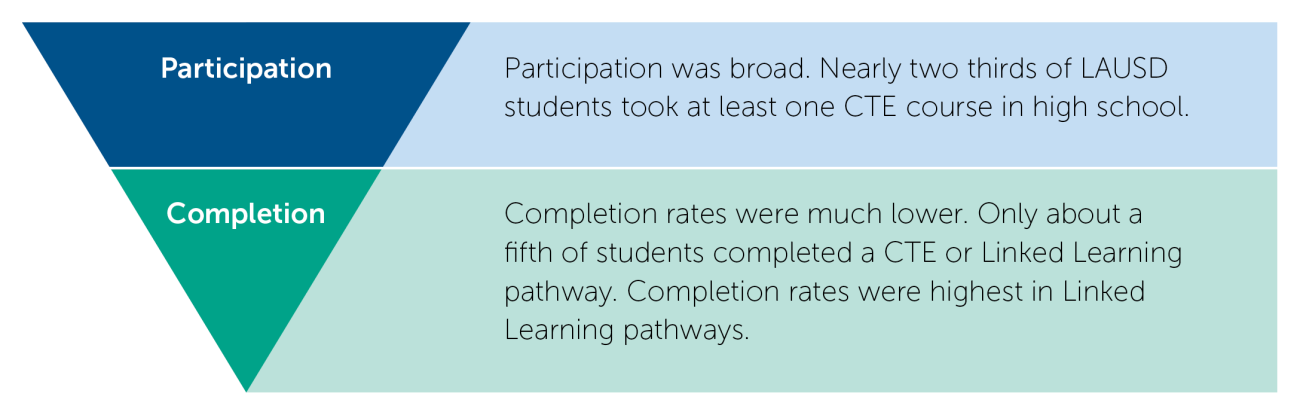
That distinction proved consequential. Students who completed the CTE course sequence within either a CTE or a Linked Learning pathway demonstrated stronger outcomes across multiple indicators, including attendance, high school graduation, completion of college- preparatory coursework, and college enrollment. Expanding access creates opportunity, but ensuring that students can complete coherent programs appears to create substantially greater educational benefits.
Lesson 2: Implementation Quality Matters
CTE is not a single educational experience. Within LAUSD, students participated in a continuum of experiences ranging from individual elective courses to Linked Learning pathways.
Compared with high school graduates who took no CTE, high school graduates who completed a certified Linked Learning pathway were:
- 16 percentage points more likely to complete a college-preparatory curriculum in high school,
- 24 percentage points more likely to enroll in college, and
- 8 percentage points more likely enroll in a 4-year college (among college attendees).
These analyses were adjusted for student and school background characteristics but did not fully account for selection bias. They are not causal estimates.
This distinction matters because implementation shapes students’ opportunities to learn. Isolated CTE courses can introduce students to new content and careers, but more robust pathways provide sustained opportunities to connect classroom learning with authentic problems, collaborate with industry professionals, develop durable skills, and reflect on future educational and career options. In other words, the value of CTE depends not simply on participation but also on the coherence and quality of students’ experiences.
The study’s findings reinforce this point: Students who completed Linked Learning pathways (both certified and noncertified) had the strongest outcomes. Similar patterns have been observed nationally, with students who experience more robust pathway models—ones that offer a sequence of three aligned courses—having stronger outcomes than students taking CTE as a one-off elective course.35 Moreover, both the current study and our prior work evaluating Linked Learning in California suggest that pathways can be particularly effective for students with low prior achievement.36
The implication is an important one for California. The policy goal should not simply be increasing CTE participation. It should be increasing the number of students who experience coherent, high-quality career pathways.
Lesson 3: Coherent Career Pathways Support the Goals of High School Redesign
Perhaps the most important lesson from LAUSD is that well-designed career pathways support the very outcomes motivating today’s calls for high school redesign.
In focus groups, students consistently described pathway experiences as making school more engaging by connecting academic learning to authentic work and real-world applications. Rather than viewing coursework as disconnected from their futures, students described seeing clearer purpose in what they were learning and greater motivation to succeed. One student made the following statement:
We work with professionals who know how to work a drone, work the camera equipment, work everything. They guided us through that process so we got to work with them and train with them. … I got to use hands-on equipment, have a full camera on me. I was like, this is cool, this is what I like to do. I didn’t know I’d like to do that until I got the chance.
Students also emphasized opportunities to develop communication, collaboration, leadership, and problem-solving skills through projects, internships, and work-based learning experiences. This is consistent with our prior work studying Linked Learning in California, where surveyed pathway students reported more growth in interpersonal skills than their nonpathway peers.37 These are precisely the skills that employers increasingly identify as essential in an economy shaped by rapid technological change.
Perhaps most striking, however, was the role pathways played in helping students make informed decisions about life after high school. Rather than asking adolescents to commit prematurely to a particular occupation, pathway experiences gave students opportunities to explore careers, discover unexpected interests, and better understand the education and training associated with different professions. As one student explained, “I didn’t know I’d like to do that until I got the chance.” That simple observation captures one of the central purposes of career pathways: not narrowing students’ options but expanding them through informed exploration.
These findings suggest that the greatest value of CTE lies not simply in exposing students to career-related coursework but also in providing access to coherent pathways that integrate rigorous academics, technical learning, work-based experiences, and meaningful postsecondary planning.
Conclusion
California has no shortage of ideas for redesigning high school. Over the past decade, the state has committed substantial funding via the Career Technical Education Incentive Grants ($300 million annually) and Golden State Pathways Program ($500 million) to increase the quality of CTE programming and build out career pathway models. The 2026–27 state budget includes ongoing funding for community schools, with $400 million dedicated to expanding community schools at the high school level. An additional $100 million is earmarked for the expansion of dual enrollment through that state’s College and Career Access Pathways grant program, which facilitates offering dual enrollment courses on high school campuses during the school day.38
The challenge is not to generate new initiatives but to connect these existing efforts into a coherent strategy for preparing young people for an increasingly complex and uncertain future. The California Secondary School Redesign Pilot Program provides an important opportunity to do just that. By encouraging districts to rethink the purpose, structure, and student experience of high school, the pilot invites educators to imagine new possibilities for secondary education.
This brief suggests that many districts may not need to begin that work with a blank slate. Rather than designing entirely new structures, districts can build on the CTE infrastructure that already exists in most California high schools, ensuring that local innovation will have a strong foundation. This approach would leverage pilot-program resources to strengthen CTE offerings through integrated career pathways and then use the pathway structure to ground aligned initiatives such as community schools and dual enrollment.
Viewed this way, career pathways become more than another initiative competing for attention within California’s redesign agenda. They provide an organizing framework that can connect and reinforce many complementary reforms. For example, instead of the current system of ad hoc dual enrollment opportunities, career pathways can facilitate the integration of intentional and aligned dual enrollment courses in ways that strengthen informed postsecondary decision-making. They can also pair well with community school models, boosting student engagement through a combination of meaningful, future-oriented learning experiences with strong student supports and family engagement.39 As California embarks on an effort to define the key components of the community-schools approach, it may be a good opportunity to articulate how these two reforms can work together.40 Rather than operating as separate initiatives, these efforts become mutually reinforcing when organized around coherent pathways that connect learning in school with students’ aspirations beyond it.
California’s greatest opportunity may not lie in inventing the next high school reform but rather in organizing and strengthening the promising reforms that have already begun. Building on what works may ultimately prove to be the most durable—and most practical—path to redesigning high school.
Warner, M. (2026, October). Building on What Works: Career Pathways as the Foundation for High School Redesign [Policy brief]. Policy Analysis for California Education. https://edpolicyinca.org/publications/building-what-works
- 1
Carnegie Foundation for the Advancement of Teaching. (n.d.). A national call to action: A research and development agenda for high school transformation. carnegiefoundation.org/wp-content/uploads/2025/07/RD-Agenda.pdf; XQ Institute. (2025). The future is high school. policyactions.xqinstitute.org; White, S. (2025, March 4). The factory model of education—Why high school needs a radical overhaul. Forbes. forbes.com/sites/scottwhite/2025/03/04/the-factory-model-of-education-why-high-school-needs-a-radical-overhaul
- 2
California Department of Education. (2026, March 2). Superintendent Thurmond highlights ongoing efforts to redesign the high school experience in California aligned with XQ Institute report [Press release]. cde.ca.gov/nr/ne/yr26/yr26rel09.asp
- 3
EdChoice. (2024, April). Teens and their schooling perspectives: A national polling report [Report]. edchoice.mcdatahub.com/edchoice/Reports/Teens_Apr_2024.pdf; Transcend. (n.d.). Beyond “fine”: How students really feel about school and why it matters. transcendeducation.org/student-experiences-student-outcomes; Young, V. M., et al. (2026, February). Reimagining high school: Student experiences today, hopes for tomorrow. Digital Promise. doi.org/10.51388/20.500.12265/286
- 4
Chang, H. N.-L., & Chavez, B. (2026, February). Unpacking California’s chronic absence crisis through 2024–25: Eight key facts [Infographic]. Policy Analysis for California Education. edpolicyinca.org/publications/unpacking-chronic-absence-through-2024-25; EdChoice, 2024; Malkus, N. (2025, June 12). Lingering absence in public schools: Tracking post-pandemic chronic absenteeism into 2024. American Enterprise Institute. aei.org/research-products/report/lingering-absence-in-public-schools-tracking-post-pandemic-chronic-absenteeism-into-2024
- 5
Transcend, n.d.
- 6
Young et al., 2026.
- 7
National Center for Education Statistics. (n.d.). NAEP report card: Reading—Grade 12 as of 2019. The Nation’s Report Card. nationsreportcard.gov/reading/nation/achievement/?grade=12
- 8
Making Caring Common Project. (2026, June). Gen Z wants to do good: How helping others supports meaning and wellbeing. Harvard Graduate School of Education. mcc.gse.harvard.edu/reports/gallup-gen-z-wants-to-do-good
- 9
Commission on Purposeful Pathways. (2026, March). A launchpad for life: A vision for purposeful pathways for all students. Strive Together. strivetogether.org/wp-content/uploads/2026/02/Commission-on-Purposeful-Pathways-Report_A-Launchpad-for-Life-A-Vision-for-Purposeful-Pathways-for-All-Students.pdf
- 10
Salisbury, A., Kasturiraman, A., Rittenhouse, C., & Alpuche, K. (2026, February 9). Closing the experience gap: How experience-based learning can reshape high school for an AI era. Humanist Venture Studio. humanist.xyz/whitepapers/closing-the-experience-gap; Anderson, J., & Winthrop, R. (2025). The disengaged teen: Helping kids learn better, feel better, and live better. Penguin Random House.
- 11
Anderson & Winthrop, 2025; Microsoft. (2025). AI in education: A Microsoft special report. cdn-dynmedia-1.microsoft.com/is/content/microsoftcorp/microsoft/bade/documents/products-and-services/en-us/education/2025-Microsoft-AI-in-Education-Report.pdf; Raman, A. (2025, May 19). I’m a LinkedIn executive. I see the bottom rung of the career ladder breaking. The New York Times. nytimes.com/2025/05/19/opinion/linkedin-ai-entry-level-jobs.html; Salisbury et al., 2026.
- 12
Anderson & Winthrop, 2025; Microsoft, 2025; Raman, 2025; Salisbury et al., 2026.
- 13
World Economic Forum. (2025, January). Future of jobs report 2025 [Report]. reports.weforum.org/docs/WEF_Future_of_Jobs_Report_2025.pdf
- 14
Lightcast. (2025, August 6). New research with America Succeeds tracks the growing demand for durable skills. Lightcast Blog. lightcast.io/resources/blog/growing-demand-for-durable-skills
- 15
XQ Institute, 2025.
- 16
Schultz Family Foundation. (n.d.). The Broken Marketplace: America’s school-to-work crisis. brokenmarketplace.org; U.S. Chamber of Commerce & College Board. (2025, September). New hire readiness report 2025: Insights from hiring managers on entry-level workforce preparedness [Report]. uschamber.com/assets/documents/2025-New-Hire-Readiness-Report.pdf
- 17
U.S. Chamber of Commerce & College Board, 2025.
- 18
Carnevale, A. P., Smith, N., Van Der Werf, M., & Quinn, M. C. (2023). After everything: Projections of jobs, education, and training requirements through 2031 [Report]. Georgetown University Center on Education and the Workforce. cew.georgetown.edu/wp-content/uploads/Projections2031-National-Report.pdf; National Center for Education Statistics. (2024, May). Condition of education: Immediate college enrollment rate. nces.ed.gov/programs/coe/indicator/cpa
- 19
Fishman, R., Nguyen, S., & Cheche, O. (2023, August). Varying degrees 2023: New America’s seventh annual survey on higher education [Report]. New America. newamerica.org/insights/varying-degrees-2023
- 20
Georgetown University Center on Education and the Workforce. (2022). Ranking 4,500 colleges by ROI (2022). cew.georgetown.edu/cew-reports/roi2022; National Student Clearinghouse Research Center. (2023, November). Completing college: National and state reports with longitudinal data dashboard on six- and eight-year completion rates (Signature Report 22). nscresearchcenter.org/wp-content/uploads/Completions_Report_2023.pdf; Webber, D. (2018, September 18). Is college worth it? Going beyond averages [Report]. Third Way. thirdway.org/report/is-college-worth-it-going-beyond-averages
- 21
Commission on Purposeful Pathways, 2026.
- 22
Schultz Family Foundation, n.d.; Young et al., 2026.
- 23
Schultz Family Foundation, n.d.
- 24
Tyack, D., & Cuban, L. (1995). Tinkering toward utopia: A century of public school reform. Harvard University Press.
- 25
Tyack & Cuban, 1995, p. 111.
- 26
Coburn, C. E. (2003). Rethinking scale: Moving beyond numbers to deep and lasting change. Educational Researcher, 32(6), 3–12. doi.org/10.3102/0013189X032006003
- 27
National Center for Education Statistics. (2024, May). Career and technical education in the United States. nces.ed.gov/programs/coe/indicator/tob; Rauf, D. S. (2025, March 21). Interest is soaring in career pathways. Here are the implications for the education market. EdWeek Market Brief. marketbrief.edweek.org/regulation-policy/interest-is-soaring-in-career-pathways-here-are-implications-for-the-education-market/2025/03
- 28
Sando, V. (2025, March 20). The top five policy trends impacting career technical education in 2024. Advance CTE.
- 29
Visher, M. G., & Stern, D. (2015, April). New pathways to careers and college: Examples, evidence, and prospects. MDRC. careertech.org/wp-content/uploads/2023/01/MDRC_New_Pathways_Careers_College_2015.pdf
- 30
Visher & Stern, 2015.
- 31
Lindsay, J., Hughes, K., Dougherty, S. M., Reese, K., & Joshi, M. (2024, April). What we know about the impact of career and technical education: A systematic review of the research. Institute of Education Sciences and Career & Technical Education Research Network. cteresearchnetwork.org/sites/default/files/2024-05/CTE-Research-Synthesis-508.pdf
- 32
Warner, M., Caspary, K., Kelley-Kemple, T., Cassidy, L., & Rush, J. (2026). Landscape of career and technical education in Los Angeles Unified School District. SRI. collegecareerpathways.org/publications/landscape-of-career-and-technical-education-in-los-angeles-unified-school-district
- 33
The California Department of Education defines high-quality college and career pathways using many of the same elements as the Linked Learning approach but does not offer a certification mechanism.
- 34
Flanagan, C., & Dougherty, S. M. (2026, July). Career and technical education as a strategy to improve long-term outcomes for English language learners (EdWorkingPaper No. 26-1510). Annenberg Institute at Brown University. doi.org/10.26300/9tre-py02
- 35
Kistler, H. C., & Dougherty, S. M. (2025, September). Evidence-based approaches to designing effective career and technical education programs (Brief No. 35). EdResearch for Action. edresearchforaction.org/wp-content/uploads/EdResearch_CTE_Design-Principles-2.pdf
- 36
Caspary, K., & Warner, M. (2020). Linked Learning student outcomes: Summary of effects on high school and early postsecondary education [Research brief]. SRI. collegecareerpathways.org/publications/linked-learning-student-outcomes
- 37
Warner, M., et al. (2018). Taking stock of the California Linked Learning District Initiative: Seventh-year evaluation report. SRI. collegecareerpathways.org/publications/taking-stock-ca-linked-learning-district-initiative
- 38
California Department of Education. (n.d.). Dual enrollment strategies. cde.ca.gov/ci/gs/hs/duenconstgs.asp
- 39
Thompson, C. (2025, September 26). Community-connected redesign at Fremont High School [Brief]. Learning Policy Institute. learningpolicyinstitute.org/product/community-connected-redesign-fremont-brief; Linked Learning Alliance & UCLA Center for Community Schooling. (2021, February). Linked Learning and community schools: Preparing all students for college, career, and civic life. d985fra41m798.cloudfront.net/resources/LL_CommSchools.pdf?mtime=20210224142438&focal=none
- 40
Ruiz, K., & Kimner, H. (2026, September). California’s Community Schools Partnership Program: From policy to practice—A governance case study in accountability, balance, and capacity [Policy brief]. Policy Analysis for California Education. edpolicyinca.org/publications/californias-community-schools-partnership-program-policy-practice