Learnings From CCEE’s Intensive Assistance Model After 3 Years



Summary
This brief examines the Intensive Assistance Model (IAM), a Direct Technical Assistance strategy through which the California Collaborative for Education Excellence piloted a professional learning community approach in five California districts with persistent performance challenges. Over 3 years, the IAM sought to strengthen educator collaboration, data use, and shared responsibility for student learning at pilot schools while testing a strategy for scaling school-based improvement districtwide. The evaluation found promising school-level gains: Several schools improved English language arts or math proficiency, and four earned external recognition for their practice. District-level results were uneven, with challenges establishing coherence across schools, protecting teacher collaboration time, and developing district-level expertise. The brief offers recommendations for strengthening coaching and opportunities for collaboration around fewer foci to support future scaling efforts.
Introduction
Across California, some schools and districts continue to struggle to improve outcomes for students, particularly those from historically marginalized groups. The state identifies districts experiencing persistent performance challenges on the California School Dashboard (Dashboard), but identifying need is only the first step. The more consequential question is what kind of support can help districts and schools change what students experience in classrooms to improve their learning outcomes.
This brief examines the Intensive Assistance Model (IAM), a Direct Technical Assistance (DTA) strategy by the California Collaborative for Education Excellence (CCEE) that piloted a structured professional learning community (PLC) model in districts with persistent performance challenges. The pilot was designed to help districts strengthen teaching and learning by building educators’ capacity to work collaboratively, use evidence of student learning, and take collective responsibility for student success.
The IAM was intended to test a theory for how to improve support for districts under DTA, the highest level of support designated under the Local Control Funding Formula. As the designated support for DTA districts within California’s Statewide System of Support, CCEE advises and assists local educational agencies (LEAs) through the state’s three-tiered structure: (a) universal assistance available to all LEAs, (b) differentiated assistance for LEAs that meet state eligibility criteria for additional support, and (c) DTA, an intensive form of support for LEAs with persistent performance challenges across multiple student groups and priority areas.
The first cohort of districts selected for DTA was identified for the 2019–20 school year. At the time, expectations for DTA were still taking shape, and districts had limited clarity about what support would involve. CCEE chose to pilot PLC at Work as a concrete strategy for organizing improvement around teacher collaboration and student learning. This decision aligned with research emphasizing the central role of teachers having multiple opportunities to put clinical coursework into practice with feedback in student achievement1 and with contemporaneous California evidence from positive outlier districts suggesting that collaborative professional learning structures, including PLCs, help build collective instructional capacity and support continuous improvement.2
The PLC at Work model offered a structured approach to school improvement that had led to measurable impacts on student achievement in schools across the country and in California.3 The PLC at Work strategy deliberately focused adult work by centering it on four essential questions:4
- What do we want students to learn?
- How will we know if they have learned it?
- How will we respond when learning has not occurred?
- How will we respond when learning has already occurred?
In the PLC at Work model, teachers collaborate within and across grade-level teams to develop common, standards-based unit plans and assessments, analyze evidence of student learning, and identify students’ strengths and areas for growth. Teams then use this information to decide how best to respond to students’ needs and share responsibility for all students across the team. In the California context, though, districts—rather than schools—are identified as the unit of change, so within this pilot, CCEE sought to develop a strategy for scaling a proven school-based improvement model to the district level. This policy brief shares the learnings from this pilot, including the successes and challenges the model faced when reaching district-level change.
The Intensive Assistance Model Pilot
The IAM was a 3-year CCEE pilot launched in 2022–23 in five districts. The state and participating districts shared the costs of more than 50 days of coaching support for each school over the course of the school year.
At each school, a Solution Tree team, including a lead coach and specialists in mathematics, literacy, assessment, and intervention, worked with school leaders and teacher teams to build the routines and tools of the PLC at Work model. Coaching helped educators define essential standards and develop common assessments; analyze evidence across classrooms and coordinate reteaching, intervention, and enrichment; and establish team norms, leadership structures, and routines for ongoing collaborative inquiry.
Although most coaching occurred at pilot schools, the IAM was intended as a district-level DTA intervention. Districts identified participating sites, cofunded the work, and were expected to secure protected collaboration time; staffing and classroom coverage; aligned curriculum and data systems; leadership support; and coordination with labor partners. They were also expected to develop internal expertise and plan for expansion beyond the initial sites.
The pilot pursued three related goals: improve student learning; develop well-implemented model sites, as reflected in PLC at Work recognition; and use those sites as learning hubs for districtwide improvement. The sites were intended to show how structured collaboration and collective responsibility could change instruction while giving districts a concrete foundation for scaling and sustaining the work.
The goal was to establish at least one “pilot school,” or model site, within each district. These schools were to receive intensive support from Solution Tree over 3 years to improve student outcomes and achieve Model PLC at Work recognition,5 which requires a school to:
- demonstrate a commitment to the PLC at Work process,
- implement the concepts for at least 3 years,
- present clear evidence of improved student learning, and
- articulate the culture, practices, and structures of the school or district.
Methods
This brief summarizes a 3-year evaluation study that used a mixed methods, implementation-focused design to understand both how the IAM was carried out across participating sites and whether participation was associated with changes in outcomes. During the 3 years, we conducted 96 semistructured interviews with a purposive sample of stakeholders, including teachers, school and district administrators, Solution Tree coaches, and CCEE leaders. These interviews explored IAM design and delivery, focusing on local readiness, coaching consistency, changes in collaborative routines, and perceived barriers or enabling conditions. We also analyzed data across 14 indicators on PLC implementation, as collected by Solution Tree coaches. The quantitative strand drew on publicly available school-level California Assessment of Student Performance and Progress (CAASPP) and attendance data to provide a descriptive portrait of IAM schools’ performance on the outcome measures as well as to present results from a weighted event-study impact analysis comparing IAM schools to nonparticipating campuses within the pilot districts.
Conceptual Framework
Using a grounded-theory-informed approach, we analyzed the data to identify recurring patterns and relationships. These patterns informed the development of a conceptual framework that organizes the findings and explains how the work unfolded across participating districts: from district inputs and school implementation conditions to educator changes, intermediate outcomes, and anticipated longer term student impacts. This framework, shown in Figure 1, organizes the report, clarifying how district system building (blue boxes), school-level enabling conditions for high-functioning PLCs (green boxes), and IAM-mediated mechanisms (red boxes) lead to instructional change and improved student learning (gold boxes). The framework distinguishes between upstream infrastructure and site conditions for collaborative improvement as well as between proximate instructional changes and distal longer term outcomes.
Figure 1. Intensive Assistance Model Qualitative Evaluation, Conceptual Framework
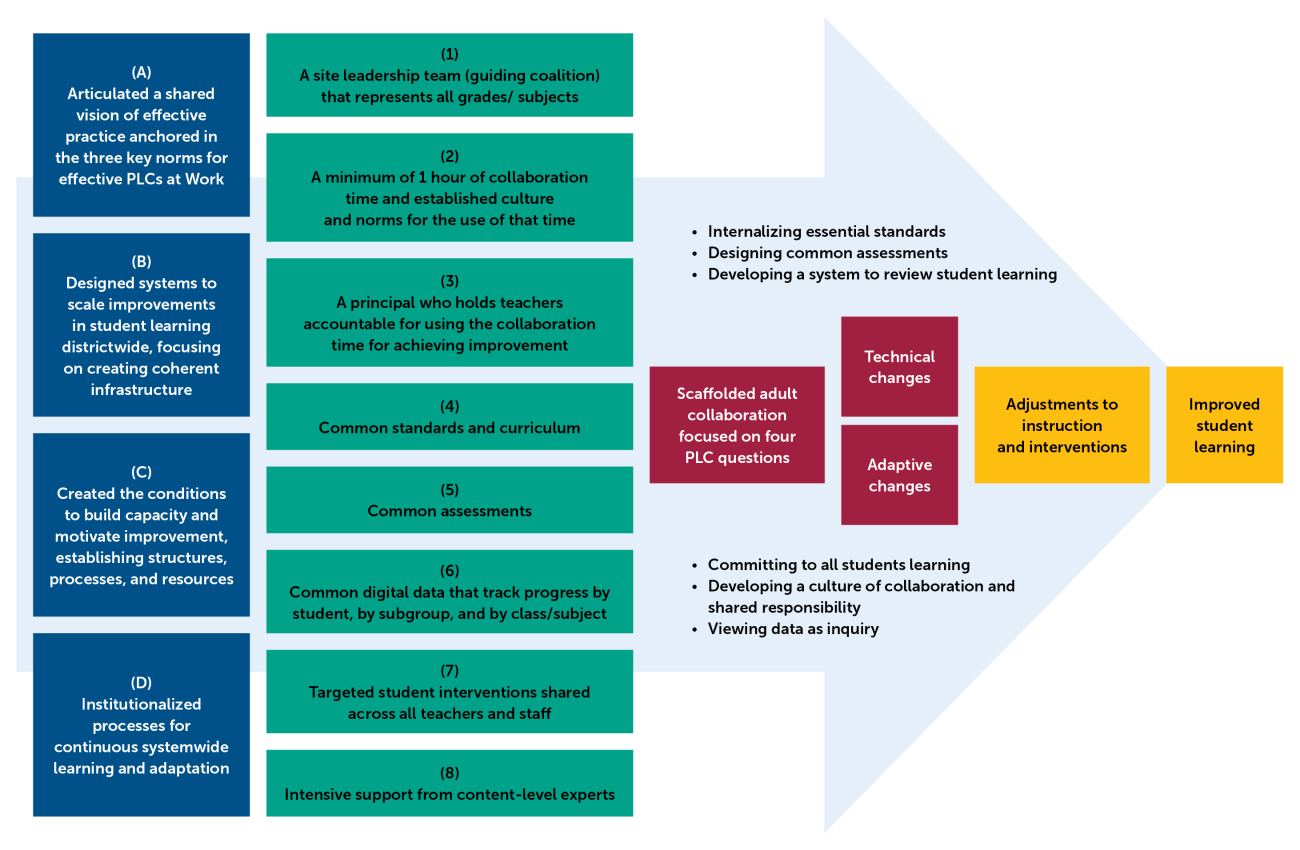
District-level drivers (blue) build coherence and enable scaling by (a) articulating a shared vision and collaboration norms, (b) designing systems to scale instructional core improvements, (c) creating conditions for capacity and motivation, and (d) institutionalizing continuous system learning. These actions enable consistent, sustained IAM adoption.6
School-level enabling conditions (green) are core elements for translating intentions into routine collaborative practice (implementation capacity). These conditions determine the feasibility of collaborative inquiry and coordinated instructional response.7
IAM mechanisms (red) operate through scaffolded adult collaboration based on the four PLC questions. The framework differentiates two types of change:
- Technical changes are improvements in instructional tools and routines (internalizing essential standards, designing common assessments, and developing a system to review student learning).
- Adaptive changes are shifts in beliefs, roles, and norms for sustained improvement (committing to all students learning, developing a culture of collaboration and shared responsibility, and viewing data as inquiry).
The adaptive leadership framework8 informs the distinction between these last two, noting that technical challenges have known solutions while adaptive challenges require learning and shifts in values or roles. Meaningful improvement hinges on both, but often more on adaptive change, because technical improvements (such as pacing guides or data trackers) may result in “surface compliance” without underlying shifts in belief and norms.
Technical and adaptive changes lead to the proximate outcome of adjustments to instruction and interventions (core instruction, differentiation, and intervention design), which are hypothesized to improve student learning. The framework supports tracing how conditions shape collaboration and how collaboration translates into instructional adjustments that influence outcomes. The qualitative approach primarily emphasizes the red components (collaborative routines, technical/adaptive change, instructional adjustments) because Year 3 data collection focused on how the IAM is experienced day-to-day, building on the green (Year 1 prerequisites) and blue (Year 2 system infrastructure) foundational elements. This focus captures the core processes mediating between enabling conditions and changes in classroom practice.
Impacts of the Intensive Assistance Model
The IAM was centered around achieving three goals:
- Goal 1: Improve student outcomes.
- Goal 2: Achieve Model PLC at Work recognition.
- Goal 3: Scale and sustain the work from pilot sites across each district.
In this section, we examine the impact of the IAM across these three goals, starting at the school level to examine Goals 1 and 2 before moving to the district level to examine Goal 3.
In our examination, we saw evidence of the model affecting school-level student achievement as well as teacher and administrator practice with some consistency. At the district level, we observed larger variation in the initial scaling of the model across the full district. Therefore, we conclude with an analysis of the challenges to scale that were experienced in taking the school-based reform to districtwide implementation.
School-Level Impacts
Goal 1: Improve student outcomes. Using publicly available, school-level data, a majority of IAM schools demonstrated large, consistent improvement in state standardized assessment performance in English language arts (ELA) and math. During the 3 years of the IAM, we observed improvements in student achievement that outpaced a control group of schools—those schools in participating districts that were not part of the IAM. However, there is variation in ELA and math improvements across pilot sites. Figures 2 and 3 show performance from preimplementation in 2021–22 through 2024–25, comparing IAM averages against control groups. Notable shifts—relative to the median IAM change and that of the control group between 2023–24 and 2024–25—are shaded in green or red.
Figure 2. ELA Proficiency Rate Trajectories by IAM Participation Status From 2021–22 to 2024–25
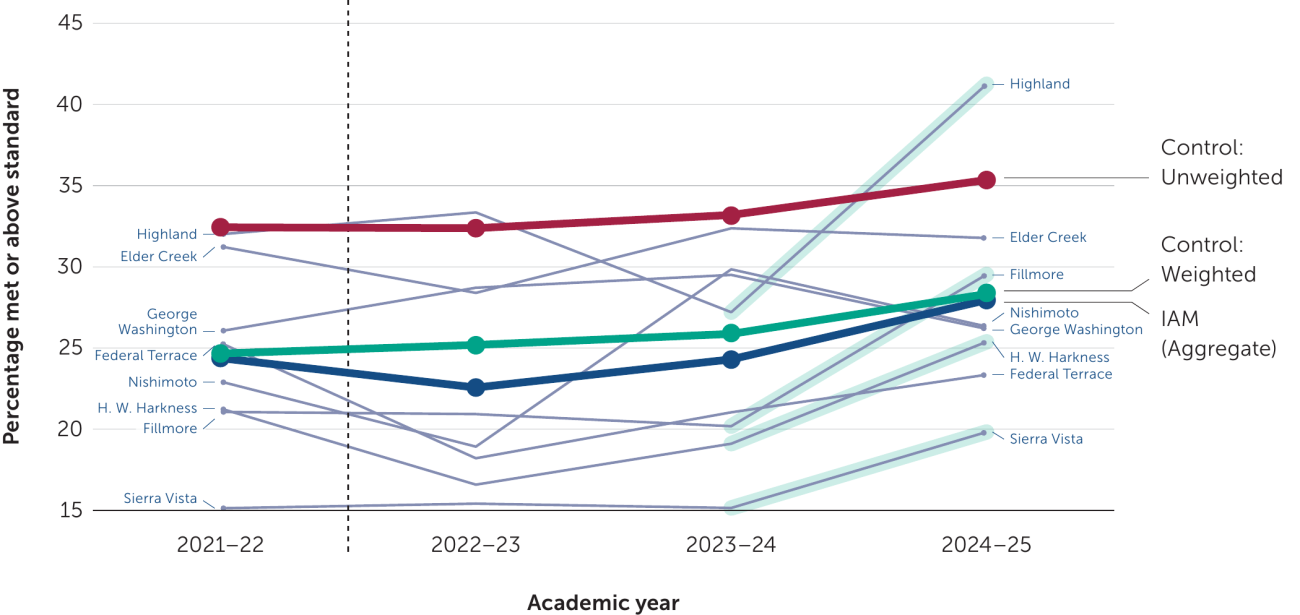
Note. Vertical dashed line: intervention onset (2023). Weighted series uses entropy balancing weights. Faded lines: individual IAM schools. Shaded bands: schools with above-median change in 2024–2025 (green = improvement).
Figure 3. Math Proficiency Rate Trajectories by IAM Participation Status From 2021–22 to 2024–25
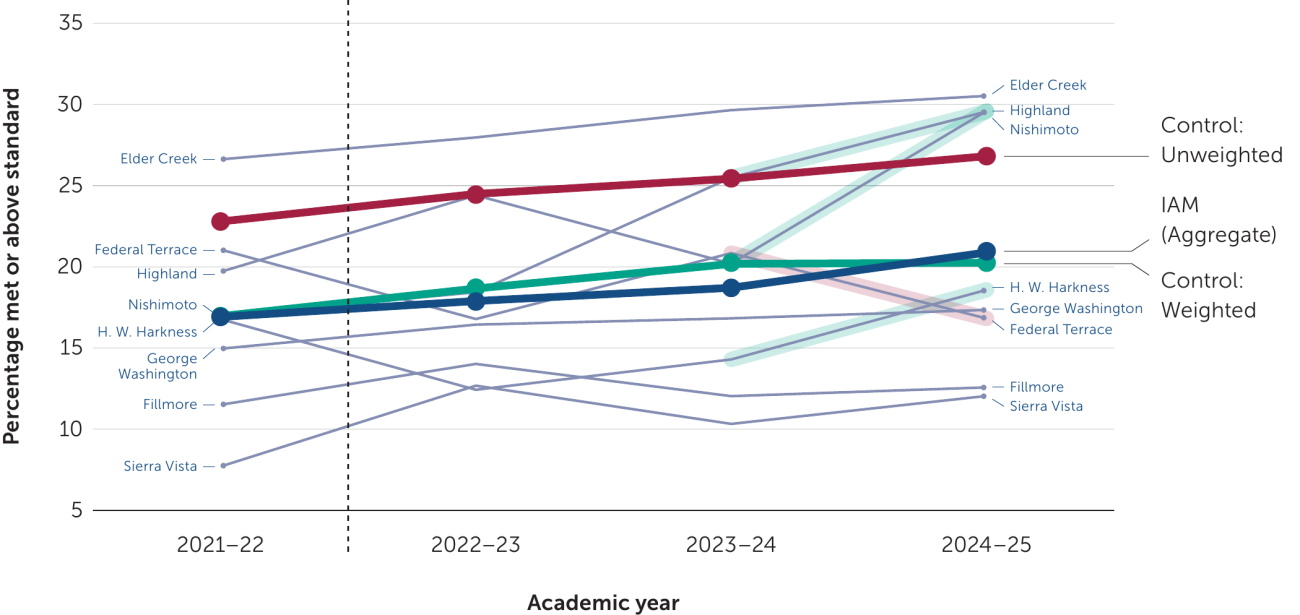
Note. Vertical dashed line: intervention onset (2023). Weighted series uses entropy balancing weights. Faded lines: individual IAM schools. Shaded bands: schools with above-median change in 2024-2025 (green = improvement, red = decline).
ELA proficiency rates increased from pre-IAM levels at Harkness, Highland, Fillmore, Nishimoto, and Sierra Vista, remained the same at Elder Creek and George Washington, and decreased at Federal Terrace. The largest gains appeared in Years 2 and 3; during this time, Highland, Fillmore, Harkness, and Sierra Vista all outpaced growth in ELA proficiency rates of the control schools in the IAM districts and the results of the aggregated IAM sites. We saw similar variation in math achievement.
Math proficiency rates surpassed pre-IAM levels in Harkness, Highland, Nishimoto, Elder Creek, and Sierra Vista, remained the same at Harkness, George Washington, and Fillmore, and decreased in Federal Terrace. During the final year of implementation, Highland, Nishimoto, and Harkness demonstrated growth levels that surpassed growth in math proficiency rates of the control schools in the IAM districts and the results of the aggregated IAM sites.
We estimated the IAM’s association with math and ELA achievement across participating schools and compared patterns across the 3-year pilot but did not find statistically significant evidence of the IAM’s impact on school outcomes. This finding is unsurprising given the small number of IAM schools and the loss of 2 baseline testing years during the COVID-19 pandemic; statistical power is limited, and we expected effects to be small and noisy. Our quantitative analysis isolates the IAM’s incremental, comparative association via difference-in-differences estimates relative to district comparison schools during an uneven postpandemic recovery. For this reason, it is not contradictory for a school to demonstrate meaningful absolute improvement—described previously—and earn external recognition—as described in the next section—while the average comparative impact estimates remain small and statistically indistinguishable from zero.
Even so, we looked transparently for consistent directional patterns—particularly whether outcomes appeared more favorable by Year 3, which would align with the implementation maturation timeline suggested by the qualitative findings. We found no impact on chronic absence, and attendance at IAM schools improved at a rate commensurate with non-IAM district schools, which were all similarly recovering from COVID-era rates.9
Goal 2: Achieve Model PLC at Work recognition. Four of the seven IAM schools received external recognition from Solution Tree and AllThingsPLC for implementing the framework and documenting learning gains after the 2024–25 school year. Nishimoto Elementary was designated a Model PLC School while George Washington, Sierra Vista, and Harkness were recognized as Promising Practices Schools. It is also worth noting that three elementary schools in a participating district, Fillmore Unified, were identified as Promising Practices Schools in 2025. The district expanded the work to these sites early in Year 1 (2022–23) of implementation, with a level of support like that received by participants in the IAM. However, only the middle school in Fillmore was part of the initial pilot, and we collected data only from the pilot site.
These applications evaluate narratives of PLC structures and consecutive years of absolute, within-school growth across multiple assessments. In the prior section, we examined the changes in student ELA and math proficiency over the IAM, so we focus our examination in this section on our data related to implementation of the improvement model.
All schools in the IAM were able to implement a system for defining clear expectations for what they wanted students to learn; they were also able to develop common assessments aligned to those expectations as well as a process for examining student learning data together. As one leader put it, the “real difference” was not effort or intent, but having a system:
In the absence of a system for what you should be doing during collaborative time, you are griping because you need an outlet. … It’s not that teachers can’t do it or don’t want to do it. They need a system. That’s the real difference. There’s a system. There are the four questions, and if you do these things, you’re going to see growth and student results.
Essential standards, common assessments, data review, and intervention planning became more than implementation tasks; rather, they became tools for acting on a shared commitment across all seven schools to ensure that every student learns. Schools often claim to have these elements in their system; however, the integration of these tools into the schools’ culture for collaboration and improvement was unique among the improvement efforts that IAM participants had experienced. In this way, the IAM helped reframe instructional improvement as a collective, values-driven responsibility rather than an individual teacher’s burden.
Six of the seven pilot schools were able to secure contractual time and classroom coverage that allowed teachers to meet collaboratively throughout the school year, with Federal Terrace being the only exception by the end of Year 3. In some cases, this required modifications to the collective bargaining agreement; in other schools, it meant hiring “specials” teachers—art, music, physical education—so that grade levels could collaborate; and in others, it meant securing substitutes well in advance of collaborative planning days. Navigating the resource constraints of time and staffing was critical for the model to work. In the one instance where these resources were not secured or protected, the school struggled to support the model.
Across participating schools, teachers moved from working in isolation to relying on one another as a normal part of solving instructional problems. As one participant described, the work shifted from a culture where “everybody was in their silo” to one defined by shared responsibility, vulnerability, and collective problem-solving. Across many schools, educators began shifting from individually driven approaches to a stronger sense of grade-level and schoolwide responsibility for student success. As one educator described it, this meant moving away from a “hero teacher” model to one where “no one is doing this alone.” A third-grade teacher explained: “A student is not just one teacher’s student; this is our third-grade student.” These shifts allowed teams to respond more flexibly when students needed support, including regrouping students, sharing instructional strategies, and stepping in when staffing gaps or instructional challenges emerged. As one educator explained, failure to meet the needs of students was no longer an option: “We can’t let these kids slide. We’ve got to fix it.”
The model also helped realign adult roles around the instructional core. Principals worked to protect collaboration time and be present in PLCs and classrooms while teacher leaders increasingly took ownership of team routines, norms, and problem-solving. District leaders also observed clearer alignment across classrooms within schools and more consistent instructional practice. One district administrator noted after observing a participating school: “This is the first building I’ve been in where everybody had learning targets posted in their classroom, where everybody’s teaching was matching the learning targets. And the kids were largely engaged.”
Over time, teams moved from treating data as something to report, defend, or comply with to using it as the central object of inquiry in PLC conversations. In stronger sites, teachers brought assessment results or student work to the table, identified patterns across classrooms, and used the data to decide what students needed next. This required making data safe enough to discuss honestly. As one school leader explained, “You can’t move anything if you don’t change the mindset about not using data as punishment. Don’t use data to condemn, use it as information to make your next move.” When data were framed as information for action, teams were better able to surface hard truths, ask sharper questions, and move from results to instructional response.
By Year 3, some grade-level teams were using data in meetings to make concrete decisions about intervention and regrouping. Rather than leaving each teacher to respond independently, teams examined which students had mastered specific learning targets, which students needed reteaching, and which teachers had been most successful with particular concepts. As one teacher reflected, “That process—making time for intervention and aligning it across a team—has been a complete game changer The mindset shift is the same: These are our kids, not just ‘my kids.’”
Changes in teacher practice also shaped how students understood data. As assessment, intervention, and goal setting became more transparent, students learned that “taking a test isn’t about failing or passing—it’s about helping us, as teachers, figure out how to support them.” Over time, students began to take more ownership of their progress. One site leader observed:
The kids are more interested in tracking their progress now, which they never, ever, ever even considered before. … You’ve got first graders wanting to know, did I improve? Am I caught up? Things like that. It’s a big deal.
The pilot also showed that productive data meetings depended on usable systems. Teams first had to solve the practical challenge of “getting data that could be used for PLC conversations” and organizing the data in ways that teachers could act on quickly. In some cases, the data surfaced uncomfortable contradictions. One principal found that although 70 percent of students had a 3.5 grade point average or higher, 70 percent were also “three or more grade levels below in math and ELA.” These moments required leaders to balance support with “positive pressure” and to model the vulnerability needed for honest inquiry.
In summary, the IAM pilot demonstrates that moving from a culture of compliance to one of collaborative inquiry transforms data from an evaluative judgment into a shared tool for coordinated action. When education systems successfully protect adult vulnerability and normalize data as a prompt for learning, they unlock flexible instructional strategies and foster deep student ownership over academic growth.
District-Level Impacts
The PLC at Work model is most commonly observed as a school-level reform model, although there have been notable district-level successes in California: Sanger Unified and Chino Valley Unified. The most challenging aspect of the IAM is helping districts translate the improvements at the schools to the district more broadly. In this section, we highlight the progress districts made as well as the challenges to scale we observed.
Goal 3: Scale and sustain the work from pilot sites across each district. Three of the participating districts—Fillmore Unified, Inglewood Unified, and Madera Unified—had developed district-level structures and processes to scale the work by the end of Year 3. As we previously described, Fillmore rapidly expanded the work to all its sites within the district during Year 1 of the IAM pilot, resulting in three of their elementary schools receiving Model PLC at Work recognition. Inglewood had established a district-level coalition to guide the work in its rollout to other sites. Finally, Madera had established plans for a “lab school” model where principals and teachers from other sites in the district could visit and learn from the staff at their three pilot sites. It is worth noting that Fillmore and Madera are the two districts that voluntarily joined the pilot; of the DTA districts, only Inglewood was able to establish district-level support structures for the model during the 3 years.
Four of the five districts were able to secure ongoing resources to support embedded collaborative time for teachers. One of the most immediate structural barriers to implementation of the IAM was the significant financial and logistical strain of securing substitute coverage for teacher training and collaborative planning. The intensive nature of the model—requiring upwards of 50 days of on-site coaching annually—necessitated frequent teacher pullouts that districts initially struggled to manage amid widespread staffing shortages. In contexts where school days lacked embedded collaborative structures, administrators were forced to divert limited local resources to ensure that teachers had time together to collaborate, creating a precarious implementation environment where the model’s success was often dictated by a district’s ability to absorb these unallocated costs. Most districts in the pilot were able to navigate this barrier successfully for one to three sites, in the cases of Madera and Fillmore, but this raises questions about the viability of such a model with all schools in a larger district.
The model did not negatively affect labor relations and was supported by labor in participating districts. An initial concern prior to launching the IAM was the potential for labor tensions, specifically regarding whether collectively bargained planning time could be repurposed for the highly structured collaboration required by the model. These concerns were particularly acute in districts already navigating intense labor negotiations or the destabilizing process of entering DTA. While some districts experienced resistance from a small number of educators who were reluctant to shift from individual planning to collective accountability, this tension generally proved less disruptive than anticipated. Evidence from the IAM suggests that in the majority of pilot schools, teachers were encouraged by the collaborative framework and eventually became advocates for the instructional shifts. Critically, districts that proactively included union representation on school-site “guiding coalitions” and in initial training experienced significantly smoother implementation. By integrating labor representation into the leadership of the model from the outset, districts were able to establish a shared understanding of common expectations and prevent any tensions experienced by staff from blocking systemic progress.
Challenges to Scale
The IAM demonstrated positive changes at the district level as described in the previous section, but challenges in taking the model to scale were also uncovered. In this section, we highlight the most pervasive challenges to scale and sustainability at the district level.
The pilot revealed important tensions between school-level autonomy required by the PLC at Work model and district-level coherence needed to support scale and sustainability. Although the IAM was a major improvement effort for participating schools, it was still one initiative among many competing for district and school attention. Principals in several districts had to shield staff from initiative overload and “manage up” to district offices when competing mandates, unclear expectations, or limited resources threatened implementation. In one case, a principal described the lack of support as so severe that “there was a point I wanted to quit” and recalled being “slapped on the wrist” after asking the district office for substitute support. These same tensions also complicated districtwide scale. While autonomy helped build buy-in at pilot schools, districts often lacked a clear structure for spreading practices beyond the initial sites. When schools selected different essential standards and developed different common assessments, district leaders had limited ability to analyze data across schools or provide coherent instructional support. As one district leader noted, the “amount of things I need to analyze is significant” because each school had selected different standards and assessments. Without being “on the same page,” identifying what was driving student growth became far more complex.
A barrier to sustainability was a significant gap in district-level expertise, since many central office staff lacked the specific capacity required to lead or support a comprehensive Model PLC at Work transformation. While some district personnel had prior experience with informal PLCs, few had successfully navigated a school through the systemic cultural and structural shifts required for this specific intensive assistance model. This challenge was exacerbated by a lack of coordination and planning for scale; district staff were frequently excluded from school-level training unless explicitly directed by senior leadership or invited by a principal, leaving them as observers rather than active facilitators or collaborators in the work. Without a clear mechanism for developing this expertise through the IAM coaching allocation, district staff expressed significant concerns regarding their ability to provide the “supportive accountability” and technical guidance necessary to sustain the model once the external assistance ended.
Finally, the IAM raises questions about the validity of the approach with DTA districts. Of the schools that achieved Model PLC at Work recognition, only two came from DTA districts, and only one of those remains open after Highland Elementary was closed in Inglewood. A total of six schools from the two voluntary districts, including the Fillmore schools not participating in the IAM, received recognition. Additionally, the only school in the IAM to see a reduction in student achievement came from a DTA district. The limited evidence of short-term impact of student outcomes in DTA districts is unsurprising and suggests that more time and coordination between the district office and individual school sites is needed to translate the necessary changes districtwide and subsequently shift student outcomes at scale. Significant improvement in student achievement, which is difficult to achieve even under ideal conditions, is exponentially more challenging in districts that are eligible for the highest tier of state-level intervention. This suggests that the model may be better adapted for districts that have foundational elements for improvement in place rather than those that are in greatest need.
The IAM pilot suggests that collective responsibility can strengthen instructional practice and student outcomes at the school level, but scaling these shifts requires greater district coherence and a stronger foundation than some DTA districts may have. Sustainable improvement depends on aligning school-level ownership with district structures that protect focus, coordinate supports, and make collaboration around student learning a systemwide expectation from the initiation of the improvement effort.
Policy Recommendations
The IAM pilot underscores a core lesson for California’s improvement agenda: Improving teaching and learning at scale requires developing technical expertise alongside the adaptive capacity to change adult practice. Both can be strengthened through sustained coaching, leadership support, and facilitated collaboration. State and district leaders can strengthen these conditions by establishing an infrastructure that develops adult capacity, secures protected time, and streamlines accountability. The following recommendations provide actionable steps to transition the educational ecosystem from compliance monitoring to systemic support by investing in districts as the essential unit of change.
- Establishing a robust local infrastructure of instructional coaching and leadership support can pair school-level autonomy with the technical and adaptive capacity needed to improve teaching and learning. Schools are unlikely to sustain complex shifts without ongoing coaching and professional development. California can strengthen its improvement infrastructure by making sustained investments in high-capacity instructional leaders to build districts’ internal capacity for instructional improvement. This infrastructure must draw on models that emphasize embedded coaching structures that develop teachers and school leaders over time through multiple touchpoints, rather than singular trainings or webinars.
- Narrowing Dashboard indicators that qualify districts for DTA to core academic outcomes could help struggling systems focus more deeply on the instructional core. Streamlining metrics to focus primarily on ELA and math performance can help mitigate initiative overload, empowering struggling systems to focus deeply on instructional quality. Nonacademic measures could still have an important role as lower stakes diagnostic and process indicators, helping districts identify barriers to learning, monitor school conditions, and align supports without contributing to initiative overload. For example, introducing process indicators modeled after collaborative frameworks would help assess whether adult practices are meaningfully changing rather than relying strictly on compliance monitoring.
- Districts can strengthen opportunities for teacher collaboration during the school day by rethinking school schedules. For example, elementary schools can embed “specials”—such as physical education, music, and the arts—within the instructional day to secure teacher collaboration and intervention time. Integrating these specialized subjects into the core school day resolves the lack of dedicated time for collaboration that served as the most immediate barrier to success in the IAM. This restructuring creates a dual-benefit system that grants students holistic academic experiences while providing teachers with the minimum 1 hour of weekly release time required to analyze assessments and deploy data-driven interventions. This also removes the cost of substitutes for in-school collaboration time when it is not built into the daily schedule.
Conclusion
The IAM pilot, as a structured intervention to improve teaching and learning in high-need California districts, centered its efforts on building coherent, instructional-focused systems through the PLC at Work framework. Examination of the IAM’s impact reveals that the core mechanism of the pilot is a process of scaffolded adult collaboration, driving change across two critical dimensions: technical shifts (e.g., internalizing essential standards, designing common assessments, and developing a system to review student learning) and adaptive shifts (e.g., committing to all students learning, developing a culture of collaboration and shared responsibility, viewing data as inquiry). A central finding of this analysis is that for the technical improvements to achieve fidelity of implementation and, ultimately, of impact, schools must successfully engage in the underlying adaptive work, thereby moving beyond superficial implementation to fundamentally transform instructional decision-making and professional culture.
The findings from this evaluation provide promising proximal signals that the IAM is taking root in ways that plausibly influence student outcomes. Evidence from the pilot suggests that the model can strengthen teacher practice in ways that contribute to longer term improvements in student learning. However, the 3-year evaluation window likely limited the ability to detect statistically significant long-term effects on standardized test outcomes.
For policy leaders, this evidence underscores that effective large-scale education reform requires deliberate investment in the technical skills and knowledge development for improvement as well as the relational work that constitutes adaptive change, developing and protecting the space for collaborative inquiry and shared leadership. The pilot suggests that schools can establish the necessary technical and adaptive changes in 3 years; however, the time needed for these changes to become embedded in practice and produce statistically significant effects on high-stakes standardized assessments may extend beyond a 3-year evaluation window, particularly in high-need schools.
The IAM pilot demonstrates that intensive, coaching-supported PLC implementation can fundamentally change how educators collaborate, use data, and take responsibility for student learning. However, translating those cultural and instructional shifts into statistically significant student achievement gains likely requires more time, stronger district coherence, and a state system focused on capacity-building rather than compliance.
This policy brief is based on the full PACE evaluation report, "Intensive Assistance Model: Implementation and Early Outcomes."
Cottingham, B. W. (2026, October). Learnings from CCEE’s Intensive Assistance Model after 3 years [Policy brief]. Policy Analysis for California Education. https://edpolicyinca.org/publications/learnings-ccees-intensive-assistance-model-after-3-years
- 1
Chetty, R., Friedman, J. N., & Rockoff, J. E. (2014). Measuring the impacts of teachers II: Teacher value-added and student outcomes in adulthood. American Economic Review, 104(9), 2633–2679. doi.org/10.1257/aer.104.9.2633; Podolsky, A., Darling-Hammond, L., Doss, C., & Reardon, S. (2019, May 16). California’s positive outliers: Districts beating the odds [Report]. Learning Policy Institute. learningpolicyinstitute.org/product/positive-outliers-districts-beating-odds-report; Rivkin, S. G., Hanushek, E. A., & Kain, J. F. (2005). Teachers, schools, and academic achievement. Econometrica, 73(2), 417–458. onlinelibrary.wiley.com/doi/abs/10.1111/j.1468-0262.2005.00584.x; Rockoff, J. E. (2004). The impact of individual teachers on student achievement: Evidence from panel data. American Economic Review, 94(2), 247–252. doi.org/10.1257/0002828041302244
- 2
Burns, D., et al. (2019, September 10). Closing the opportunity gap: How positive outlier districts in California are pursuing equitable access to deeper learning [Report]. Learning Policy Institute. learningpolicyinstitute.org/product/positive-outliers-closing-opportunity-gap-report
- 3
California Department of Education. (n.d.). Alignment and coherence: Sanger Unified. cde.ca.gov/pd/ps/plstoriesacsusd.asp
- 4
DuFour, R., et al. (2024). Learning by doing: A handbook for Professional Learning Communities at Work (4th ed.). Solution Tree.
- 5
Model PLC at Work is Solution Tree’s DuFour and Eaker Recognition tier for schools and districts that demonstrate sustained implementation of the PLC at Work process and provide at least 3 years of student-achievement data showing growth (reviewed through Solution Tree’s Evidence of Effectiveness process). See What is DuFour and Eaker Recognition? at AllThingsPLC (allthingsplc.info/what-is-dufour-and-eaker-recognition).
- 6
Cottingham, B. W., & Myung, J. (2025, August). Improving the instructional core at scale: A case study of Chino Valley Unified School District [Report]. Policy Analysis for California Education. edpolicyinca.org/publications/improving-instructional-core-scale
- 7
Cottingham, B. W., Hough, H. J., & Myung, J. (2023, December). What does it take to accelerate the learning of every child? Early insights from a CCEE school-improvement pilot [Report]. Policy Analysis for California Education. edpolicyinca.org/publications/what-does-it-take-accelerate-learning-every-child
- 8
Heifetz, R. A., & Laurie, D. L. (1997). The work of leadership. Harvard Business Review, 75(1), 124–134. pubmed.ncbi.nlm.nih.gov/10174450/
- 9
See the full analyses and quantitative findings in the full report.