When AI Use Outpaces District Strategy



Summary
This brief from Policy Analysis for California Education (PACE) explores how California districts are responding to generative artificial intelligence (AI) use in schools. Interviews with California district leaders show uneven readiness, with nearly half of districts having little or no organized response to AI use. Only about one quarter of interviewees reported broader organizational efforts aimed at adopting guidelines, providing professional learning, and approving AI tools. To respond to the risks and opportunities posed by the rapid development of AI, the authors recommend sustained professional learning that builds educators’ routine and adaptive expertise. Communities of practice can help educators explore AI’s uses, risks, and classroom impact while informing district policy and planning.
Background
Unlike many previous educational technologies, artificial intelligence (AI) is not waiting for districts to decide whether to adopt it. Teachers and students are already using AI regardless of whether districts have adopted formal strategies or guidance, and new generative AI models, capabilities, and applications continue to emerge at a rapid pace.1 A nationally representative survey found that 60 percent of U.S. public school teachers used AI for their work during the 2024–25 school year, including 32 percent who reported using AI at least weekly.2
AI can be used in education for administrative tasks, teacher work, and as part of student learning. In all three domains, it presents substantial opportunities and risks for schools. The greatest risks with administrators and teachers using AI are around privacy, bias, and equity.3 On the opportunity side, AI could reduce routine administrative work, strengthen schools’ organizational capacity by streamlining complex administrative processes, and reduce barriers that have long limited educators’ ability to implement effective instructional practices consistently.4
Even sophisticated AI tools have not, by themselves, transformed teaching and learning. Their impact depends on how educators integrate them into instruction, how students use them, and the broader systems that support implementation.5 Researchers have documented potentially productive student uses of AI, including seeking explanations and generating practice materials.6 On the risk side, initial concerns about cheating have become more nuanced around the idea of “cognitive off-loading,” when students overly rely on AI to do the “thinking” parts of an assignment. This can happen if teachers design tasks that allow or enable students to lean on AI too heavily when completing them in addition to instances when students “cheat” by using AI to do work their teachers intended them to do without assistance. Emerging evidence suggests that when AI substitutes for—rather than supports—students’ thinking, it can reduce engagement with challenging learning tasks and weaken later performance when AI is unavailable.7 Whether AI ultimately improves teaching and learning, creates unintended harms, or simply becomes another missed opportunity will depend less on the technology itself than on the decisions that educators and education leaders make about how to use it.
What Are Educational Leaders in California Doing to Address AI in Education?
Given the role of districts in shaping local policy and practice, we included questions about districts’ work on AI in interviews with superintendents (or their designees) from a stratified random sample of 94 California school districts. Eighty-three interviews contained enough information to characterize the district’s response. Four patterns emerged: (a) low awareness and no organizational response, (b) moderate awareness and little organizational response, (c) emerging organizational response, and (d) broader organizational response. These categories describe whether district leaders had moved beyond knowing that individual educators were experimenting with AI to creating an organized response from the district (Table 1).
Table 1. Interview Quotations Exemplifying Different Levels of District Responses to AI
| Level of response | Example quotation |
|---|---|
| Low awareness, no organizational response | “Our board is curious about it. They want to learn more. … One of the concerns expressed was … students using it for cheating or writing papers. And so that’s one on the ‘to do’ list, to create an AI agreement. … Myself, I think [AI could] be very helpful to write a quick message, but I haven’t invested the time to learn.” |
| Moderate awareness, little organizational response | “I think a lot of people are using ChatGPT. I mean, I know I use that immensely. I went to ACSA [Association of California School Administrators]. It had a wonderful symposium on AI recently, and I attended that. It came up with some really great resources for educators and teachers [like] filter[ing] through your emails and helping teachers with lesson plans. So, my encouragement level is for teachers to use it in those ways.” |
| Emerging organizational response |
“I would definitely say we’re at the awareness level. Our curriculum [leader] … has done some ‘Hey, do you want to know a little bit more about AI and ChatGPT and those kinds of things?’ She’s [offered] some professional development in that area, but it’s been voluntary at this point.” |
| Broader organizational response |
“We’re adopting our AI guidelines at our June 26 board meeting. … I do think our leadership team uses it more, and we’re working with our teachers to essentially approve different AI tools that will be a focus of our professional development next year. … One of [the IT] directors has worked really hard to lead different groups. … We have a certificated AI group classified and then a large, overall working group to identify appropriate tools. So, I wouldn’t say it’s high utilization in the classroom … but it is an area that’s emerging. I think once we share out our AI guidelines and then share with our teachers the tools that are already approved and how to use them, it’ll be a growing area.” |
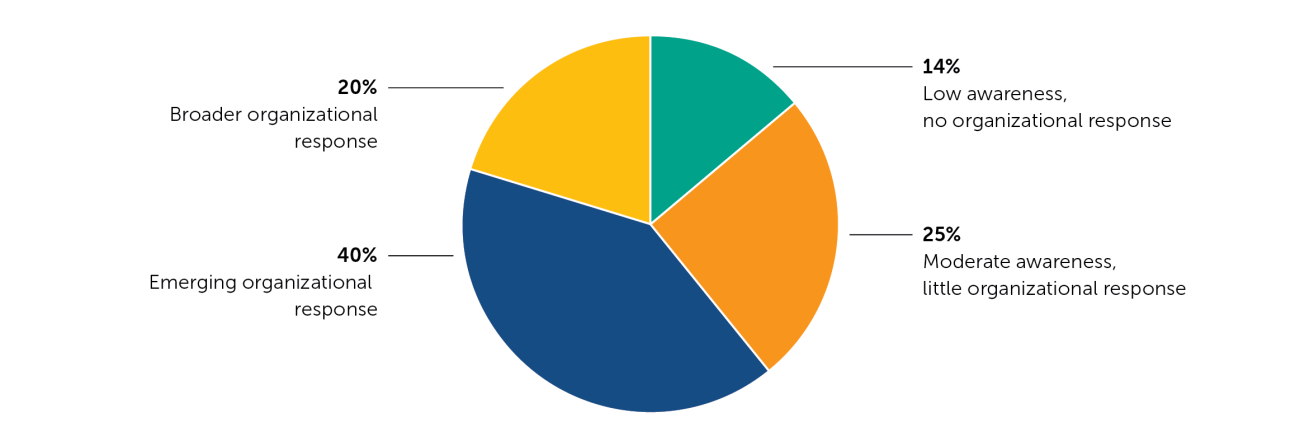
The interview data showed that in many California districts, teachers and administrators are using tools such as ChatGPT, Gemini, Claude, and Copilot to draft communications, plan lessons, generate materials, manage workflow, and explore new approaches to their work. Individual use, however, has moved ahead of district leadership in many districts (Figure 1).
Figure 1. Leader Awareness and Organizational Response to AI Use in Districts
Note. Percentages may not total 100 percent due to rounding. Source. Responses are from a Getting Down to Facts III study of district capacity for mathematics improvement in transitional kindergarten (TK) through eighth grade. (For a full description of the study’s sample and methods, see The California State Role in Supporting District Capacity for TK–K Mathematics Improvement by H. A. Gallagher, L. Townie, D. M. Gomez, & S. Loeb, 2026, SCALE Initiative: Stanford University (gettingdowntofacts.com/sites/default/files/The%20California%20State%20Role%20in%20Supporting%20District%20Capacity%20for%20TK%E2%80%938%20Math%20Improvement.pdf).
In 39 percent of districts, there was essentially no organizational response to AI. In these districts, leaders either had little visibility into how AI was being used (14 percent) or could name isolated examples of use but described no coordinated district action (25 percent). These districts were not necessarily opposed to AI, but teachers and administrators were learning about AI on their own, and districts had missed the chance to shape how the tools were used, what risks received attention, and how early learning spread across the organization.
A second large group of districts (40 percent) had begun to respond, but their responses were still nascent. Leaders in these districts described being at an “awareness” stage, taking concrete steps (e.g., offering initial professional development, exploring approved tools, or forming committees to discuss responsible use). These districts had begun moving from individual experimentation towards organizational action, but most had not yet built the structures needed to guide AI use consistently across the district.
Only 20 percent of districts described a broader organizational response. These districts reported multiple forms of activity, such as governance work, professional learning, approved tools, implementation planning, and monitoring. Even here, however, breadth did not always mean strategy. Some districts were doing several things at once without clearly articulating how those efforts fit together, while others described responses that appeared more clearly strategic. In those cases, leaders named intentional efforts to build educators’ capacity, to help staff use AI in ways that saved time and supported their core work, and to approach AI as an ongoing organizational learning challenge rather than simply a technology rollout.
These data show that the central issue around AI use in California districts is not whether AI has arrived. It has, and use is spreading through individual educators faster than it is being taken up by school systems. That creates risks for privacy, academic integrity, equity, and instructional quality. It also means districts may miss opportunities to use AI in ways that support teachers’ work, improve operations, and help students learn how to use these tools well.
Districts need to (a) create policy and guidance and (b) foster organizational learning in order to use AI for improvement and transformation.8 This remainder of this brief takes on the second main task that districts need to undertake: fostering organizational learning. The evidence from Getting Down to Facts III shows how many demands and constraints districts are juggling,9 which is likely a key reason so many district leaders have not yet more deeply engaged with AI. External organizations, such as County Offices of Education (COEs) and nonprofits, could play a key role in helping districts take important steps towards organizational learning without requiring senior leaders to devote extensive bandwidth or resources to AI.
How Might Districts Respond to AI More Strategically?
The greater purpose of TK–12 education is to support productive childhood development through meaningful learning experiences, which research tells us are deeply human as well as both social and emotional in nature.10 This goal does not change with the emergence of AI. Efforts to deepen educators’ AI literacy must stay grounded in this goal—rather than aiming to shift educators into becoming technology experts, for example—and must support educators to understand better the role that AI plays in teaching and learning.
The speed of AI advancements—coupled with the current lack of clear policy, research, and validated AI curricula—calls for approaches that not only build routine expertise but also develop adaptive expertise. In a novice-to-expert mental model, routine expertise is the ability to apply skills or tools frequently, efficiently, and with fidelity. Adaptive expertise, on the other hand, describes a practitioner’s ability to retrieve and apply knowledge flexibly in the face of complexity (Table 2).11
Table 2. Characteristics of Routine and Adaptive Expertise
| Routine expertise | Adaptive expertise |
|---|---|
| Can apply a set of skills with increasing fluency and efficiency | Can retrieve, organize, and apply professional knowledge flexibly |
| One’s beliefs taken for granted and not open to discussion or scrutiny | Aware of one’s own beliefs underpinning practice and when they get in the way |
| Based on notions of “novice to expert”—practice makes perfect | Recognize when old problems persist or new problems arrive and seek expert knowledge |
Source. Adapted from Leading Powerful Professional Learning: Responding to Complexity with Adaptive Expertise by D. M. Le Fevre, H. S. Timperley, K. Twyford, & F. R. Ell, 2019, Table 7.1. Copyright 2019 by Corwin.
Processes that cultivate adaptive expertise involve more than tools and 1-day trainings. They require ongoing professional learning; incorporating inquiry into one’s pedagogical underpinnings, knowledge of and relationship with students, and the examination of local data; and participating in collaborative conversations that enable educators to make informed decisions about when it is or is not advantageous to use AI. Digital Promise’s AI literacy framework provides guidance on such professional learning through the framework’s three modes of engagement: understand, use, evaluate.12 This framework braids together basic understandings of AI, creative problem-solving within a local context, and the ability to critically evaluate impact through human judgment.
The results of the interview data highlight the greater need for systematized processes in education that build collective—in addition to individual—routine and adaptive expertise. One example for how districts can do this comes from communities of practice (CoPs) organized by Lead by Learning.
An Example of Building Educators’ Expertise in AI
Lead by Learning, a professional learning center at Northeastern University in Oakland, California, has spent more than 2 decades designing, studying, and implementing professional learning processes, most often in the form of CoPs that facilitate classroom-based inquiry. In 2025–26, with the support of the Kapor Foundation, Lead by Learning partnered with Northeastern University’s Khoury College of Computer Science to pilot a CoP focused on this inquiry question: “What does it mean to teach and learn in the age of AI?”
This CoP held the following core beliefs:
- AI integration in K–12 schools is not merely a technical challenge to be addressed primarily through IT departments but rather a deeply human endeavor that must consider educators and students as individual users and collaborative learners. As one participant shared, “Teachers are not just end users, but people who have to live with the tradeoffs that come with AI.”
- AI is a powerful tool, but its efficacy is linked to user ability and discernment. If we want to support students with using AI responsibly and acquiring the 21st-century skills needed to succeed, we must provide ongoing, collaborative professional learning that empowers educators to be confident, skilled, discerning users of AI, so they can model and support that for their students.
- AI usage should enhance educators’ expertise in teaching and learning as well as leverage educators’ deep relationships with students and the greater school community.
Secondary educators, primarily from the same large, urban school district, participated in the CoP to investigate this question collaboratively. They were encouraged to leverage their experience and expertise with their practice, students, and community.
In the CoP, they were asked to identify instructional challenges they faced when trying to support student learning and to explore the role AI could play in improving classroom instruction. All activities in the CoP focused on the development of routine and adaptive expertise, and every session used the following design:
- a short training on an essential skill (for example, output verification or AI bias) to promote AI literacy, develop shared language, and ensure ethical usage;
- time to experiment with AI in collaboration with other practitioners as well as experts and coaches to connect skills with practice and troubleshoot with support in real time;
- collaborative, classroom-based inquiry connecting professional learning with student needs and impact, using in-time data and honest conversation to push one another’s thinking and share promising practices; and
- synthesis and documentation of next steps to support positive accountability and ensure that collaborative learning fueled responsible AI integration in classrooms.
These features align with research on effective professional learning.13 As participants engaged, Lead by Learning staff and Khoury College faculty observed and documented participants’ reactions and learning, mirroring a key role that TK–12 systems leaders should play when supporting professional learning. Educators who are working through complex challenges illuminate critical pain points and helpful use cases that can and should inform policy and planning systemwide. This not only promotes a symbiotic relationship between policy and practice but also ensures that those who are affected by systemic decisions have a voice. As one secondary teacher noted, “Teachers who’ve been working through these questions have real data to offer the policy conversation,” both in their districts and at the state level.
The CoP culminated with educators sharing their inquiry work with one another and providing key takeaways (Table 3).
Table 3. Educators’ Key Takeaways From the Community of Practice
| Key takeaways | Participant quotations |
|---|---|
| AI literacy and integration should not be separated from more general conversations about pedagogy and effective instruction practice. | “AI is only as effective as the pedagogy guiding it. It amplifies good teaching; it doesn’t replace it.” |
| Retain educator agency as practitioners while supporting them to make informed decisions about AI use. | “[I want to ensure] that AI tools are used responsibly and do not replace my professional judgment as an educator … [about] the full context of my students’ needs.” |
| Structured inquiry focused on relevant, meaningful, real-time challenges energized educators and deepened their sense of collective efficacy. | “This CoP reinvigorated me. It hasn’t saved me time, but the work is fresh and more dialed in than what I do on my own.” “I have a stronger vocabulary to encourage best practices for AI use for both staff and students. I feel I’m better able to approach guiding users to information with curiosity and with less judgment.” |
| Educators need spaces to have critical, honest conversations about challenges and ethics. | “I have some colleagues that have been really onboard with AI, but sometimes engage … in ways that might feel tricky. … [W]e need … to invite teachers into self-reflection around ethics!” |
Understanding AI’s role in teaching and learning will take time and a systemic approach. Educators are ready for, and even welcome, the challenge. As one educator shared, “Educators won’t do anything just because you tell them to. But if we think it will make a positive difference for our students, we’re willing to do a whole lot.” Strong, sustained, and systemic investments in professional learning in this area will support educators not only with navigating teaching and learning in the age of AI but also with confronting other complex challenges with coherence, curiosity, and shared leadership towards change.
Conclusion and Recommendations
While generative AI presents complex challenges and opportunities, the strategies that help educators take on these issues are not specific to AI. When districts invest in developing and adopting ongoing, collaborative professional learning that builds routine and adaptive expertise, educators galvanize their collective energy and tackle pressing challenges in ways that address local needs.
The following are some steps that district and COE leaders in California could take in this area.
Districts need to move forward with creating policy and guidance for AI use because both the risks of inaction and the benefits of thoughtful action are great. Districts can build on an array of resources from the state as well as leading nonprofits, both of which have done substantial work to create tools to help districts with this task, such as the following:
- The California Department of Education’s Artificial Intelligence webpage provides nonbinding guidance and related resources to help California schools use AI safely and effectively by addressing human-centered implementation, AI literacy, equitable access, academic integrity, and data privacy.
- CoSN’s K–12 Gen AI Maturity Tool helps districts assess their readiness to implement AI across leadership, operations, data, technology, security, and legal and risk issues as well as identify next steps.
- Teach AI has created a range of resources to support districts with creating policy and guidance and with building AI literacy for educators and students.
COE and district leaders need to activate a community of practice. Administrators and teachers both need to build their routine and adaptive expertise around AI in education. In the California context, a COE could play a particularly powerful role by developing a cross-district CoP for small and mid-sized districts that may not have staff dedicated to navigating AI. CoPs like the one described in this brief develop AI literacy while creating structures where educators can experiment, inquire about impact, and have honest conversations about the challenges that emerge when integrating AI into teaching and learning. The specific formats can vary according to local needs; what’s important is providing up-to-date information and creating spaces where educators can work together to figure out the implications for their practice. Documenting the group’s learning through strong knowledge management systems could also inform other areas in the system, including policy and strategic planning.
When working on AI, leaders should maintain focus on existing goals and equity areas. Competing priorities and siloed initiatives can quickly overwhelm educators and distract them from important goals. When articulating a district response to AI, leaders must be mindful not to separate AI from existing school and district priorities. In large districts where key functions can be siloed in different departments, AI integration should be the joint work of IT, Curriculum and Instruction, Research and Development, and other departments. Regardless of district size, the key question is not “How do we integrate AI?” but rather “How might AI support us to make forward progress towards our goals?”
System leaders should take advantage of grassroots expertise. Educators and students are already using AI. Because systems have not caught up with individual users, it can be tempting to focus on user regulation, such as switching to in-class assessment to prevent students from cheating with AI. While regulatory policies are important, systems should build on the AI literacy and local use cases that individual users have developed on their own. What have these users learned about AI, and how might others benefit from their learning? What troubles them about how AI might affect their lives? What supports do they crave? Scanning the systems for existing assets and expertise not only is a way to understand current reality but also provides important data for identifying short- and long-term steps across the system.
Any systemic, strategic approach to AI integration will require time. However, these processes can move beyond compliance by activating curiosity, agency, and informed decision-making. When they are done well, these processes can shift systems from a reactive to a strategic state and address other complex challenges, some of which we have yet to confront. In short, it is time well spent.
Ahn, J., & Gallagher, H. A. (2026, September). When AI use outpaces district strategy: Building educator capacity for thoughtful integration [Policy brief]. Policy Analysis for California Education. https://edpolicyinca.org/publications/when-ai-use-outpaces-district-strategy
- 1
Fitzpatrick, S. (2025, June 11). AI is the technology schools never asked for: How “arrival technologies” reveal the limits of educational planning. Teaching in the Age of AI. fitzyhistory.substack.com/p/ai-is-the-technology-schools-never; Mote, E. (2026, June). Guardrails to growth: How safety unlocks AI’s true potential [Conference presentation]. Stanford AI Summit, Stanford University.
- 2
Ash, A. M. (2025, June 24). Three in 10 teachers use AI weekly, saving six weeks a year. Gallup. news.gallup.com/poll/691967/three-teachers-weekly-saving-six-weeks-year.aspx
- 3
Burns, M., Winthrop, R., Luther, N., Venetis, E., & Karim, R. (2026, January). A new direction for students in an AI world: Prosper, prepare, protect [Report]. Center for Universal Education at Brookings. brookings.edu/wp-content/uploads/2026/01/A-New-Direction-for-Students-in-an-AI-World-FULL-REPORT.pdf
- 4
Agnew, C., et al. (2026, May). Getting Down to Facts III: Artificial intelligence, learning, and the future of California schools [Research brief]. Stanford University. gettingdowntofacts.com/research-briefs/artificial-intelligence-learning-and-future-california-schools; Barnard, C., Agnew, C., & Loeb, S. (2026, May). Getting Down to Facts III: The learning experiences that matter and AI’s role [Report]. Stanford University. gettingdowntofacts.com/reports/learning-experiences-matter-and-ais-role; Kozleski, E. (2026, May). Getting Down to Facts III: Redesigning special education: Leveraging technology for flexibility, equity, and inclusive designs for learning [Technical report]. Stanford University. gettingdowntofacts.com/reports/redesigning-special-education-leveraging-technology-flexibility-equity-and-inclusive
- 5
AI Hub for Education and National Student Support Accelerator. (2026, August). AI tutoring is not a monolith: What we actually know [Brief]. Stanford University. scale.stanford.edu/sites/default/files/AI%20Tutoring%20is%20Not%20a%20Monolith%20What%20We%20Actually%20Know.pdf; Barnum, M. (2026, April 9). Why Sal Khan’s AI revolution hasn’t happened yet, according to Sal Khan. Chalkbeat. chalkbeat.org/2026/04/09/sal-khan-reflects-on-ai-in-schools-and-khanmigo; Mundia, F. (2026, April 17). Khanmigo and the learning engineering gap: 6 lessons for building EdTech. LinkedIn. www.linkedin.com/pulse/khanmigo-learning-engineering-gap-6-lessons-building-edtech-mundia-ym8gf
- 6
Anthropic. (2025, April 8). Anthropic education report: How university students use Claude. anthropic.com/research/anthropic-education-report-how-university-students-uwse-claude
- 7
Bastani, H., et al. (2025). Generative AI without guardrails can harm learning: Evidence from high school mathematics. Proceedings of the National Academy of Sciences, 122(26), e2422633122. doi.org/10.1073/pnas.2422633122; Rismanchian, S., Uzun, H., Matayoshi, J., Cosyn, E., & Kurd-Misto, E. (2026). Faster completion, less learning: Generative AI reduced study time on math problems and the knowledge they build. arXiv. doi.org/10.48550/arXiv.2605.21629
- 8
Gallagher, H. A., Yongpradit, P., & Kleinman, G. (2023, August). From reactive to proactive: Putting districts in the AI driver’s seat [Commentary]. Policy Analysis for California Education. edpolicyinca.org/newsroom/reactive-proactive
- 9
Loeb, S. (2026, May). Getting Down to Facts III: Toward a stronger next generation of California education [Summary report]. Stanford University. gettingdowntofacts.com/sites/default/files/Toward%20a%20Stronger%20Next%20Generation%20of%20California%20Education.pdf
- 10
Hau, I. C. (2025). Love to learn: The transformative power of care and connection in early education. PublicAffairs; Hausfather, S. J. (1996). Vygotsky and schooling: Creating a social context for learning. Action in Teacher Education, 18(2), 1–10. doi.org/10.1080/01626620.1996.10462828
- 11
Le Fevre, D. M., Timperley, H. S., Twyford, K., & Ell, F. R. (2019). Leading powerful professional learning: Responding to complexity with adaptive expertise. Corwin.
- 12
Mills, K., et al. (2024, June). AI literacy: A framework to understand, evaluate, and use emerging technology. Digital Promise. doi.org/10.51388/20.500.12265/218
- 13
Darling-Hammond, L., Hyler, M. E., & Gardner, M. (2017, June 5). Effective teacher professional development [Report]. Learning Policy Institute. learningpolicyinstitute.org/product/effective-teacher-professional-development-report