What COVID Taught Us About Students’ Social-Emotional Development—and Why California Should Rethink How It Provides Support


The COVID-19 pandemic disrupted schooling at an unprecedented scale, reshaping both students’ opportunities to learn and the conditions under which learning occurred. Widespread school closures reduced students’ access to in-person instructional routines, altered teacher–student interactions, increased students’ responsibility for managing learning outside traditional classrooms, and exacerbated stress and trauma—conditions that significantly influenced students’ social-emotional development. However, these effects have often been overshadowed by the focus on academic recovery, which leads to gaps in how we systemically understand and respond to students’ holistic needs. At this moment, we are presented with a critical opportunity to reassess how the state supports social-emotional learning (SEL).
Much of the California Department of Education’s SEL guidance was developed in or before 2020; direction includes California’s Social and Emotional Learning: Guiding Principles (2017) and T[ransformative]-SEL Competencies and Conditions for Thriving (2020). There is a need to revisit and modernize the state’s strategy in light of postpandemic realities. In particular, California can draw lessons from CORE Districts’ SEL measurement work to better align expectations, measurement, and support across state, county, and district systems.
The Collaborative for Academic, Social, and Emotional Learning (CASEL) defines SEL as “the process through which all young people and adults acquire and apply the knowledge, skills, and attitudes to develop healthy identities, manage emotions and achieve personal and collective goals, feel and show empathy for others, establish and maintain supportive relationships, and make responsible and caring decisions” (What Is Social and Emotional Learning?). Sometimes, SEL is used more loosely to refer to mental health, student behavior, or broader school culture and climate. This commentary uses SEL to refer more precisely to core competencies and skills such as those included in the California T-SEL Competencies.
California does not have a mandated, uniform SEL assessment administered consistently across all districts. Instead:
- On the California School Dashboard, SEL is captured indirectly through behavioral proxies such as suspension rate and chronic absenteeism rather than through direct skill measurement.
- The California Healthy Kids Survey (CHKS) is the most systematic SEL-adjacent measurement in California. However, participation in CHKS is not fully mandated and the survey measures school climate, connectedness, and safety more than direct SEL competencies.
- CORE Districts’ SEL survey is a large-scale, consistently administered, SEL survey instrument. Although not used throughout California, many districts (e.g., Fresno Unified School District, Long Beach Unified School District, Los Angeles Unified School District, San Francisco Unified School District, and Santa Ana Unified School District) have used it annually since 2014 to create a standardized measurement of student SEL competencies across schools and grade levels.
CORE Districts’ large-scale longitudinal data show that even before COVID-19, students’ social-emotional competencies followed complicated developmental patterns; these data further show that the pandemic shifted many of those trajectories downward, especially for younger students.1
Another study finds that students who started the pandemic with stronger self-management, self-efficacy, and growth mindset skills were more likely to maintain higher academic performance during COVID-disrupted schooling, particularly in middle school and among students with disabilities.2
Together, these findings carry a clear message for California: Students’ social-emotional competencies are not only foundational to academic resilience but also dynamically shaped by context. The state’s approach has not kept pace with how these skills develop and should be meaningfully supported in the postpandemic era.
Social-Emotional Development Does Not Steadily Increase Overtime
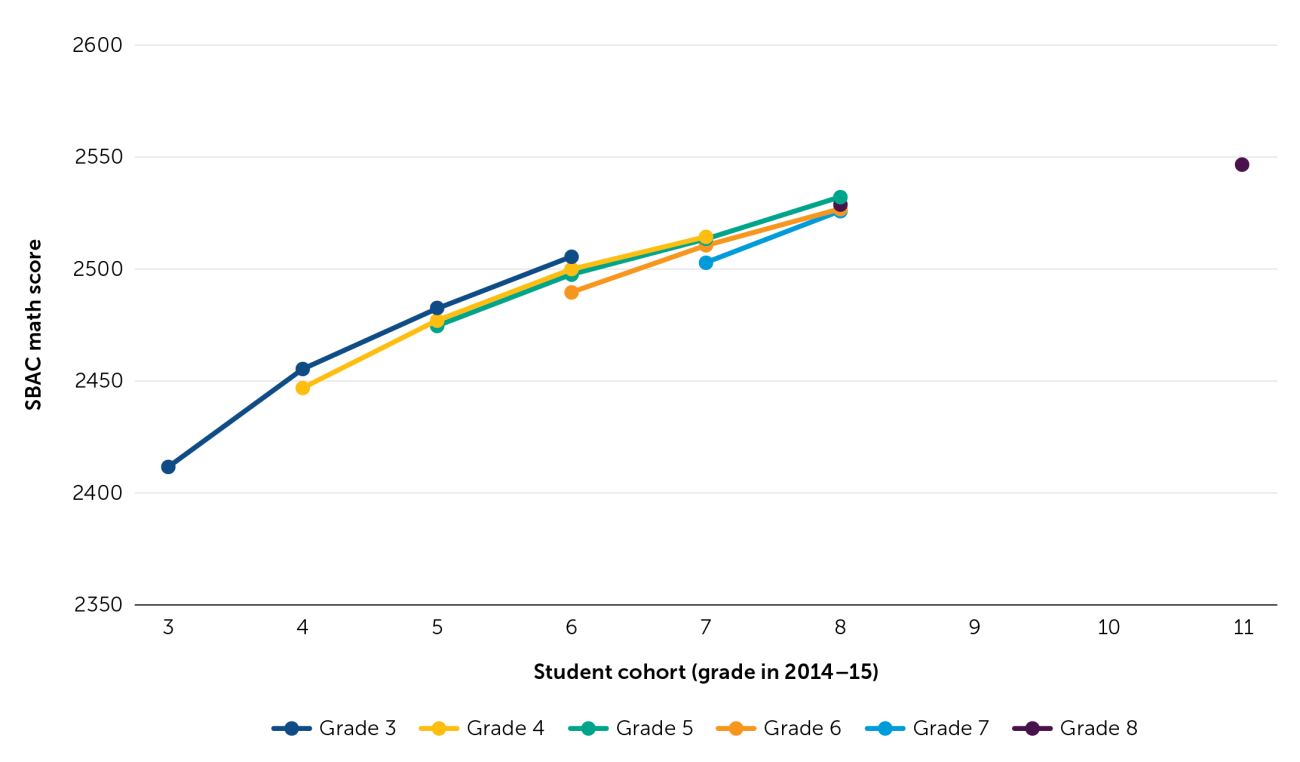
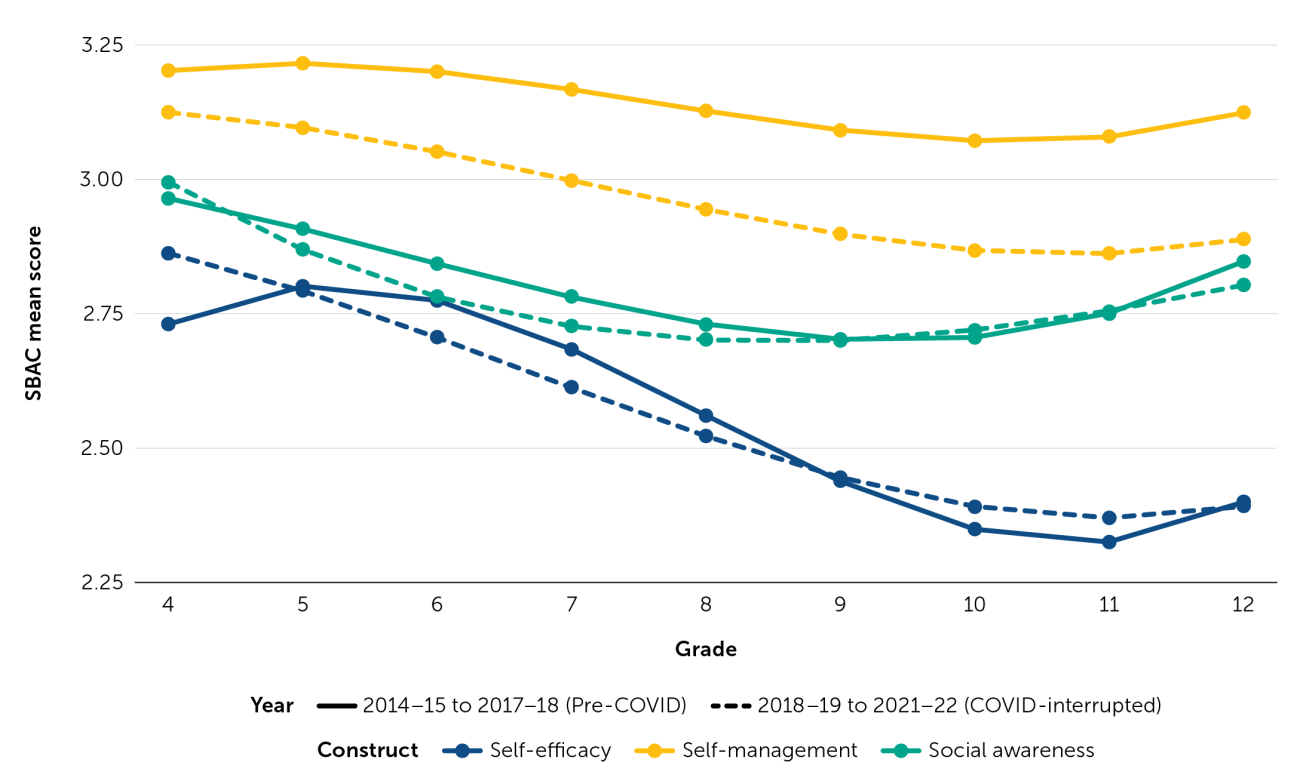
One of the most striking findings from CORE Districts’ longitudinal study is that, unlike cognitive skills, which typically grow in an upward pattern across adolescence (see Figure 1 for an example of math assessment scores, which has a pattern similar to ELA scores), social-emotional competencies do not consistently increase as children age; instead, they follow more complex and nonlinear trajectories (see Figure 2).
Before the pandemic, students’ self-management, self-efficacy, and social awareness generally declined during late elementary and middle school, with only modest recovery in high school. Self-efficacy showed the steepest drop. These patterns are not signs of failure. They reflect normative developmental changes. As academic demands intensify and social comparisons increase, students’ perceptions of their competencies often dip. Therefore, expecting steady, uniformly positive social-emotional growth is unrealistic, even under typical schooling conditions. A decline in seventh-grade self-efficacy does not necessarily signal that a school’s SEL program is ineffective. It may instead reflect the developmental realities of early adolescence within a shifting school ecology.
Figure 1. Trends of Smarter Balanced Assessment Consortium Mathematics (SBAC) Scores (2014–15 through 2017–18)
Source. Wang, 2025.
Figure 2. Developmental Trajectories of SEL Constructs (2014–15 through 2017–18 versus 2018–19 through 2021–22)
Source. Wang, 2025.
COVID Shifted the Curve, Especially for Younger Students
The pandemic intensified already-present downward trends in certain SEL competencies. However, the effects were not uniform. Elementary and middle school students experienced the greatest disruptions, perhaps because they were developmentally less prepared to manage unstructured remote learning. High school students showed smaller changes in self-efficacy and social awareness relative to pre-COVID cohorts. However, the gap in self-management skills between the two time periods was even larger among high school students than it was among younger students.3
This is not surprising. During remote and hybrid instruction, students had to manage their time, regulate their attention, persist through technical and motivational barriers, and seek help more independently than ever before. Self-management was no longer just a helpful skill. It was a prerequisite for learning.
Overall, the empirical evidence highlights the importance of supporting the development of social-emotional competencies during the transition into and through middle school as students experience heightened academic demands, shifting social dynamics, and reduced external structures and supports. These findings suggest that the COVID disruption did not create entirely new challenges but rather amplified existing developmental vulnerabilities, particularly for younger students transitioning into more independent learning.
Prepandemic Social-Emotional Competencies Predicted the Level of Academic Disruption
During the pandemic, educators wondered whether students’ social-emotional competencies mattered more when instructional routines were disrupted. The evidence suggests they did.
Researchers linked students’ prepandemic (2018–19) SEL scores to their academic outcomes in the first postclosure testing year (2020–21); they found consistent positive associations between social-emotional competencies and achievement in math and ELA, even after controlling for prior achievement and student characteristics.4 Students with higher pre-COVID self-management, self-efficacy, and growth mindset scored higher during the pandemic. Notably, these associations were stronger in Grade 6 than in Grade 4—precisely during the transition to middle school when academic demands increase and school structures shift.
For students with disabilities (SWD), the associations were even more pronounced for growth mindset and self-efficacy. Although SWD learners reported lower average levels of these competencies, those who reported higher levels saw larger academic benefits during COVID-disrupted learning. This suggests that motivational beliefs and self-regulatory capacities may be particularly salient under conditions of disruption as well as consequential for students already facing structural barriers.
This finding underscores that strengthening students’ capacity to navigate challenges, especially when support is strained, can meaningfully affect academic resilience.
Attendance, Chronic Absenteeism, and the SEL Connection
Any conversation about postpandemic recovery in California must grapple with chronic absenteeism. Consistent with national trends, California’s chronic absenteeism increased substantially during and after the pandemic. Even as test scores in 2023–24 stabilized in some grades, many districts continue to report historically high rates of students missing 10 percent or more of the school year, with 20 percent of students being chronically absent.
CORE Districts’ longitudinal SEL evidence adds an important dimension to this discussion. During COVID-interrupted years, attendance was more strongly associated with self-management and social awareness than in pre-COVID years.5 In other words, the link between school engagement and students’ social-emotional competencies tightened under disrupted learning conditions.
These findings suggest that chronic absenteeism is not solely a logistical or compliance issue but also a developmental and relational issue. Importantly, the relational aspect likely operates in both directions: Stronger self-management and social awareness may support attendance, and consistent attendance may in turn provide the structures and relationships that foster SEL development. Viewing chronic absenteeism through a social-emotional lens broadens the set of policy tools available to districts and reinforces a central insight of this research—that academic behavior and social-emotional development are deeply intertwined.
Equity Requires More Than Universal SEL
Wang (2025) and Wang & Li (2026) reveal substantial heterogeneity in SEL trajectories across gender, race/ethnicity, English learner status, disability status, and socioeconomic status. For example:
- Girls began with higher self-efficacy than boys in Grade 4 but experienced steeper declines during adolescence, particularly during COVID-interrupted years.
- Asian American students consistently reported initial lower self-efficacy, self-management, and social awareness than White peers, even after adjusting for academic performance in both pre-COVID and COVID-interrupted times. Black students also reported initial lower self-management than White students in both periods.
- Students with disabilities reported significantly lower levels across all four SEL competencies in Grades 4–6. For most subgroups (e.g., gender, free or reduced-price lunch, and English language learners), differences in SEL-achievements are small. In contrast, associations for growth mindset and self-efficacy are meaningfully stronger for the SWD subgroup.
- Pre-COVID, socioeconomically disadvantaged students tended to score significantly lower on self-management than their peers in early grades and had similar linear and quadratic developmental patterns in later grades. During COVID, the initial scores were similar between socioeconomically disadvantaged students and others, but socioeconomically disadvantaged students tended to have a steeper decline in self-management and a small but higher rate of development in later grades.
These patterns highlight a critical point: A one-size-fits-all SEL strategy is unlikely to close gaps. Instead, differences in both baseline levels and growth trajectories suggest the need to consider subgroup-specific patterns when designing and evaluating SEL supports.
Considerations for California Policymakers
California has already invested significantly in SEL initiatives and guiding principles. The important next step is to move from guidance to meaningful, developmentally informed actions.
Interpret SEL trends developmentally
The California Department of Education and local education agencies are among those who may benefit from recognizing that SEL development is nonlinear, does not necessarily grow over time, and varies by SEL skill. Policymakers can support efforts to identify typical development trajectories and then to monitor when students deviate from expected developmental patterns.
Prioritize the elementary-to-middle school transition
Grades 5 and 6 represent a critical window for intervention. By Grade 6, associations between SEL and achievement strengthen, indicating that supports for motivational and self-regulatory skills during this period may be especially impactful.
Integrate SEL into core academic strategies
Academic learning is closely tied to students’ social-emotional competencies. Efforts such as tutoring and instructional acceleration are more effective when they explicitly support students’ self-management, self-efficacy, and goal-setting skills. Rather than treating SEL as a separate initiative, schools can embed SEL competencies into everyday instruction to strengthen students’ engagement, persistence, and learning outcomes.
Leverage the connection between attendance and SEL
Policies that strengthen self-management, build belonging, and enhance relational support may indirectly improve attendance and academic recovery. As California continues to address elevated absenteeism, recognizing and leveraging the connection between school-going and SEL may be critical to long-term recovery.
Provide focused supports for vulnerable subgroups
Students with disabilities, English learners, and socioeconomically disadvantaged students demonstrated both lower average competencies and distinct developmental patterns. Tailored interventions—such as Multi-Tiered System of Supports, whole child approaches, or positive behavioral interventions and supports—particularly when they strengthen growth mindset and self-efficacy, may be provided during the school day or in afterschool programs to support improved teaching and learning.
Start longitudinal monitoring
The state could start consistent measures of student SEL—like its approach through the CHKS—tracking cohorts to determine whether developmental trajectories will rebound, stabilize, or diverge further in the postpandemic period. Such longitudinal data can also inform more timely supports by identifying when and for whom additional interventions are most needed.
Wang, Y. C. (2026, May 21). What COVID taught us about students’ social-emotional development—and why California should rethink how it provides support [Commentary]. Policy Analysis for California Education. https://edpolicyinca.org/newsroom/what-covid-taught-us-about-students-social-emotional-development-and-why-ca-should-rethink-how-it-provides-support
- 1
Wang, Y. C. (2025). The developmental trajectories of students’ social-emotional competencies across grades 4–12: Longitudinal evidence before and during COVID-19 [Manuscript under revision for American Educational Research Journal].
- 2
Wang, Y. C., & Li, S. (2026). The protective role of social-emotional competencies in student academic performance during COVID-19 [Manuscript submitted for publication to Educational Policy].
- 3
Wang, 2025.
- 4
Wang & Li, 2026.
- 5
Wang, 2025.