How Changes in Foster Youth Classification Status Relate to Student Absenteeism and Discipline



Summary
In California, youth in foster care experience some of the highest rates of chronic absence, with more than one in three missing 10 percent or more of the 2024–25 school year. Boosting the school attendance of youth in foster care requires pinpointing and addressing the factors that influence their attendance—including entry into and exit from classification status as foster youth while still in school. This brief presents new evidence of how such status relates to attendance and discipline in four of California’s CORE school districts. Entry into classification as a foster youth is associated with decreases in days absent and chronic absence alongside increases in exclusionary discipline, while exiting classification is associated with increases in absenteeism and no significant change in disciplinary risk. These findings have implications for strengthening educational stability and for state policies aimed at supporting the educational well-being of youth in foster care.
Introduction
California is home to about 30,000 school-aged youth in foster care,1 a vulnerable group of students who have experienced abuse or neglect by a parent or guardian and consequently have been removed from their homes and placed into the care of temporary foster families.2 Youth in foster care tend to have persistently high rates of chronic absence (missing 10 percent or more of the school year), with rates reaching a postpandemic peak of 46.5 percent in the 2021–22 school year. Although these rates have declined slightly, they remain about 10 percentage points above prepandemic levels (Figure 1).
Figure 1. Foster Youth Chronic Absence Rates by School Year
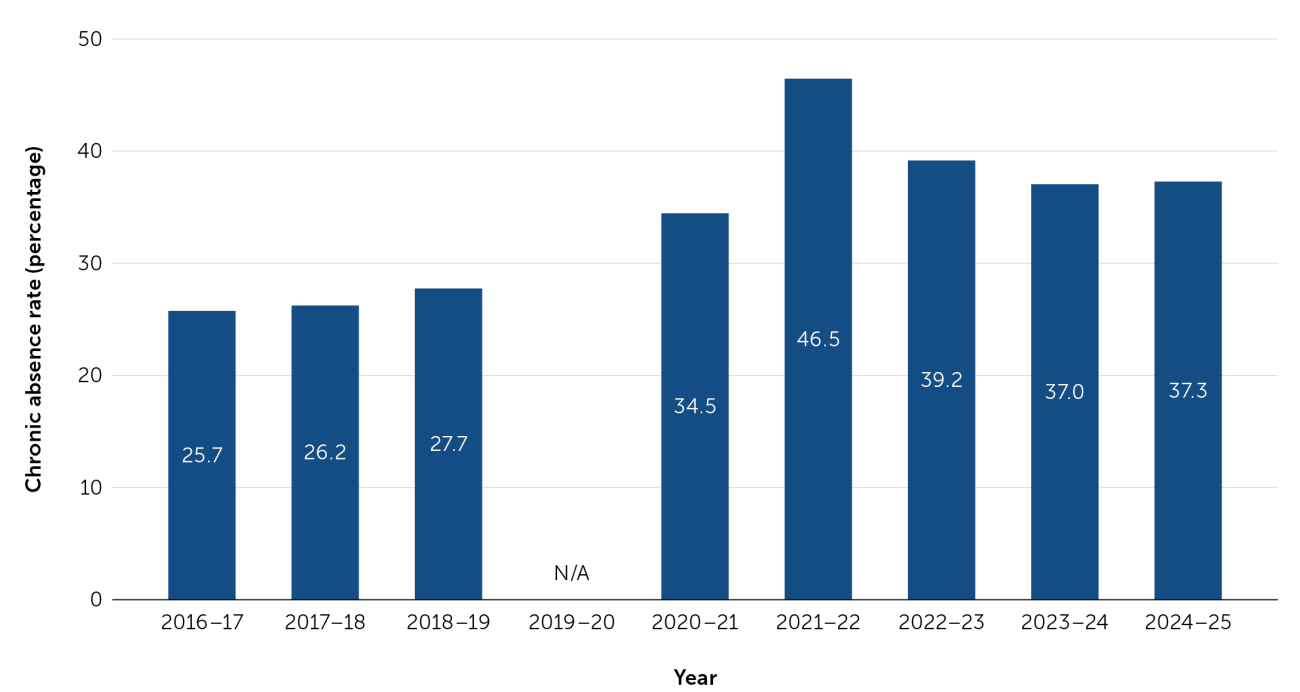
Source. California Department of Education Dataquest (dq.cde.ca.gov/dataquest). Note. Absenteeism data for 2019–20 are not available due to issues with data validity and reliability. Additionally, the California Department of Education encourages caution when looking at data from both 2019–20 and 2020–21.
Similarly, youth in foster care are frequently subjected to exclusionary discipline (removal from the regular learning environment due to misbehavior), with suspension rates hovering between 13 and 15 percent since 2016–17 (Figure 2). Addressing chronic absence and exclusionary discipline is critical because missed instructional time and disciplinary removals limit students’ opportunities to both learn and succeed in school.
Figure 2. Foster Youth Suspension Rates by School Year
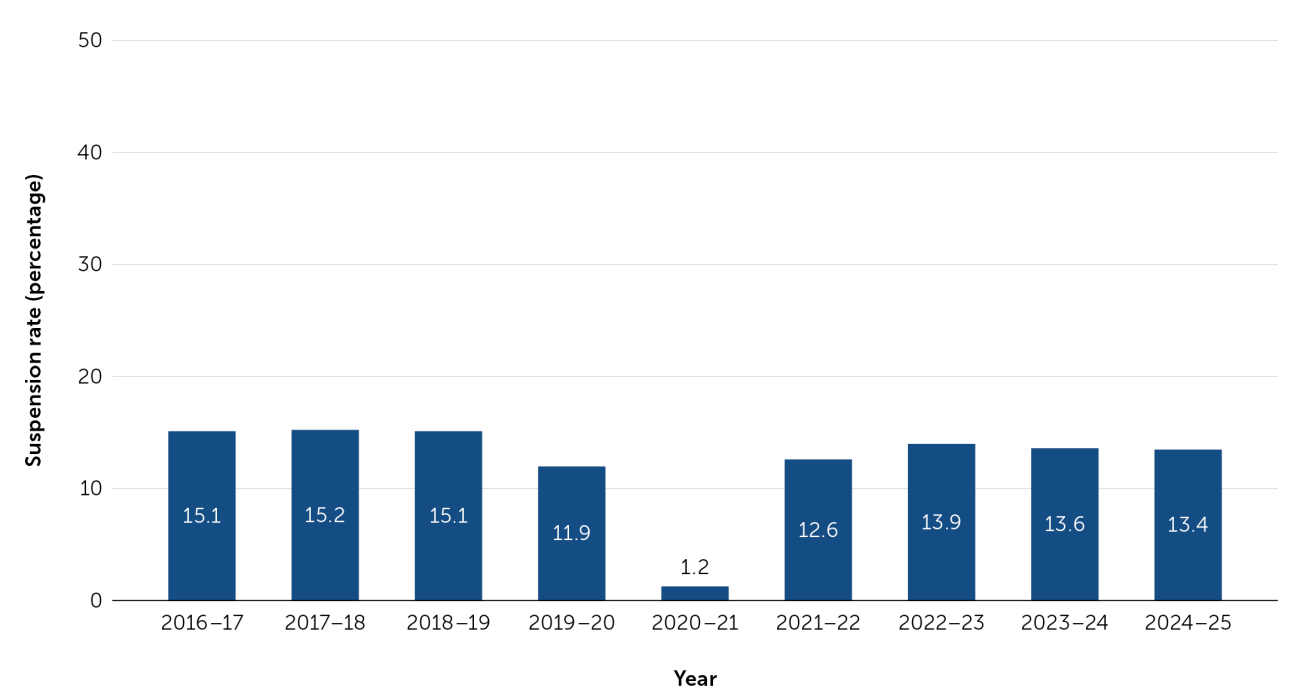
Source. California Department of Education Dataquest (dq.cde.ca.gov/dataquest). Note. The California Department of Education encourages caution when looking at data from both 2019-20 and 2020-21.
Instability in the educational experiences of youth in foster care, often driven by frequent changes in foster care placement, contributes to a range of negative outcomes, including high rates of chronic absence and elevated exposure to exclusionary discipline. A less well-understood dynamic within this broader pattern of instability is how these students experience transitions into and out of foster youth classification status.
The aim of this policy brief is twofold. First, we provide an overview of absenteeism and disciplinary outcomes among youth in foster care, including key challenges and policies supporting their education. Second, we present new findings from four of California’s CORE districts on how the attendance and disciplinary outcomes of youth in foster care vary with annual changes in their foster youth classification status. Together, these findings have implications for state education policies aimed at improving attendance and reducing exclusionary discipline during critical transition periods, particularly for students exiting the foster care system.
Why Youth in Foster Care Experience Elevated Absenteeism and Discipline
Youth in foster care experience persistently high rates of chronic absence and exclusionary discipline due to a combination of individual-level challenges and broader structural and institutional conditions that shape their educational environments. These mechanisms often operate simultaneously, reinforcing patterns of disengagement from school and increasing exposure to punitive responses.
Individual-level challenges. At the individual level, many youth in foster care experience significant behavioral and mental health challenges rooted in prior trauma, including abuse and neglect.3 Trauma exposure is strongly linked to heightened internalizing and externalizing behaviors,4 which can undermine students’ ability to engage consistently in school. These challenges not only increase the likelihood of behavioral incidents that often lead to disciplinary responses within schools but also disrupt attendance by weakening school attachment and daily functioning.5 In this way, behavioral and emotional needs serve as a common pathway linking foster youth status to both absenteeism and disciplinary involvement.
School context. Youth in foster care are disproportionately enrolled in low-performing, high-poverty, and nontraditional school settings, including alternative schools that often serve students with academic or behavioral challenges.6 Prior research shows that such schools tend to rely more heavily on exclusionary disciplinary practices.7 These environments may lack sufficient staffing, mental health supports, or trauma-informed practices, increasing both disciplinary exposure and disengagement from school, which contribute to absenteeism. Thus, the school contexts in which youth in foster care are concentrated play a critical role in shaping both attendance and discipline outcomes.
System-level challenges. Beyond individual circumstances, youth in foster care are uniquely affected by systemic instability. Some of these students experience five or more foster home placements,8 with most changing schools at least once during a given academic year and nearly one quarter changing schools four or more times.9 School moves disrupt instructional continuity, peer relationships, and access to support services,10 all of which are closely tied to attendance and behavioral outcomes. Frequent transitions can also increase the likelihood that students enter new school environments with stricter disciplinary climates or limited knowledge of students’ prior needs, heightening the risk of exclusionary discipline.
Cross-system coordination gaps. Finally, limited coordination between child welfare and education systems can exacerbate these challenges. When schools and child welfare agencies lack shared information or aligned accountability, early warning signs (such as rising absences or minor behavioral incidents) may go unaddressed.11 Missed opportunities for preventive intervention can allow attendance problems to escalate and disciplinary responses to become more punitive over time. These coordination gaps highlight how institutional failures, rather than student behavior alone, contribute to elevated risks of both absenteeism and discipline among youth in foster care.
Supporting the Education of California’s Youth in Foster Care
To address some of the barriers to attendance and learning for youth in foster care, California became the first state to pass legislation12 ensuring educational rights for foster students. Assembly Bill (AB) 490 contains two key provisions that promote educational stability for foster children: (a) requiring each district to appoint an education liaison for foster children to facilitate common educational processes, such as enrollment, placement and transfers; and (b) allowing children in foster care to remain in their current schools if they change foster placements. In 2016, the state passed AB 854,13 which established a Foster Youth Services Coordinating Program (FYSCP) requiring school districts to implement school-based supports that promote the educational success of youth in foster care.14
At the federal level, the primary policy lever aimed at supporting the educational well-being of children in foster care is through provisions in Federal Title I, Part A, of the Elementary and Secondary Education Act (1965), which ensures educational stability. Since 2015, Title I has required that students in foster care be allowed to stay in their schools of origin if that is determined to be in their best educational interests.15
Although these policies aim to support the educational stability of youth in foster care by allowing them to remain in their schools of origin, implementation of these regulations in practice remains limited.16 Key barriers to implementation include lack of interagency collaboration between child welfare agencies and school districts alongside challenges in adequately funding and coordinating transportation services to ensure that children remain in their schools of origin after moving placements.
Foster Youth Classification, Attendance, and Discipline
While school mobility resulting from placement changes in foster care is a key determinant of both absenteeism and exclusionary discipline, an important and often overlooked dynamic is students’ entry into and exit from foster youth classification status while they remain enrolled in school. We define entry into classification status as the school year in which a student is officially designated as a “foster youth” in administrative records and exit from classification status as the year in which the student is no longer identified as a foster youth in those records. These transitions may shape not only students’ attendance patterns but also their exposure to school disciplinary practices.
Transitions into foster youth status. Although youth in foster care experience elevated absenteeism and disciplinary risk due in part to school mobility,17 prior research suggests that entry into foster care can, under certain conditions, be associated with improved school engagement. For example, transitioning into foster care has been linked to increased attendance, especially for children who remain in care for an entire school semester.18 Entry into care may move students out of destabilizing or unsafe home environments and into more structured settings, increasing access to adult supervision, educational advocacy, and social supports that stabilize daily school participation. These same supports may also reduce behavioral disruptions that precipitate exclusionary discipline.
Foster caregivers may be better positioned to communicate with schools, advocate for services, and navigate disciplinary procedures, which can mitigate both attendance problems and punitive disciplinary responses.19 In addition, once students are formally classified as foster youth, schools may respond by activating targeted supports that influence both attendance and discipline. In California, the FYCSP authorizes districts to develop programs specifically designed to support youth in foster care.20 These efforts include enhanced transportation, individualized learning plans, and socioemotional and behavioral supports, all of which may reduce absences and lower the likelihood of exclusionary disciplinary actions.
Transitions out of foster youth status. By contrast, exiting foster care, particularly after a brief placement during the school year, has been associated with declines in attendance.21 Youth who exit foster care may return to unstable family environments or experience stress during the reunification process,22 which can disrupt school routines and engagement. These disruptions may also increase the likelihood of behavioral challenges that result in disciplinary referrals, especially if formal supports are withdrawn once students exit classification status. As a result, transitions out of foster care may represent a period of heightened vulnerability for both absenteeism and exclusionary discipline. It is important to acknowledge that family reunification could be a positive experience for foster youth as well.
Data and Methodology
Our findings are based on data on approximately 11,200 youth in foster care from four CORE districts over 4 school years (2015–16 to 2018–19). Table 1 lists key characteristics of the sample disaggregated by classification status over the 4 years: never classified (i.e., non-foster-youth), always classified as a foster youth, ever entered, and ever exited.
Table 1. Descriptive Statistics on a Sample of Youth in Foster Care From Four CORE Districts by Classification Status
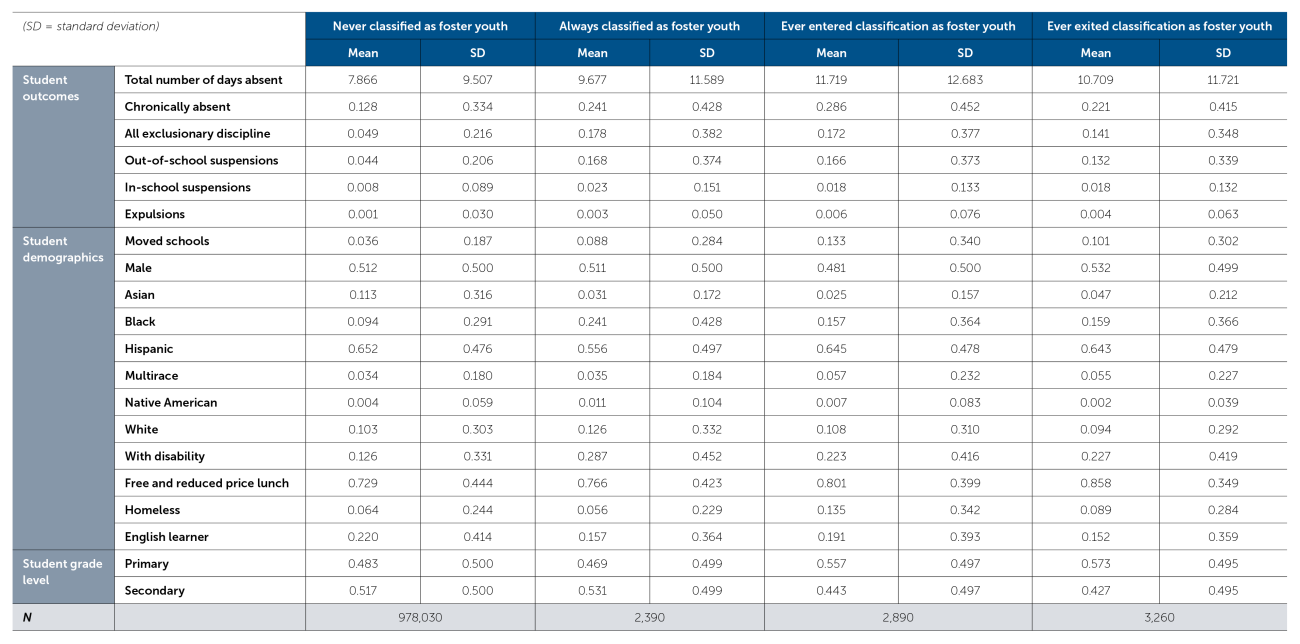
As expected, students consistently classified as foster youth experienced substantially worse attendance outcomes than students never classified as foster youth. Students always classified as foster youth missed nearly 10 days of school on average, compared to about 8 days among students never classified, and nearly one quarter (24 percent) were chronically absent, compared to 13 percent of students never classified. Attendance outcomes were even more pronounced for students who entered foster youth classification during the observation period. These students missed almost 12 days of school on average, and 29 percent were chronically absent. Students who exited foster youth classification also exhibited elevated absenteeism, missing roughly 11 days of school, with 22 percent meeting the threshold for chronic absence.
Disparities were similarly evident for disciplinary outcomes. Students never classified as foster youth had very low rates of exclusionary discipline, with fewer than 5 percent experiencing any exclusionary disciplinary action. In contrast, nearly 18 percent of students always classified as foster youth experienced at least one exclusionary discipline event, including out-of-school suspension, compared to 17 percent among those who entered foster youth classification and 14 percent among those who exited. Out-of-school suspensions drove much of this disparity, occurring nearly four times as often among students always classified as foster youth than among students never classified. While expulsions were rare across all groups, they were nonetheless more prevalent among students who ever entered foster youth classification.
Consistent with prior research, foster youth in all classification groups exhibited higher rates of school mobility than their non-foster-youth peers. For example, students always classified as foster youth were more than twice as likely to move schools during the year compared to students never classified. Across demographic characteristics, each foster youth group was composed predominantly of Hispanic students and a large majority qualified for free or reduced-price lunch, underscoring the intersection of foster care involvement with broader structural disadvantage. Together, these descriptive patterns highlight substantial disparities in both attendance and disciplinary outcomes across foster youth classification trajectories, motivating the need for analyses that account for transitions into and out of foster youth status.
For all analyses, we employed a statistical method known as asymmetric fixed effects,23 where we looked at how absences for youth in foster care changed before and after their classification status changed. We looked separately at changes when youth entered classification and when they exited classification. With this method, each child serves as their own control, thereby allowing us to account for differences, both observed and unobserved, among children who remain stable over time. We incorporated additional controls to attenuate potential biases in our analyses.
How Changes in Foster Youth Classification Status Link to Absenteeism: Key Findings
In this section, we describe our findings on how changes in foster youth classification status are associated with absenteeism.
Entering and Exiting Foster Youth Classification Are Linked to Meaningful Changes in Student Absenteeism
Absences tend to decline when students enter classification status. Youth in foster care experience fewer absences during the year they are classified as foster youth. On average, these students miss about 2.4 fewer days of school and are 12.8 percentage points less likely to be chronically absent upon entry into care (Figure 3). In practical terms, if youth in foster care typically miss around 11 days of school, our results suggest they would miss closer to 9 days during the year they enter foster care.
Figure 3. Relationships Between Absenteeism and Foster Youth Classification Status Entry and Exit
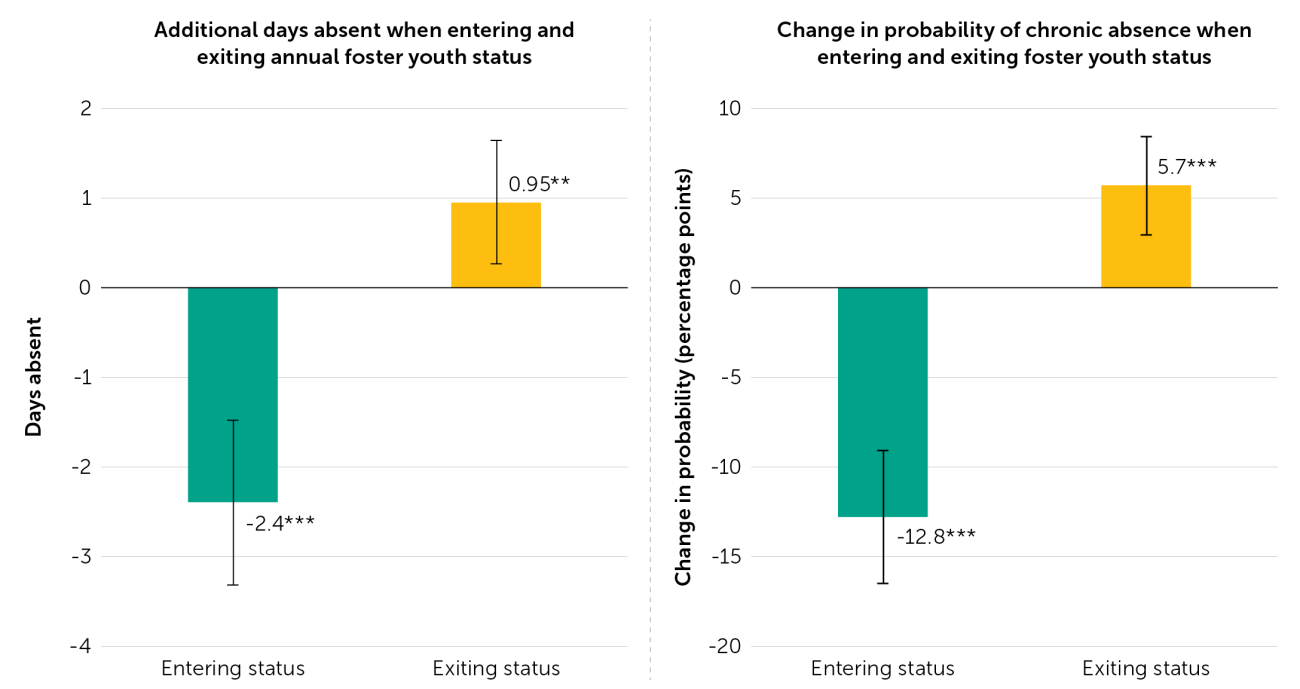
Note. ***p < .001; **p < .01; results based on asymmetric fixed effects models.
Absences tend to increase when students exit classification status. In contrast, exiting foster youth classification status is associated with lower attendance outcomes. Students miss approximately 1 additional day of school and experience a 5.7 percentage point increase in the likelihood of chronic absence during the year they exit status. For a typical student in foster care who faces a 24 percent probability of chronic absence, this corresponds to an increase to nearly 30 percent upon exit from foster youth classification status. It is important to note that we are unable to determine the underlying reasons for this association. These results could reflect broader systemic issues underlying the reunification process rather than something intrinsic about youth who leave foster care to reunite with their families.
These patterns are stronger for younger students. The relationship between foster care transitions and absenteeism varies by grade level (Figure 4). Elementary school students show the largest changes: Entering foster care is associated with 3.8 fewer days absent, compared to 2.2 fewer days for middle school students, while no significant relationship is observed for high school students. A similar pattern emerges for chronic absence: Elementary school students entering classification experienced a decline of 17.8 percentage points in chronic absence, and middle school students experienced a decline of 12 percentage points. Finally, exiting classification is only significantly related to chronic absence for elementary school students in foster care, for whom chronic absence increased by 5.4 percentage points.
Figure 4. Relationships Between Absenteeism and Foster Youth Classification Status Entry and Exit by Grade Level
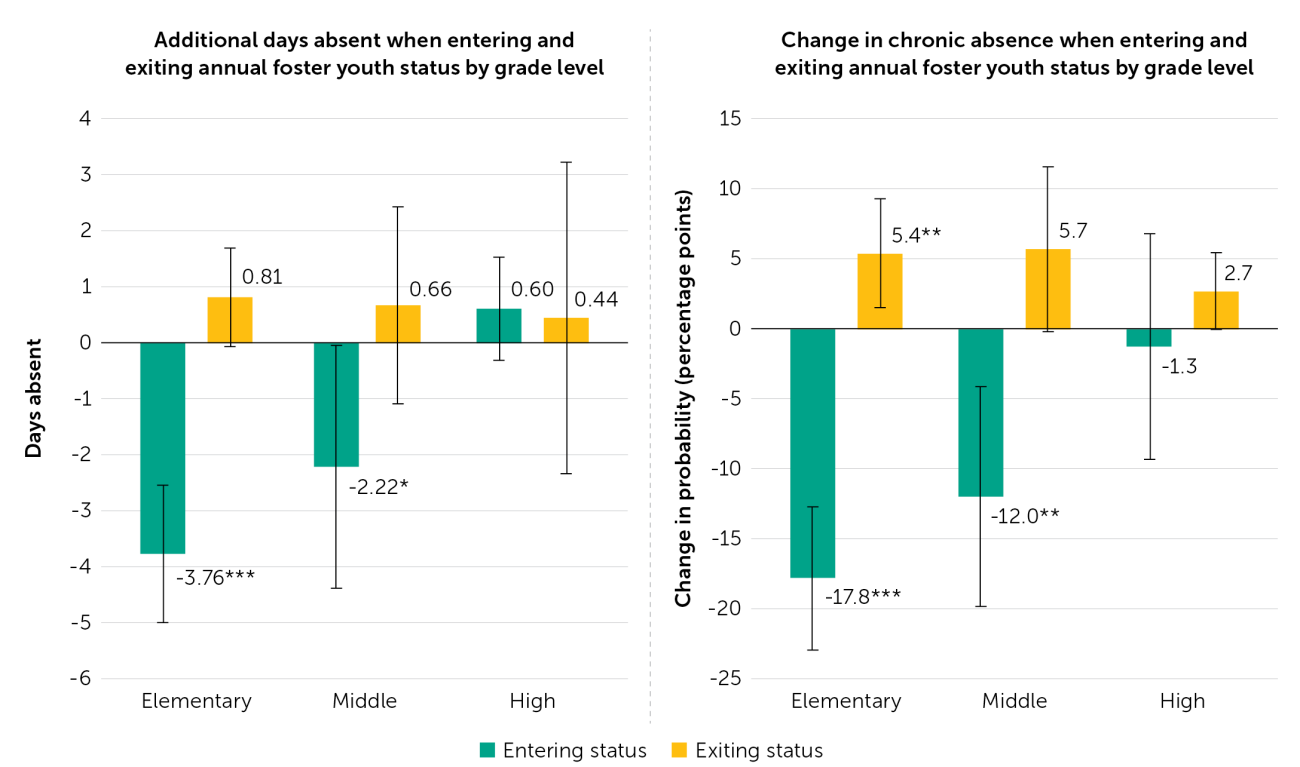
Note. ***p < .001; **p < .01; *p < .05; results based on asymmetric fixed effects models.
Entering and Exiting Foster Youth Classification Are Linked to Meaningful Changes in Student Discipline
Youth in foster care face higher rates of exclusionary discipline. Students are more likely to experience exclusionary discipline during the years when they are in foster care than during the years when they are not. After accounting for individual students’ characteristics and differences across schools and grades, foster care status is linked to a higher likelihood of being disciplined. Importantly, this increase is almost entirely due to out-of-school suspensions. We do not find clear or consistent differences for in-school suspensions or expulsions, largely because these outcomes occur infrequently and do not show meaningful changes associated with foster care status. Because out-of-school suspension is the only disciplinary outcome that shows a clear and reliable pattern, we focus our figures and discussion on this measure. Even so, the increase is substantial—during a typical year, 4–5 percent of students receive exclusionary discipline, meaning youth in foster care face a noticeably higher risk.
Disciplinary risk increases when students enter foster care. When we examine transitions into and out of foster care, a clear pattern emerges. The elevated disciplinary risk occurs primarily when students enter foster care (Figure 5). Entry into foster care is associated with a meaningful increase in the likelihood of out-of-school suspension. In contrast, leaving foster care is not associated with noticeable changes in discipline outcomes. This suggests that disciplinary risk is concentrated around the initial transition into care, rather than reflecting a persistent pattern throughout or after foster placement.
Figure 5. Relationships Between Out-of-School Suspensions and Foster Youth Classification Status Entry and Exit.
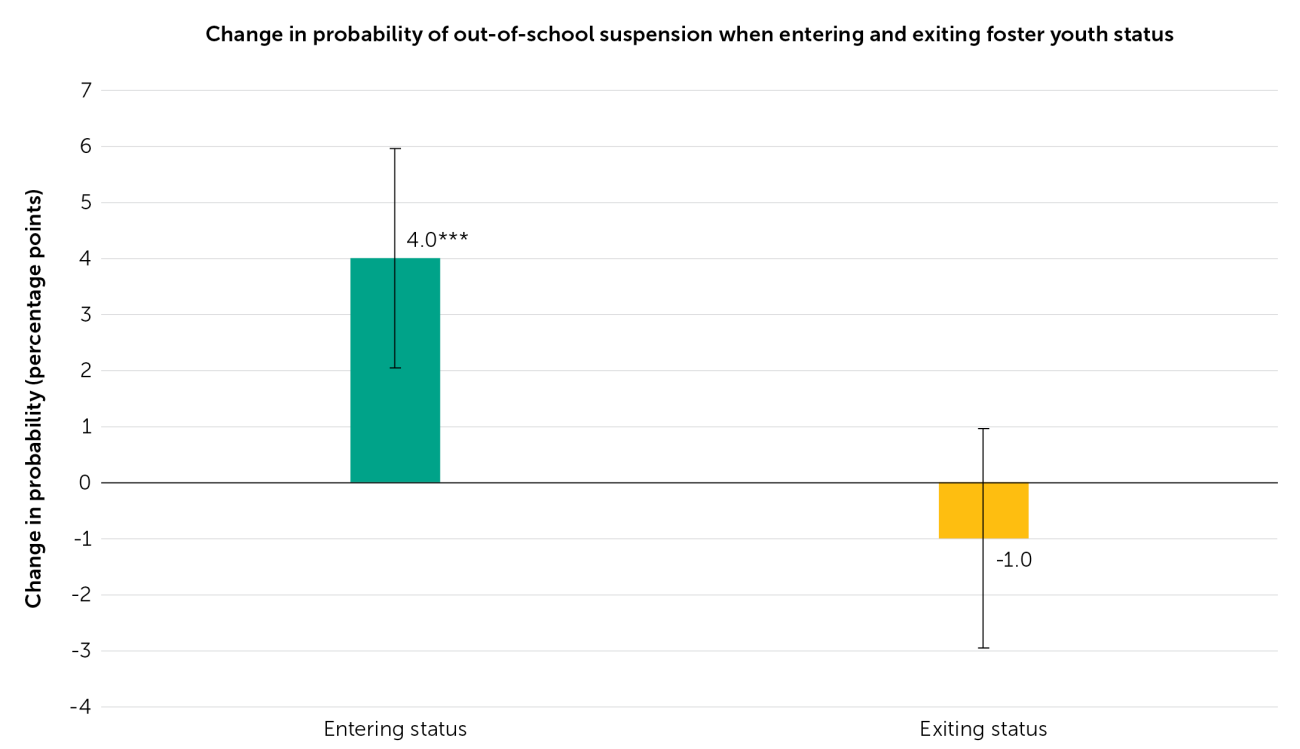
Note. ***p < .001; results based on asymmetric fixed effects models.
There are no consistent differences across most student subgroups. The relationship between foster care status and discipline is largely consistent across gender, race/ethnicity, and grade level. Two modest exceptions emerge: Male youth in foster care experience slightly higher rates of exclusionary discipline than female, and students exiting care during the secondary grades (sixth to twelfth) show a somewhat lower likelihood of exclusionary discipline compared to those in elementary grades. Overall, though, the differences between subgroups are small, indicating that elevated disciplinary risk among youth in foster care is a broadly shared experience rather than one concentrated within specific demographic groups.
Recommendations
Based on our findings, we offer three recommendations. The first is aimed primarily at policymakers; the other two are targeted at districts and schools who serve foster youth.
Extend Stability Provisions for Those Exiting
In terms of implications for the education policies that support youth in foster care, federal educational stability provisions under Title I, Part A, no longer hold when these students exit the system. Current guidelines only encourage—but do not require—educational and child welfare agencies to prioritize educational stability for youth who transition out of the foster care system.24 Periods of instability associated with both entering and exiting foster care are linked to elevated risks of absenteeism and exclusionary discipline, indicating that educational vulnerability does not end when foster care classification ends. Extending stability provisions to students exiting foster care, even on a short-term basis (e.g., the initial exit year), could help reduce school disruptions that contribute to missed instructional time and disciplinary incidents. Maintaining continuity in school placement, peer relationships, and support services during this transition may mitigate both chronic absence and heightened disciplinary risk.
Invest in Education Liaisons
Former youth in foster care who experience increased absences or disciplinary involvement as they transition out of classification status may benefit from targeted advocacy and coordination of services. Education liaisons, such as those supported under California’s AB 490, are well positioned to serve this role. Liaisons can monitor attendance patterns and disciplinary referrals; coordinate with families, educators, and child welfare professionals; and ensure that students receive timely academic, socioemotional, and behavioral supports. Prior research suggests that education liaisons can improve academic outcomes for youth in foster care25 and help stabilize attendance by intervening early with proactive problem-solving approaches.26 Our findings indicate that similar supports may also be critical for preventing behavioral challenges from escalating into exclusionary discipline, particularly during periods of transition. However, additional research is needed to directly assess the extent to which education liaisons can reduce both absenteeism and disciplinary involvement.
Strengthen Cross-Sector Collaboration
Policies that promote stronger cross-sector collaboration between schools and the child welfare system hold promise in boosting the educational success of youth in foster care, particularly those who are transitioning out of foster care status.27 Schools that extend social welfare support services to students who are exiting foster care status could enable those students to continue to receive individualized supports through a case management approach, which could help promote stronger attendance and academic achievement.28 Strengthened collaboration can also support data sharing and joint monitoring of attendance and discipline patterns, enabling schools and agencies to identify points of risk and intervene before students become disengaged or pushed out of the education system. Finally, cross-sector collaboration can play an important role in supporting families upon reuniting with their children so that they receive the necessary supports to ensure consistent schooling attendance and engagement.
Conclusion
Youth in foster care remain one of the most vulnerable student populations and continue to face often insurmountable educational challenges. By digging deeper into how the attendance and discipline patterns for these students shift as their classification status changes, we have identified critical junctures where additional targeted resources and supports could make a difference to their educational livelihoods, especially for those students who are exiting status as a foster youth.
Gee, K. A., Woods, S. C., & Gottfried, M. A. (2026, March). How changes in foster youth classification status relate to student absenteeism and discipline [Policy brief]. Policy Analysis for California Education. https://edpolicyinca.org/publications/how-changes-foster-youth-classification-status-relate-student-absenteeism-discipline
- 1
California Department of Education. (n.d.). Foster youth in California schools. cde.ca.gov/ds/sg/fosteryouth.asp
- 2
Children’s Bureau. (2024). Child maltreatment 2022. U.S. Department of Health and Human Services, Administration for Children and Families. acf.hhs.gov/cb/data-research/child-maltreatment
- 3
Baldwin, J. R., et al. (2023). Childhood maltreatment and mental health problems: A systematic review and meta-analysis of quasi-experimental studies. American Journal of Psychiatry, 180(2). doi.org/10.1176/appi.ajp.20220174; Burns, D., Espinoza, D., Adams, J., & Ondrasek, N. (2022, September 12). California’s students in foster care: Challenges and promising practices [Brief]. Learning Policy Institute. learningpolicyinstitute.org/product/california-students-foster-care-brief
- 4
Kim, J., & Cicchetti, D. (2010). Longitudinal pathways linking child maltreatment, emotion regulation, peer relations, and psychopathology. Journal of Child Psychology and Psychiatry, 51(6), 706–716. doi.org/10.1111/j.1469-7610.2009.02202.x
- 5
Gottfried, M. A., & Gee, K. A. (2017). Identifying the determinants of chronic absenteeism: A bioecological systems approach. Teachers College Record, 119(7), 1–34. doi.org/10.1177/01614681171190070
- 6
Barrat, V., & Berliner, B. (2013, January). The invisible achievement gap, part 1: Education outcomes of students in foster care in California’s public schools [Technical report]. The Center for the Future of Teaching & Learning at WestEd. researchgate.net/publication/286456190_The_Invisible_Achievement_Gap_Part_1_Education_Outcomes_of_Students_in_Foster_Care_in_California’s_Public_Schools
- 7
Gottfredson, G. D., Gottfredson, D. C., Payne, A. A., & Gottfredson, N. C. (2005). School climate predictors of school disorder: Results from a national study of delinquency prevention in schools. Journal of research in crime and delinquency, 42(4), 412–444. doi.org/10.1177/0022427804271931; Liu, J., Penner, E. K., & Gao, W. (2023). Troublemakers? The role of frequent teacher referrers in expanding racial disciplinary disproportionalities. Educational Researcher, 52(8), 469–481. doi.org/10.3102/0013189X231179649; Mendez, L. M. R., Knoff, H. M., & Ferron, J. M. (2002). School demographic variables and out-of-school suspension rates: A quantitative and qualitative analysis of a large, ethnically diverse school district. Psychology in the Schools, 39(3), 259–277. doi.org/10.1002/pits.10020
- 8
Courtney, M. E., Charles, P., Okpych, N. J., Napolitano, L., & Halsted, K. (2014). Findings from the California Youth Transitions to Adulthood Study (CalYOUTH): Conditions of foster youth at age 17. Chapin Hall at the University of Chicago. chapinhall.org/wp-content/uploads/CY_YT_RE1214_1.pdf
- 9
Burns et al., 2022.
- 10
Somers, C. L., et al. (2020). Academic achievement among a sample of youth in foster care: The role of school connectedness. Psychology in the Schools, 57(12), 1845–1863. doi.org/10.1002/pits.22433
- 11
Zetlin, A., Weinberg, L., & Shea, N. M. (2010). Caregivers, school liaisons, and agency advocates speak out about the educational needs of children and youths in foster care. Social Work, 55(3), 245–254. doi.org/10.1093/sw/55.3.245
- 12
Cal. Assemb. B. 490, Chapter 862 (Cal. Stat. 2003). leginfo.ca.gov/pub/03-04/bill/asm/ab_0451-0500/ab_490_bill_20031012_chaptered.html
- 13
Cal. Assemb. B. 854 (2015–2016). leginfo.ca.gov/pub/15-16/bill/asm/ab_0851-0900/ab_854_bill_20150915_enrolled.htm
- 14
Student Achievement and Support Division. (2024, July). Report to the Governor, the Legislature, and the Legislative Analyst’s Office: 2024 Foster Youth Services Coordinating Program report. California Department of Education. cde.ca.gov/ls/pf/fy/documents/fyscplegreport2024.docx
- 15
U.S. Department of Education & U.S. Department of Health and Human Services. (2024). Ensuring educational stability and success for students in foster care: Non-regulatory guidance. ed.gov/media/document/non-regulatory-guidance-ensuring-educational-stability-and-success-students-foster-care-november-15-2024-108448.pdf
- 16
Alliance for Children’s Rights. (2020, December). School stability for California’s youth in foster care: A review of laws and promising local practices. allianceforchildrensrights.org/resources/ssr2020
- 17
Burns et al., 2022.
- 18
Conger, D., & Rebeck, A. (2001, December). How children’s foster care experiences affect their education. Vera Institute of Justice and New York City Administration for Children’s Services. vera.org/downloads/publications/How_foster_care_affects_education.pdf
- 19
Morton, B. M. (2016). The power of community: How foster parents, teachers, and community members support academic achievement for foster youth. Journal of Research in Childhood Education, 30(1), 99–112. doi.org/10.1080/02568543.2015.1105334
- 20
Student Achievement and Support Division, 2024.
- 21
Conger & Rebeck, 2001
- 22
Bellamy, J. L. (2008). Behavioral problems following reunification of children in long-term foster care. Children and Youth Services Review, 30(2), 216–228. doi.org/10.1016/j.childyouth.2007.09.008
- 23
Allison, P. D. (2019). Asymmetric fixed-effects models for panel data. Socius: Sociological Research for a Dynamic World, 5. doi.org/10.1177/2378023119826441
- 24
U.S. Department of Education & U.S. Department of Health and Human Services, 2024.
- 25
Zetlin, A., Weinberg, L., & Kimm, C. (2004). Improving education outcomes for children in foster care: Intervention by an education liaison. Journal of Education for Students Placed at Risk (JESPAR), 9(4), 421–429. doi.org/10.1207/s15327671espr0904_5
- 26
Weinberg, L. A., Oshiro, M., & Shea, N. (2014). Education liaisons work to improve educational outcomes of foster youth: A mixed methods case study. Children and Youth Services Review, 41, 45–52. doi.org/10.1016/j.childyouth.2014.03.004
- 27
Wulczyn, F., Smithgall, C., & Chen, L. (2009). Child well-being: The intersection of schools and child welfare. Review of Research in Education, 33(1), 35–62. doi.org/10.3102/0091732X08327208
- 28
Rubin, D., et al. (2013). Improving education outcomes for children in child welfare. Children’s Hospital of Philadelphia PolicyLab. policylab.chop.edu/sites/default/files/pdf/publications/PolicyLab_EtoA_%20Improving_Education_Outcomes_for_Children_in_Child%20Welfare_2013.pdf