California’s Community Schools Partnership Program: From Policy to Practice



Summary
California’s Community Schools Partnership Program (CCSPP) is one of the state’s most ambitious education investments. This brief examines the first phase of implementation as a lens on governance challenges that pervade California education: aligning roles and accountability across a multilevel system, distinguishing what should be set statewide from what is locally determined, and building institutional capacity to monitor and support implementation in real time. Local flexibility requires clearer guardrails, and progress monitoring drifts towards compliance without shared standards. As California commits $1 billion in ongoing funding, the next phase—now structured with a study preceding certification—offers a critical opportunity to learn from the first: to clarify state-funded roles, define quality standards collectively, and build the knowledge base that high-quality implementation requires.
Introduction
The California Community Schools Partnership Program (CCSPP) represents one of the most ambitious investments in education in California’s history. Established in 2020 with $45 million in federal COVID-19 pandemic recovery funds and subsequently expanded to over $4 billion in one-time state funding,1 the program aims to transform how schools serve students and families—not by intentionally adding another categorical initiative but by positioning community schools as an organizing framework capable of creating coherence across a wider set of whole child investments. In 2026, with $1 billion in ongoing funds signaling the state’s long-term commitment, the question is no longer whether California will invest in community schools, but whether it has built the infrastructure to translate that investment into effective and sustainable implementation.
The community school strategy refers to a “whole child, whole systems” approach to school improvement in which educators, community partners, families, and students work together to create the conditions and systems necessary for engagement and high-quality learning. These schools have safe, inclusive classrooms and positive school climates; integrated support services and enrichment opportunities; active engagement and empowerment of students and families; and a commitment to collaborative, site-based leadership. Varying iterations of these schools have existed for more than a century, with a robust body of research describing their common characteristics across contexts and increasing evidence of school improvement and student achievement.2
Consistent with this broader research base, a growing body of CCSPP evidence suggests early promise. Longitudinal grantee reporting, case studies, and state-level outcome data point to expanding partnerships, stronger collaborative leadership, and meaningful gains for historically underserved students, including reductions in chronic absence, declining suspension rates, and improvements in academic achievement at some sites.3 What the evidence base has not yet examined is how the state’s own implementation infrastructure—a nested system of state-led and regional technical assistance centers and County Offices of Education (COEs) charged with turning policy intent into school-level practice—has functioned. Important questions remain about how the conditions have supported effective implementation, the challenges that have emerged, and how the system has adapted over time.
These questions are now urgent. The state’s adopted 2026 Budget Act (Assembly Bill 109)4 provides $1 billion in ongoing Proposition 98 funding for community schools, and the accompanying education omnibus trailer bill (Assembly Bill 126)5 structures the next phase in a way that appears to have absorbed a central lesson of the first. Rather than building a certification system against a standard that does not yet exist, the legislation sequences the work deliberately: It reappropriates up to $3 million in otherwise-CCSPP funds for a set of analyses, due to the State Board of Education (SBE) by June 2028, to determine what features are actually associated with community schools’ progress and to inform the long-term technical assistance, reporting, and certification structure. Only then does a school-site certification process follow, funded at up to $10 million, piloted no later than the 2028–29 school year, and implemented no later than October 2031. The statewide technical assistance system—the State Transformational Assistance Center (S-TAC) and a network of Regional Technical Assistance Centers (R-TACs), led or co-led by COEs—is charged with carrying out this work.
The next phase of CCSPP is therefore a test of whether California can learn from the first. The same technical assistance infrastructure that spent 5 years improvising its roles is now being asked to define what quality community school implementation means for the entire state and to build the certification architecture that will determine how $1 billion a year in continued funding is held accountable. The legislation has sequenced that work well. But as this brief will show, the first phase’s difficulties were never chiefly about sequencing on paper; they were about whether the substance of coordination, specification, and shared learning actually materialized beneath the formal structure. Whether the next phase succeeds depends on what the state understands about why the first phase unfolded as it did.
This brief takes up that question, drawing on interviews with staff from two of the state’s eight R-TACs as well as with eight CCSPP grantees across 15 counties, supplemented by document analysis of California Department of Education (CDE) guidance materials and SBE meeting minutes. The CCSPP experience, viewed through this lens, illustrates a broader challenge in California education governance, one that extends beyond community schools and has recently been examined across multiple policy domains:6 the difficulty of translating ambitious legislative intent into coherent, accountable implementation across a complex, multilevel system.
In Getting Down to Facts III, Loeb7 characterized California’s core education governance challenges as the “ABCs”: (a) weak accountability and alignment across levels of the system, (b) an unresolved balance between state guidance and local control, and (c) capacity of educators and institutions, of which this brief takes up the institutional dimension. CCSPP is a particularly useful case through which to examine these system-level governance challenges because, as a high-profile and widespread reform effort, it has had to grapple with all of them at once. The initiative combines many of the features that define the state’s current reform agenda: a major equity-focused investment, a commitment to local flexibility, a distributed support infrastructure, and an emerging need to define quality in ways that reflect the state’s awareness of the compliance burden and its effort to minimize it. How CCSPP works through these conditions reveals what it might take to move beyond large-scale investment and policy design towards the harder work of building the alignment, guidance, support, and learning infrastructure needed to translate ambitious policy into coherent and sustained practice.
In CCSPP’s case, the system-level challenges of accountability, balance between state guidance and local control, and capacity building surface in three interconnected ways. First, the state developed a conceptually sound capacity-building framework, the California Community Schools Framework,8 but its rollout was governed by the rhythms of the annual state budget process rather than the realities of implementation—a mismatch that left each level of the system improvising its role, building capacity, and supporting implementation all at once, and largely disconnected from one another. Second, while California’s Community Schools Framework provided a shared definition and set of values, the state stopped short of the practical specificity needed to guide implementation. In particular, it did not clearly distinguish between elements that should be consistent across all community school contexts and those that should be locally determined. Third, CCSPP revealed the challenge of building institutional capacity for learning in real time. The state sought to monitor and support implementation before the field had fully established shared indicators, benchmarks, or quality markers for what meaningful progress should look like and before its own attempts to define them had been tested and taken up by grantees. As a result, tools designed to support reflection and learning often functioned more like compliance instruments, limiting their usefulness for interpreting progress, building trust, and generating the cumulative knowledge needed to improve policy and practice.
CCSPP operates at the frontier of what the broader community schools field knows, generating lessons not only about implementation but also about the evidence, measurement, and governance infrastructure needed to support innovation at scale. Taken together, an analysis of the CCSPP process to date offers California a timely opportunity to learn from the initiative’s first phase and deliberately use that learning to strengthen the next one, building the knowledge and governance infrastructure that the first phase had to do without, and approaching that work with the same ambition the legislature brought to the original investment. These lessons can also inform other large-scale policy initiatives, especially those that depend on local adaptation, distributed support systems, and the state’s capacity to learn from implementation while it is still unfolding.
Data and Methods
Data collection primarily involved conducting a series of semistructured interviews in spring 2024 with CCSPP grantees (i.e., COE and local educational agency [LEA] staff) and state-contracted capacity builders. We drew on existing relationships with two R-TACs to recruit participants, with the goal of better understanding the experiences of both the formal technical assistance providers and the grantees receiving support. This resulted in a total of 14 interviews with six staff members from the R-TACs and eight CCSPP grantees, representing 15 counties across California. Interviews were supplemented by document analysis, including CDE reporting and guidance materials and SBE meeting minutes.
These interviews were not originally designed to answer the governance questions that this brief takes up. They grew out of ongoing, improvement-oriented documentation of implementation, and it was in reviewing that material that the patterns discussed here came into focus. As such, the brief does not offer a comprehensive audit of CCSPP’s support system: It draws on the perspectives of some participating support providers and grantees as well as two of the eight R-TACs, without formal interviews at the state level, at a particular point in a multiyear rollout. The value of this analysis lies less in evaluating any single actor than in using close observation of part of the system as a window onto governance challenges that pervade California education more broadly and that recent statewide analyses independently document.9
Background and Context
CCSPP emerged in California as part of the state’s pandemic response: to “more efficiently and effectively provide trauma-informed integrated educational, health, and mental health services to pupils with a wide range of needs that have been affected by the COVID-19 pandemic.”10 It followed numerous prior state investments in whole child supports that had accumulated without a clear organizing framework to connect efforts across programs, agencies, and schools. Specifically, over the past several years, the state had already made significant but uncoordinated investments (e.g., expanded learning, community and family engagement, Multi-Tiered System of Support, and inclusive practices) that mapped onto, enabled, or could be made more coherent through a community school strategy. When the legislature substantially expanded CCSPP in 2021–22, it did so alongside a broader set of whole child investments: large infusions to expand transitional kindergarten (TK), student mental and behavioral health, and family engagement. Central to the legislature’s considerable investment in CCSPP was the argument that community schools could function as an organizing framework—that is, an operating system capable of creating coherence across an interdependent set of whole child investments, amplifying their collective impact. CDE’s CCSPP requests for applications (RFAs) articulated this rationale directly; community schools should be understood not as “one initiative among many that are currently being funded in California, but rather as an equity-enhancing strategy that aligns with and can help coordinate and extend a wide range of state, LEA, and school site initiatives.”11
For LEAs, the CCSPP investment offered a significant opportunity, but one that arrived amid extraordinary fiscal, political, and organizational pressures. Categorical program funds, such as the Expanded Learning Opportunities Program and the mandated expansion of TK, were arriving at the same time as the full weight of compounding pressures that the public largely did not see: economic volatility,12 declining enrollment,13 unfunded pension liabilities,14 political divisiveness,15 climate-change-related crises,16 and unprecedented leadership turnover.17 LEAs that received CCSPP funds were expected to design and implement sophisticated community school strategies—broadly inclusive of students, families, educators, labor partners, and communities—while simultaneously navigating these compounding realities. The challenge was not simply that LEAs were overwhelmed. CCSPP required the very capacities that pandemic recovery had strained: staff time, stable leadership, cross-agency coordination, relational trust, and the ability to integrate multiple initiatives into a coherent strategy. New funding created an opportunity, but it did not automatically supply the organizational conditions (i.e., new systems and cultures of collaboration) needed to act on it.
To support the development of a shared statewide approach, the CDE’s CCSPP Implementation Team convened a facilitated community input process (from November 2021 through February 2022) to develop a California Community Schools Framework and inform the program’s implementation.18 Bringing to bear decades of experience in community school and adjacent strategies, leaders from community-based organizations, youth organizers, education reform advocates, and practitioners provided significant guidance. The resulting California Community Schools Framework drew on a Learning Policy Institute literature review19 identifying four programmatic pillars of community schools—integrated student supports, family and community engagement, collaborative leadership and practices, and expanded learning time and opportunities—and added key conditions, cornerstone commitments, and proven practices reflecting California’s particular emphasis on community voice and shared decision-making. This process was a valuable way to bring diverse stakeholders with relevant expertise into the early design of CCSPP, helping establish a high-level statewide framework and shared vision for community schools in California that articulated the initiative’s core values and principles.
The grant program also emerged within the broader context of California’s approach to education governance, which distributes authority, supervision, and implementation responsibilities across a complex set of actors.20 For example, the Statewide System of Support, established under the Local Control Funding Formula (LCFF) in 2013, has created a statewide infrastructure combining the content expertise of COEs with the coordination functions of the California Collaborative for Educational Excellence (CCEE), the SBE, and the CDE. Like the Statewide System of Support, CCSPP’s implementation infrastructure rested on a theory that the state should support implementation through a distributed network of capacity-building partners, technical assistance providers, and learning communities. Schools would be supported by their LEAs, COEs would facilitate local learning networks, the R-TACs would provide regional content expertise,21 and the S-TAC would support the R-TACs and provide overall strategy and resource development. Each level was encouraged to partner with community and nonprofit partners, both to model collaborative practice and to bring the experiences of non-LEA educators, community organizers, and youth and family advocates into the work. The question, then, is how this infrastructure functioned in practice. CCSPP was designed to bring coherence to a set of whole child investments through a distributed system of support, but its implementation also surfaced broader governance challenges that extend well beyond community schools. In what follows, we draw on the Getting Down to Facts III framing of California’s central education governance challenges and use each dimension as a lens for analyzing CCSPP implementation. We then consider what this analysis suggests for strengthening the next phase of CCSPP and for improving the design, support, and implementation of future policy initiatives.
Accountability and Alignment
“Who’s doing what, and who has what responsibility?”
The first challenge of accountability and alignment shows up in CCSPP most visibly in the gap between how the capacity-building infrastructure was designed and how it actually functioned once implementation began. The capacity-building infrastructure that California designed for CCSPP was conceptually well suited to the task. Each level of the nested system (i.e., S-TAC, R-TACs, COEs, and LEAs) was intended to build on the one above it, with the S-TAC setting direction and the R-TACs translating that direction into regionally responsive support. This approach makes good sense: By distributing expertise across levels while maintaining a shared statewide approach, the system could be both consistent and locally grounded as well as responsive to local contexts.
The logic of CCSPP’s capacity infrastructure design was undercut less by any flaw in the design itself than by the sequence in which it was built, largely dictated by the mechanics of California’s education budget (Figure 1). Major investments like CCSPP move according to the opportunities afforded by annual state income tax revenue and the corresponding legislative rule making. The historic sums behind CCSPP were made possible by revenue that exceeded initial projections, which created both the opportunity and the pressure to move money quickly. That timing rarely syncs with what implementation requires: Standing up support infrastructure, building relationships, and developing shared tools all take time that an annual budget window does not provide. In spring 2022, CDE released the first cohort of CCSPP grantee applications and simultaneously launched the competitive RFAs for the S-TAC contract. The RFAs for eight competitive R-TAC contracts followed several months later. Because the state was building the support infrastructure alongside LEA implementation rather than in advance of it, Cohort 1 grantees had to make foundational decisions about staffing, partnerships, governance, and program design without the tools, guidance, and learning structures meant to support them. Every level of the system was standing itself up and responding to urgent external demands at the same time—building the plane, as the saying goes, while flying it.
Figure 1. CCSPP Capacity-Building Sequencing, March 2022–March 2023
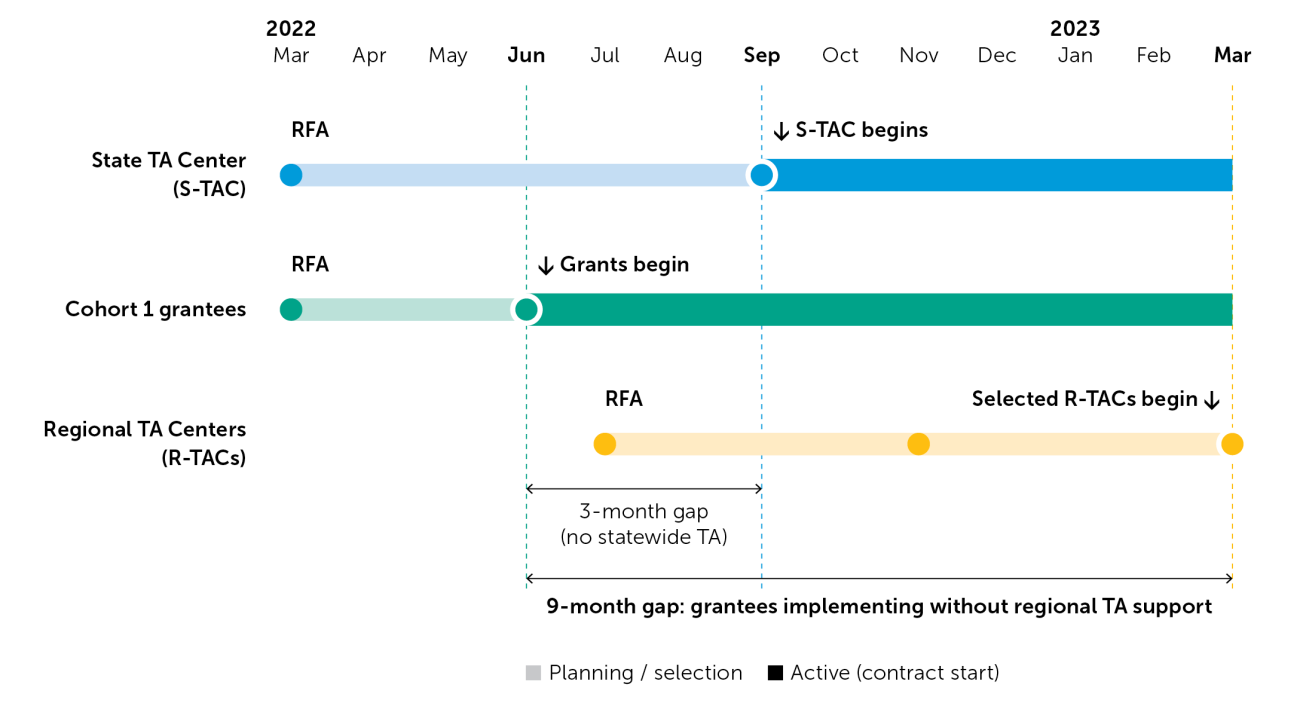
The sequencing issue at the launch of the program resulted in persistent role ambiguity. Instead of providing overarching leadership that would support consistent content and methodologies across R-TACs as well as statewide, the S-TAC found itself responding directly to grantees’ requests for guidance and support—the work that the R-TACs were legislatively tasked with doing. Furthermore, when the R-TAC LEA leads were eventually formally selected, their contracts with the state were intentionally broad to allow for flexibility to respond to regional priorities, but that breadth compounded rather than resolved ambiguity. One R-TAC leader described the situation during the first year of the contract:
We’re trying to figure out as an R-TAC … what do we create? And I think for a while, we were waiting for the S-TAC to do that, but it doesn’t seem like that’s gonna happen … that relationship has been super unclear. In terms of who’s doing what, who has what responsibility … it’s been a process of seeing how that shakes out.
Without this clarity of timing and roles or a shared roadmap, R-TACs and the S-TAC independently defined their own boundaries, responded in parallel to state directives, and fielded and responded to urgent support requests from LEAs, often without knowing what the other levels of the system were doing. The predictable consequences were a lack of alignment across support structures, duplication of efforts, and varying levels of usefulness: Eight regional centers independently developed tools (e.g., LEA needs and asset assessments) and resources (e.g., practitioner-facing implementation frameworks building off the overarching CCSPP framework’s “four pillars, four cornerstone commitments, four key conditions of learning and four proven practices”22) that could have been built once and shared to be adapted as needed. As one R-TAC interest holder put it: “If you’ve got eight R-TACs all developing their own implementation tools, that’s crazy. But also, if that’s what it means to be regionally based, we need a better platform to share with each other.” The result was a fragmented landscape of parallel tools and resources, with limited visibility across R-TACs into what was being developed elsewhere.
This role confusion was in no way a failure of intent. CDE had envisioned a highly collaborative, nested, and flexible system, and the actors within it worked in good faith under genuinely difficult conditions. But good faith is not the same as coordination: Distributing responsibility across levels without the proper groundwork and structure to make those roles clear to one another meant the implementation support infrastructure struggled to function as a coherent system.
Even with better sequencing, a deeper challenge would have remained: The infrastructure was never fully designed around a shared understanding of what it was coordinating towards or how implementation feedback would be used to inform and adapt implementation.
Balance Between State Guidance and Local Control
“Without vision, definition, or structure, the work at LEA level slides back to the status quo.”
The second challenge—the balance between state guidance and local control—sits at the philosophical heart of community schools work and proved just as difficult to resolve in CCSPP’s implementation.
Community schools work is locally driven by design. The California Community Schools Framework reflects a philosophy that meaningful school transformation requires genuine responsiveness to the specific assets, needs, goals, and priorities of each community. Flexibility is not a concession to local preference but rather a core implementation principle that sits comfortably within California’s broader decade-long shift away from centralized mandates towards local control. That shift has allowed districts to innovate and respond to their communities in ways that a more prescriptive system would not permit. But it has also created a highly uneven implementation landscape, with local models varying substantially in depth, coherence, and alignment with the state’s vision.
In the absence of explicit statewide guardrails, the resulting definitional variability across local contexts makes it exceedingly difficult to generate the cumulative knowledge or comparative evidence needed to bring transformational practices to scale. In practice, a “community school” in one district may mean comprehensive school and system transformation centered around whole child development; in another district, it may mean a colocated family resource center. That definitional variability is not merely semantic; it shapes what gets implemented, what gets measured, and ultimately, what the field is able to learn and sustain.
The California Community Schools Framework offered a coherent vision, but vision is not the same as an operational plan. Flexibility is only generative when it operates within shared guardrails for what quality implementation and success look like. In school-transformation scholarship, this is sometimes described as the distinction between what should be “tight”—consistent and nonnegotiable across contexts—and what should be “loose”—appropriately adaptive to local conditions.23 The governance responsibility of a state-level initiative is to make that distinction explicit: to specify which frameworks, structures, processes, and benchmarks hold the work together statewide and to protect the remaining space as the legitimate territory for local adaptation. Without that specification (e.g., clear guardrails around what’s tight), flexibility doesn’t enable local innovation. Instead, it produces ambiguity that the system will predictably fill with whatever is most familiar. Furthermore, without clarity about what must be consistent across communities, local flexibility can become a mechanism through which access, quality, and expectations vary according to local capacity, exacerbating inequality.
In a compliance-oriented public education infrastructure,24 reforms can become procedural rather than transformational. When the state does not clearly define what quality implementation looks like, schools and districts may respond by documenting activities rather than transforming practice. Pahlka and Greenway describe this as a “cascade of rigidity,”25 in which broad policy ideas become increasingly narrow and rule-bound as they move through layers of administration. For example, family engagement becomes a checklist of programs because it is genuinely difficult to define what meaningful, two-way relationships with families look like, which makes it difficult to measure and incentivize engagement, let alone scale it within the broader culture and systems of schooling.
That is largely what happened in CCSPP. The state’s emphasis on local flexibility, which was well aligned with community school values, also meant that the distinction between consistent statewide expectations and areas for local adaptation was not always made explicit. The nested technical assistance infrastructure had many hallmarks of structure: formal contracts, deliverables, and designated roles at each level. But structural features cannot be assumed to generate the organizational and relational infrastructure that a nested system requires—the role clarity, shared expectations, and accumulated trust across levels that allow people to coordinate effectively and, perhaps more critically, to surface and address what isn’t working. And those conditions cannot be contracted into existence. R-TACs, already navigating unclear role boundaries with state leads and local COEs and under pressure to begin supporting LEAs before those boundaries were resolved, were largely left to define quality community school implementation on their own.
Without statewide benchmarks, shared indicators, or an agreed-upon implementation rubric, that improvisation meant constantly shifting between supporting genuine transformation and helping LEAs fulfill reporting requirements without clear authority about which was supposed to take precedence. As one R-TAC team member described:
We’ve had to learn to be very flexible and responsive on different things that come down from the state, like how to be responsive and supportive when the [Annual Progress Report] comes out. And there’s tons of questions, but we’ve never really seen it before. And you’re having to learn something, ask all the questions you can and then provide a service to support folks doing it in a timely manner. It’s more just a learning experience, I think, for all of our teams, and how to do that in a way that is not duplicative.
Interviewees consistently expressed interest in more substantive structure, offering specific ideas about the kinds of guidance, expectations, and support that would strengthen implementation. Another R-TAC staff member articulated what a more practical and actionable implementation framework might look like:
I think of community schools through the national framework, where I feel like 80 percent of what happens can be consistent across all community schools. So there’s got to be some kind of a toolkit that is a step-by-step guide for that 80 percent. … I understand that that other 20 to 30 percent, you have to be able to do on your own. But there’s got to be something for that other 70 or 80 percent.
LEAs echoed a similar need for clearer signposts and guidance. As one district leader explained: “I need some kind of rubric or steps or a flowchart … something to tell me what to do next. Even if it’s different at each site.” And R-TAC partners observed the consequence of operating without this guidance: Without vision, definition, or structure, the work at LEA level slides back to the status quo.
What these perspectives share is not a desire for rigidity but for just enough specification to make local adaptation meaningful rather than arbitrary or haphazard. The absence of that specification reflects a state-level governance gap: determining which elements should be common statewide and developing the tools and benchmarks to make those elements consistent across LEAs. The conceptual architecture of CCSPP assumed that statewide specificity and local flexibility were possible but never resolved how to achieve both, and the S-TAC was not resourced or positioned to fill that gap. R-TACs could not fill it from the regional level either, and the overall result was a technical assistance infrastructure that reproduced—rather than resolved—the ambiguity it was built to navigate, leaving the harder work of changing ownership, culture, and practice at the school and district levels largely unnamed and unaccounted for.
That definitional ambiguity didn’t just shape how the technical assistance infrastructure operated; it was also reflected in the progress-monitoring tools the state built to track whether investments in community school development were yielding results.
Capacity: Navigating Progress Monitoring and Support
The third challenge, institutional capacity, appeared in the absence of a shared definition of success. This is not to say the state made no attempt. The S-TAC and R-TACs developed voluntary capacity-building rubrics intended to help sites gauge their progress and to align with existing reporting tools so as to minimize administrative burden and, in theory, connect reflection to accountability. But these efforts reflected an early iteration and reached a field that did not yet have a shared base of knowledge about how to use them well. Without sufficient time for the codevelopment, piloting, and broad practitioner input that build genuine, shared understanding and uptake, the rubrics were unevenly used and never cohered into an agreed-upon picture of what meaningful progress looks like. Without that clearer agreement about the goal and the markers of progress towards it, the ability to support implementation well, learn from efforts, and strengthen the initiative over time was constrained. This was less a failure of planning than a reflection of the field’s still-developing knowledge about how to define, measure, and support high-quality community school implementation.
The field-level knowledge base for what quality implementation of community schools actually looks like (e.g., what indicators signal meaningful progress, what leading measures predict long-term outcomes) is itself still being developed, drawing on growing practitioner expertise and evidence not only in California but nationally.26 Without sufficient definitional clarity about what constitutes the central, nonnegotiable aspects of a community school strategy, it is difficult to identify measures that are reliable across contexts. Even well-designed data collection efforts risk aggregating evidence from comprehensive whole child transformation models alongside sites where “community school” means something far more limited—and treating the resulting picture as coherent.
The California Community Schools Framework provides a definition and a set of values and practices, but a definition is not the same as a measurement framework. CCSPP was, in many respects, operating at the frontier of research that is still in progress. This is not a critique of the initiative’s ambition; it is a condition of the real-time evolution of the work. But it meant that the tools the state developed to identify and monitor progress were, from the outset, being asked to do something the field hadn’t yet fully agreed upon.
The state developed two tools intended to support implementation planning and track progress against those plans: an implementation plan template and the Annual Progress Report (APR). The implementation plan was intended to be a living document periodically reviewed and updated as the dynamic realities of community school development unfolded. The APR was designed to provide a snapshot of how implementation was happening on the ground, drawing on local data and self-reflection rather than top-down compliance metrics. Both tools reflected California’s stated commitment of avoiding prescription and centering local context.
Without agreed-upon indicators or quality markers to orient the APR, LEAs were asked to assess their own progress against standards they were also responsible for setting—a self-evaluation exercise that, without shared benchmarks, tends to confirm rather than interrogate existing practice. The open-ended and uneven nature of the reporting also limited its usefulness as a comparative measure. Because the APR relied on self-reporting, what one LEA understood as evidence of strong implementation might look quite different from another LEA’s interpretation of the same question, making cross-site comparison unreliable at the instrument level. And because implementation of community schools is itself supposed to reflect local context and priorities, it was never clear whether the APR was capturing the right things consistently enough across sites to yield a coherent statewide picture. This is the tight/loose problem applied to measurement: Without clarity about what should be consistent across all grantees and what should vary, the data collected varied in ways that made it difficult to learn at scale. What was designed as a space for honest reflection functioned instead as a compliance exercise not because the state mandated it, but because ambiguity in a system already primed for compliance tends to produce compliance.
For R-TACs, this created an untenable dual role: simultaneously supporting LEAs in genuine transformation work and helping them navigate reporting requirements without clear authority about which function took precedence or how to hold both in tension. This tension mirrors a structural dilemma that COEs face in their broader charge under the LCFF both to build districts’ capacity for continuous improvement and to review and approve their Local Control and Accountability Plans (LCAPs).27 When the same entity is asked to be both thought partner and compliance interpreter, trust becomes fragile, and the support relationship bends towards the safer, more easily documented function. In CCSPP, without statewide rubrics or shared progress markers to anchor R-TAC support, monitoring defaulted to outputs over outcomes, counting trainings held and meetings attended rather than tracking the deeper shifts in practice and culture that community schools aim to achieve.
This points less to a failure of the tools themselves than to a broader challenge: The system had not fully accounted for the dynamic, evolving nature of community school implementation at scale. In effect, CCSPP has been testing hypotheses about how to build capacity for community school transformation without having been explicitly designed as a learning system to support that work. The initiative has generated real and valuable data—through APRs, case studies, and longitudinal grantee reporting—about what implementation of community schools looks like across California. But those data have been collected without a clear mechanism to test the hypotheses embedded in the California Community Schools Framework, to account for how implementation varies across contexts, or to create the feedback loops that would allow evidence to shape practice in real time. The result is an evidence base that has grown substantially over 5 years without yet being fully interpretable to the system that produced it.
What CCSPP’s First Phase Reveals
The CCSPP experience, viewed through the lens of governance, surfaces a pattern that researchers have identified across California education policy: ambitious legislative intent, thoughtfully designed implementation architecture, and a gap between what the system was designed to do and what it was actually equipped to do. In CCSPP’s case, that gap appeared at every level. A nested capacity-building infrastructure that was conceptually sound was undercut by a rollout dictated by budget timelines rather than implementation readiness, leaving multiple parts of the system to improvise simultaneously. A philosophical commitment to local flexibility, while appropriate in principle, was not paired with clarity about what should be consistent statewide; in that vacuum, a system already oriented towards compliance defaulted to what it knew. And monitoring tools designed to promote reflection rather than compliance ended up producing compliance anyway, because reflection without shared benchmarks has nowhere to land. These are not three separate implementation problems. They are three expressions of the same underlying condition: an initiative designed with real ambition but without the governance infrastructure to translate that ambition into coherent, accountable practice at scale.
What 5 years of CCSPP has nonetheless produced should not be underestimated. There is a growing practitioner community with deepening expertise. There is a substantial—if still unevenly interpretable—body of evidence about what community school implementation looks like across California’s extraordinary diversity of contexts. There are R-TACs, COEs, and LEAs that have, despite difficult structural conditions, developed real knowledge about what works and what doesn’t. And there is, for the first time, a credible signal of long-term state commitment in the form of $1 billion in ongoing funds. The question the next phase poses is not whether California will continue to invest in community schools but whether it will strengthen the infrastructure to make that commitment count.
That question now has a structure attached to it. The trailer bill (AB 126) does not simply set a certification deadline; it funds a study, sequenced deliberately ahead of certification, to determine what features are actually associated with community schools’ progress before any standard is designed against them. This is the sequencing that was largely absent from CCSPP’s original launch, where the legitimate need to account for a massive public expenditure arrived before the knowledge and infrastructure required to do it well, and monitoring tools designed to promote reflection defaulted to compliance because reflection without shared benchmarks has nowhere to land. The legislature’s mandated scope for the study similarly reflects a corrective instinct, calling for a summary of the research on features associated with progress; identifying the key components that should be tracked and how they might be assessed at scale; streamlining reporting across overlapping requirements like the LCAPs, School Plans for Student Achievement, and Expanded Learning Opportunities Program plans; and recommending a long-term technical assistance structure embedded within the Statewide System of Support. The study has the potential to do precisely the definitional, measurement, and coordination work that the first phase had to improvise without.
Notably, the legislation does not confine this work to the existing infrastructure. It permits the analyses to be conducted by one or more institutions of higher education, which may in turn partner with a research-based nonprofit organization. The structure itself, in other words, invites the state to pair the institutional memory built over the first phase with outside analytical, practitioner, and community perspective. Whether that invitation is taken up is one of the central choices the next phase presents.
Priorities for the Next Phase
The legislation has put a sound structure in place. But as was learned from the first phase, a well-sequenced study can still fall short of its promise. Two risks are worth attending to.
The first concerns who does the work and how. Because the analyses can be housed within or close to the existing technical assistance infrastructure, there is a natural risk of confirmation bias, in which the study validates the frameworks and tools already in circulation rather than interrogating them, and the wide range of education interest-holders the statute calls for are engaged in the kind of cursory, after-the-fact way that drew criticism in the first phase. The statute’s own allowance for outside institutions and nonprofit research partners is the safeguard here, but only if it is used as an invitation for broader perspectives. Engagement that consists of soliciting reactions to near-final products is not the same as engagement that shapes what questions get asked and whose knowledge counts as evidence.
The second risk follows directly. The statute mandates engagement but does not define what adequate engagement requires, leaving “engage with a wide range of education interest-holders” to be satisfied by whatever is most convenient. This is exactly the dynamic this brief has documented: A requirement without specification will often be met in the most minimal way that satisfies it. If the state is serious about building the definitional clarity the first phase lacked, the entity conducting the study should be expected to codevelop and publish an explicit engagement plan—one that names who will be at the table, including anyone who may have been unintentionally disengaged during the first phase as well as newer voices whose work is increasingly central to community schools, such as behavioral health providers and collective-impact collaboratives; that describes who felt sidelined or disengaged during the first phase; that specifies how practitioner and community knowledge will actually inform the analysis, not just be collected alongside it; and that makes the process and its influence on the findings transparent and trackable. The credibility of whatever standards emerge depends on it.
The stakes for this study are not hypothetical. Georgia’s community schools certification pilot, launched before consensus-defined standards and a rubric were complete, was ultimately suspended.28 But California has given itself the time that Georgia did not take. Using this time well means acting across the full arc from study to pilot to statewide certification, along three interdependent lines, each addressing one of the governance challenges this brief has traced:
- Address accountability and alignment by clarifying the formal state-funded roles before standards are set. Before the certification process is designed, the state should revisit the roles and relationships across the S-TAC, the network of R-TACs, the COEs, and the districts with the benefit of 5 years of experience, making explicit what each level is uniquely responsible for rather than leaving those boundaries to be negotiated in real time. Clarifying the formal infrastructure is necessary but not sufficient. Beyond the state-funded structure lie significant capacity-building expertise and resources that community schools also depend on, held by nonprofit intermediaries, community-based organizations, and field-adjacent capacity builders that support schools and districts directly. Alignment must account for these partners too, defining not only who holds formal responsibility but also how the wider ecosystem of support providers connects to it. This is particularly urgent because certification design will require the same entities to hold both a capacity-building role and an evaluative one. The first phase demonstrated what happens when that dual role—and the conflict of interest tensions it carries—go unaddressed. The support relationship bends towards the safer, more easily documented function. Deciding deliberately who certifies, who supports, and how those functions relate is a design question that should be answered before standards are drafted, not discovered afterward.
- Address the balance between state guidance and local control by working as a field to define collectively what is tight and what is loose, with diverse practitioners shaping the answer. The study can inform what should be tight across all community schools and what should remain appropriately loose, not to constrain local innovation but to give practitioners a shared foundation to build from. This distinction matters especially in a state with a decade-long commitment to local control: The aim is not to recentralize unilaterally but to ensure that local adaptation is building towards something coherent and shared, rather than producing a landscape in which “community school” means something different in every district. Evidence from existing certification systems suggests that standards work best when they are lean and focused, capturing essential elements with clearly defined nonnegotiables and sufficient flexibility for different contexts, and when they are developed through a collaborative, consensus-building process with practitioners rather than handed down.29
- Build institutional capacity by treating the study as an inclusive knowledge-building process and the existing evidence as one asset of many. The study is an important instrument for this work, and its value depends on whether it is treated as genuine, inclusive knowledge building rather than a procedural step towards a predetermined design. The task is to identify what community schools actually mean across the range of contexts in which they are being implemented; to develop process and outcome measures that can travel reliably across those contexts; and to aggregate diverse practitioner expertise systematically into a valid, comparable evidence base. California has a valuable body of evidence to mine: 5 years of APRs, case studies, and longitudinal grantee reporting from thousands of schools. That accumulated evidence is currently underused, not for lack of a shared vision but for lack of a shared way to analyze it. The California Community Schools Framework gives the field a common implementation framework, describing what community schools should include and value, but that is a different instrument from an analytical framework that specifies how progress should be measured and compared across widely varying sites. Developing that analytical layer now, before certification standards are set, would convert a compliance byproduct into a robust empirical foundation for what gets certified and why. As that research foundation matures, it creates the conditions for more precise governance: clearer expectations about what strong implementation looks like; better targeted support for the schools, districts, and partners working to achieve it; and funding allocations grounded in what the evidence shows rather than what happens to be most easily counted.
What the adopted budget allows for in the next phase is not a solution but a genuine opportunity, thoughtfully sequenced and adequately funded. Whether it is taken up well depends on choices the legislation does not compel: who shapes the study, what questions it is designed to answer, and whose knowledge of community school practice is treated as authoritative. California has shown real willingness to invest in ambitious, equity-focused reform, but investment alone does not ensure effective implementation.
Ruiz, K., & Kimner, H. (2026, October). California’s community schools partnership program: From policy to practice—A governance case study in accountability, balance, and capacity [Policy brief]. Policy Analysis for California Education. https://edpolicyinca.org/publications/californias-community-schools-partnership-program-policy-practice
- 1
California Department of Education. (n.d.-a). California Department of Education (CDE) Elementary and Secondary School Emergency Relief (ESSER) fund 60-day report budget narrative. ed.gov/sites/ed/files/2020/09/California_ESSER-60-Day-SEA-Report-FINAL.pdf; Thornton, L. (2024, May 10). State provides $1.3 billion more for community schools. EdSource. edsource.org/updates/state-provides-1-3-billion-more-for-community-schools; Thurmond, T. (2021, October 14). Overview of the California Community Schools Partnership Program [Memorandum]. California Department of Education. cde.ca.gov/be/pn/im/infomemooct2021.asp
- 2
iag, M., & Castrechini, S. (2016). Coordinated strategies to help the whole child: Examining the contributions of full-service community schools. Journal of Education for Students Placed at Risk (JESPAR), 21(3), 157–173. doi.org/10.1080/10824669.2016.1172231; Daniel, J., Malone, H.-L. S., & Kirkland, D. E. (2023). A step closer to racial equity: Towards a culturally sustaining model for community schools. Urban Education, 58(9), 2058–2088. doi.org/10.1177/004208592095490; Daniel, J., Quartz, K. H., & Oakes, J. (2019). Teaching in community schools: Creating conditions for deeper learning. Review of Research in Education, 43(1), 453–480. doi.org/10.3102/0091732X188211; Dryfoos, J. (2005). Full-service community schools: A strategy—not a program. New Directions for Youth Development, 2005, 7–14. doi.org/10.1002/yd.124; Lewis, H. (2013). New York City public schools from Brownsville to Bloomberg: Community control and its legacy. Teachers College Press; Min, M., Anderson, J. A., & Chen, M. (2017). What do we know about full-service community schools? Integrative research review with NVivo. School Community Journal, 27(1), 29–54. adi.org/journal/2017ss/MinAndersonChenSpring2017.pdf; Oakes, J., Maier, A., & Daniel, J. (2017, June 5). Community schools: An evidence-based strategy for equitable school improvement [Brief]. National Education Policy Center and Learning Policy Institute. learningpolicyinstitute.org/product/community-schools-equitable-improvement-brief; Sanders, M. (2016). Leadership, partnerships, and organizational development: Exploring components of effectiveness in three full-service community schools. School Effectiveness and School Improvement, 27(2), 157–177. doi.org/10.1080/09243453.2015.1030432
- 3
Durazi, A., & Fensterstock, N. (2025). Shasta COE Community Connect: A community schooling local data use case [Brief]. UCLA Center for Community Schooling. communityschooling.gseis.ucla.edu/shasta-coe-community-connect-a-community-schooling-local-data-use-case; Germain, E., Hernández, L. E., Klevan, S., Levine, R., & Maier, A. (2024, August 26). Reducing chronic absenteeism: Lessons from community schools [Report]. Learning Policy Institute. doi.org/10.54300/510.597; Hernández, L. E., Swain, W., & Maier, A. (2026, May). California community schools: Past, present, and early impacts of the California Community Schools Partnership Program (Getting Down to Facts III). SCALE Initiative, Stanford Accelerator for Learning. gettingdowntofacts.com/reports/california-community-schools-past-present-and-early-impacts-california-community-schools; Kwon, A., & Fensterstock, N. (2025). AUHSD 5Cs: A community schooling local measure data use case [Brief]. UCLA Center for Community Schooling. communityschooling.gseis.ucla.edu/auhsd-5cs-a-community-schooling-local-measure-data-use-case; Sabat Bass, N., & Saunders, M. (2024). Annual Progress Report Findings: 2022–2023 [Report]. UCLA Center for Community Schooling. communityschooling.gseis.ucla.edu/annual-progress-report-findings-2022-2023; Saucedo, E. (2024, December). California’s community schools initiative: Progress and impact [Report]. California Budget & Policy Center. calbudgetcenter.org/resources/californias-community-schools-initiative-progress-and-impact; Swain, W., Leung-Gagné, M., Maier, A., & Rubinstein, C. (2025). Community schools impact on student outcomes: Evidence from California [Report]. Learning Policy Institute. doi.org/10.54300/541.498
- 4
Budget Act of 2026, Assemb. B. 109 (2025–2026), Chapter 19 (2026). leginfo.legislature.ca.gov/faces/billNavClient.xhtml?bill_id=202520260AB109
- 5
Education Finance: Education Omnibus Trailer Bill, Assemb. B. 126 (2025–2026), Chapter 65 (2026). leginfo.legislature.ca.gov/faces/billNavClient.xhtml?bill_id=202520260AB126
- 6
Myung, J., Hough, H. J., & Marsh, J. A. (2025, December). TK–12 education governance in California: Past, present, and future [Report]. Policy Analysis for California Education. edpolicyinca.org/publications/tk-12-education-governance-california
- 7
Loeb, S. (2026, May). Toward a stronger next generation of California education (Getting Down to Facts III Summary Report). SCALE Initiative, Stanford Accelerator for Learning. gettingdowntofacts.com/sites/default/files/Toward%20a%20Stronger%20Next%20Generation%20of%20California%20Education.pdf
- 8
California Department of Education. (n.d.-b). California Community Schools Partnership Program. cde.ca.gov/ci/gs/hs/ccspp.asp; California State Board of Education. (2022, January). California Community Schools Framework. drive.google.com/file/d/1jwnfcaxVVFaVoPdrvbTLaa0Ex0EQ5xZg/view; Los Angeles County Office of Education. (n.d.). California Community Schools Framework. lacoe.edu/services/student-support/community-schools-initiative/ca-community-schools-framework
- 9
Loeb, 2026; Myung et al., 2025.
- 10
California Community Schools Partnership Act, Cal. Education Code § 8902 (2021). leginfo.legislature.ca.gov/faces/codes_displayText.xhtml?lawCode=EDC&division=1.&title=1.&part=6.&chapter=6.&article=
- 11
California Department of Education. (n.d.-c). Request for applications—California Community Schools Partnership Program: Implementation Grant. cde.ca.gov/fg/fo/r17/ccsppimplementationrfa.asp
- 12
Lafortune, J., & Guinan, B. (2025, November). Financing California’s public schools [Fact sheet]. Public Policy Institute of California. ppic.org/publication/financing-californias-public-schools
- 13
Lafortune, J., & Prunty, E. (2023, December). Factors and future projections for K–12 declining enrollment [Report]. Public Policy Institute of California. ppic.org/publication/factors-and-future-projections-for-k-12-declining-enrollment; Warren, P., & Lafortune, J. (2020, February). Declining enrollment in California schools: Fiscal challenges and opportunities in the coming decade [Report]. Public Policy Institute of California. ppic.org/publication/declining-enrollment-in-california-schools-fiscal-challenges-and-opportunities-in-the-coming-decade
- 14
Randazzo, A., Moody, J., Marchitello, M., & Murphy, P. (2023, January). Pension debt challenges for equity in education: The effect of teacher pension debt costs on K–12 education funding in California [Report]. Equable and Opportunity Institute. pensionequityinedbudgets.com/_files/ugd/d438eb_cc0589e6665847f7ad39b459ecd1fcc3.pdf
- 15
Jochim, A., Diliberti, M. K., Schwartz, H., Destler, K., & Hill, P. (2023, January). Navigating political tensions over schooling: Findings from the fall 2022 American School District Panel survey [Report]. Center for Reinventing Public Education and Rand Corporation. crpe.org/asdp-2023-politics-brief
- 16
Legislative Analyst’s Office. (2022, April 5). Climate change impacts across California: K–12 education. lao.ca.gov/Publications/Report/4586; Miro, M. E., et al. (2022). Assessing risk to the national critical functions as a result of climate change [Report]. Homeland Security Operational Analysis Center. rand.org/content/dam/rand/pubs/research_reports/RRA1600/RRA1645-7/RAND_RRA1645-7.pdf; Preston, C. (2020, June 18). Coronavirus is the practice run for schools. But soon comes climate change. HuffPost. huffpost.com/entry/corona-climate-change-education_n_5ec71886c5b6698f38f4f0f8
- 17
Knight, D. S., et al. (2026). Educator retention in context: Understanding patterns in principal turnover in Texas and Washington State during the COVID-19 era. Educational Evaluation and Policy Analysis, 48(2), 803–812. doi.org/10.3102/01623737251367056; Schwartz, H. L., & Diliberti, M. K. (2023, July 12). Politics is the top reason superintendents are stressed: Selected findings from the Spring 2023 American School District Panel Survey (Report No. RR-A956-17). RAND Corporation. rand.org/pubs/research_reports/RRA956-17.html; White, R. S. (2023, May 15). School superintendent turnover is increasing and gender gaps are barely budging, but accurately assessing the consequences remains a challenge. The Conversation. theconversation.com/superintendent-turnover-is-increasing-and-gender-gaps-are-barely-budging-but-accurately-assessing-the-consequences-remains-a-challenge-200693; Zuckerman, S. J., Teahon, M., Surface, J. L., Mausbach, A. T., & Riley, K. M. (2023). Rural superintendent turnover in challenging times: A review of the literature. The Rural Educator, 44(1), 56–68. doi.org/10.55533/2643-9662.1341
- 18
California Department of Education, n.d.-b; California State Board of Education, 2022; Los Angeles County Office of Education, n.d.
- 19
Maier, A., Daniel, J., Oakes, J., & Lam, L. (2017, December 14). Community schools as an effective school improvement strategy: A review of the evidence [Report]. Learning Policy Institute. learningpolicyinstitute.org/product/community-schools-effective-school-improvement-report
- 20
Ripma, T., & Loeb, S. (2026, May). Who governs California’s schools? A cross-state map of supervision, administration, and implementation in CA, FL, NY, and TX (Getting Down to Facts III). SCALE Initiative, Stanford Accelerator for Learning. gettingdowntofacts.com/reports/who-governs-californias-schools-cross-state-map-supervision-administration-and
- 21
State Transformational Assistance Center for Community Schools. (n.d.). Regional Technical Assistance Centers. cadigitalcommons.org/home/about-us/the-r-tac
- 22
California Department of Education, n.d.-b; California State Board of Education, 2022; Los Angeles County Office of Education, n.d.
- 23
Fullan, M. (2007). The new meaning of educational change (4th ed.). Teachers College Press; Fullan, M. (2008). The six secrets of change: What the best leaders do to help their organizations survive and thrive (1st ed.). Jossey-Bass; Trask, S., & Cowie, B. (2022). Tight-loose: Understanding variability, trade-offs and felt accountability across the curriculum-pedagogy-assessment dynamic. The Curriculum Journal, 33, 587–601. doi.org/10.1002/curj.163; Wylie, E. C., et al. (2008, June). Tight but loose: Scaling up teacher professional development in diverse contexts (ETS Research Report Series No. RR-08-29). dx.doi.org/10.1002/j.2333-8504.2008.tb02115.x
- 24
Willis, J., & Loeb, S. (2026). The hidden, guiding hand of compliance in California public schools (Getting Down to Facts III). SCALE Initiative, Stanford Accelerator for Learning. gettingdowntofacts.com/reports/hidden-guiding-hand-compliance-california-public-schools
- 25
Pahlka, J., & Greenway, A. (2024, December). The how we need now: A capacity agenda for 2025 and beyond. Niskanen Center. niskanencenter.org/wp-content/uploads/2024/12/Niskanen-State-Capacity-Paper_-Jen-Pahlka-and-Andrew-Greenway-2.pdf
- 26
Learning Policy Institute. (n.d.). Community Schools Forward. learningpolicyinstitute.org/project/community-schools-forward
- 27
Trinidad, J. E., Klaus, K., Ito, A. B., & Yu, E. J. (2026, May). Re-envisioning California’s County Offices of Education (Getting Down to Facts III). SCALE Initiative, Stanford Accelerator for Learning. gettingdowntofacts.com/reports/re-envisioning-californias-county-offices-education
- 28
Germain, E., Maier, A., Espinoza, D., & Oakes, J. (2025). Community schools certification: An approach for implementation [Report]. Learning Policy Institute. doi.org/10.54300/220.412
- 29
See, for example, ConnectEd. (2010, February). Linked learning pathway certification criteria. College & Career Alliance Support Network, University of California, Berkeley. casn.berkeley.edu/resource_files/Linked_Learning_Certification.pdf; Germain et al., 2025.