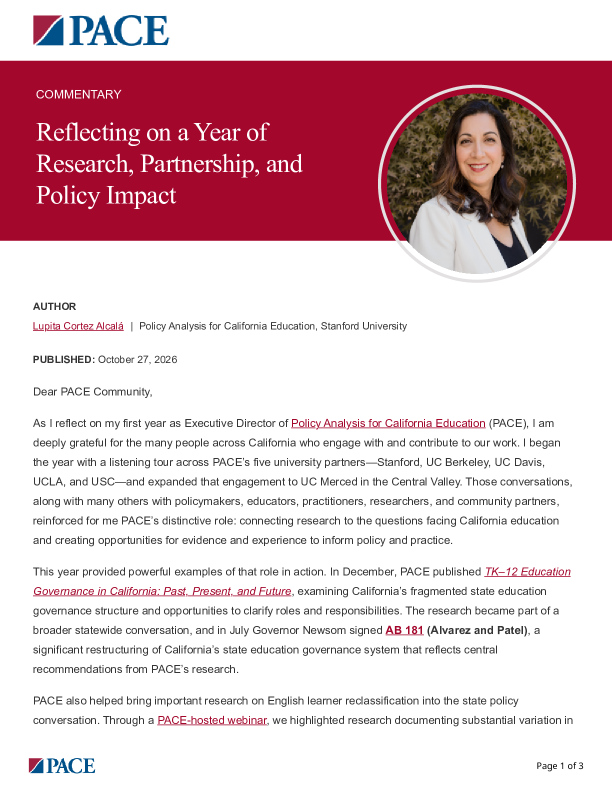
Commentary author
Publication Type
Commentary
Summary

In a reflection on her first year as PACE's Executive Director, Lupita Cortez Alcalá highlights the organization’s role in connecting rigorous research with California education policy. PACE's work helped inform two major legislative changes: AB 181, restructuring state education governance, and AB 2555, establishing more consistent and equitable English learner reclassification practices. Through its partnership with Stanford’s SCALE Initiative on Getting Down to Facts III, PACE also helped disseminate 55 technical reports and 22 policy briefs examining critical challenges facing California schools. Alongside research on literacy, mathematics, special education, and other priorities, PACE expanded opportunities for dialogue among researchers, policymakers, educators, and communities. Looking ahead to major leadership transitions and further governance reforms in 2027, Alcalá emphasizes PACE’s commitment to independent, nonpartisan research and collaborative, evidence-informed policymaking for improving opportunities and outcomes for California students.

California’s K–12 students struggled on the new statewide Smarter Balanced assessments (SBAC) last year. The results highlight the challenges facing students and teachers as the state shifts to computer-based tests on new curricula with higher standards for achievement. Disadvantaged groups...

October 22, 2015 | The Californian

California's 1.4 million English Learner children are often pigeon-holed and trapped for years in a school system that also impedes their academic progress and blocks their path to college. That’s the conclusion of a report released this week and published...