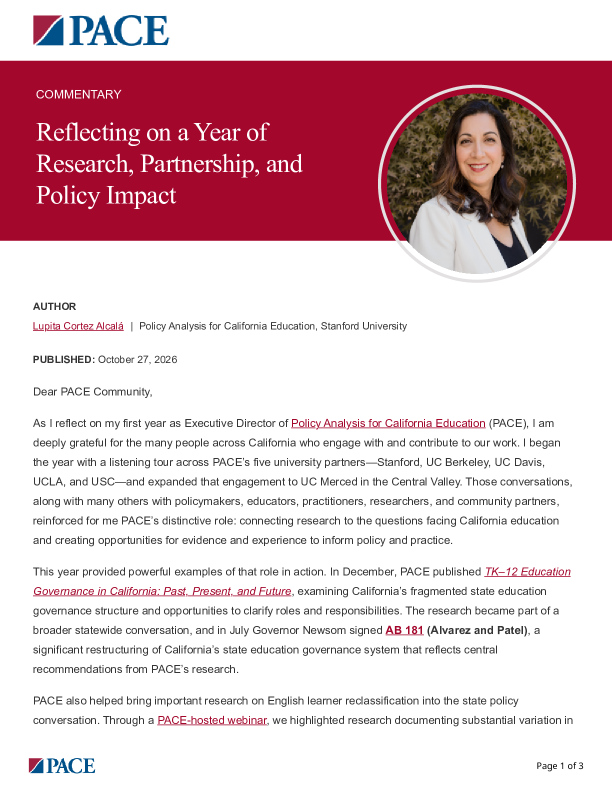
In a reflection on her first year as PACE's Executive Director, Lupita Cortez Alcalá highlights the organization’s role in connecting rigorous research with California education policy. PACE's work helped inform two major legislative changes: AB 181, restructuring state education governance, and AB 2555, establishing more consistent and equitable English learner reclassification practices. Through its partnership with Stanford’s SCALE Initiative on Getting Down to Facts III, PACE also helped disseminate 55 technical reports and 22 policy briefs examining critical challenges facing California schools. Alongside research on literacy, mathematics, special education, and other priorities, PACE expanded opportunities for dialogue among researchers, policymakers, educators, and communities. Looking ahead to major leadership transitions and further governance reforms in 2027, Alcalá emphasizes PACE’s commitment to independent, nonpartisan research and collaborative, evidence-informed policymaking for improving opportunities and outcomes for California students.
On May 7, 2026, the SCALE initiative at Stanford announced the release of Getting Down to Facts III, a trove of new research about California's education systems. It wasn't a surprise — this is the third time that Stanford has...
Key findings by UCLA Associate Professor of Education Lucrecia Santibañez on teachers’ language and cultural skills, emergent bilingual students, and educational outcomes impacted by family mobility will be showcased at the annual meeting of the American Educational Research Association (AERA)...
More than 20 years ago, Proposition 227 was passed in California, requiring that all public schools teach curriculum in English and providing only a year of special instruction to English learner students in the hope of quickly producing assimilated and...