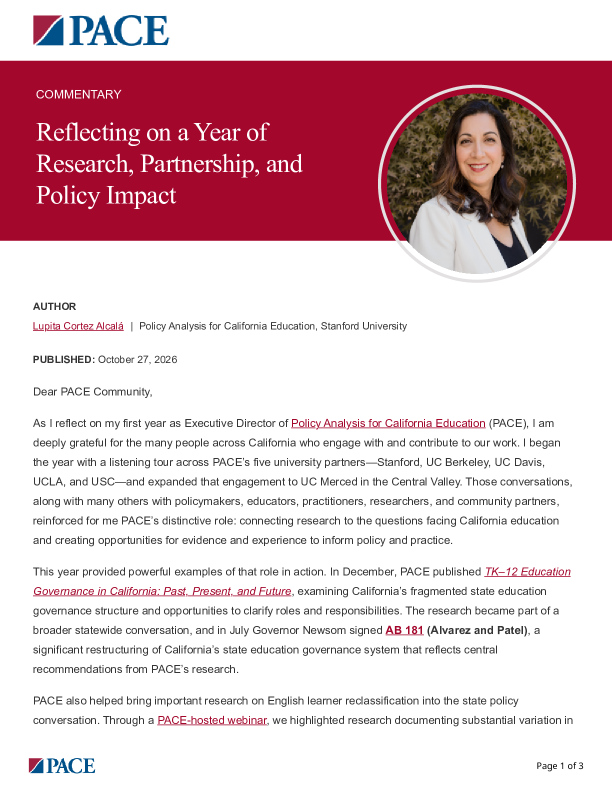
Commentary author
Publication Type
Commentary
Summary

In a reflection on her first year as PACE's Executive Director, Lupita Cortez Alcalá highlights the organization’s role in connecting rigorous research with California education policy. PACE's work helped inform two major legislative changes: AB 181, restructuring state education governance, and AB 2555, establishing more consistent and equitable English learner reclassification practices. Through its partnership with Stanford’s SCALE Initiative on Getting Down to Facts III, PACE also helped disseminate 55 technical reports and 22 policy briefs examining critical challenges facing California schools. Alongside research on literacy, mathematics, special education, and other priorities, PACE expanded opportunities for dialogue among researchers, policymakers, educators, and communities. Looking ahead to major leadership transitions and further governance reforms in 2027, Alcalá emphasizes PACE’s commitment to independent, nonpartisan research and collaborative, evidence-informed policymaking for improving opportunities and outcomes for California students.

July 13, 2026 | Los Angeles Times

https://www.latimes.com/california/newsletter/2026-07-13/chabria-monCalifornia and across the country has been somewhat distressing.  Along with claims that Americans are becoming illiterate, here in the Golden State there are worries that even the highest-achieving students aren’t prepared for our universities, and a study shows backsliding...

Summary

STANFORD, Calif. — California has enacted one of the most significant education governance reforms in state history, adopting legislation through the 2026–27 state budget that reflects three central recommendations from the Policy Analysis for California Education (PACE) report TK–12 Education Governance in California: Past, Present, and Future.

July 10, 2026 | LAist

Gov. Gavin Newsom has signed a bill that will vastly reshape the role of the state superintendent of public instruction, an elected position that currently oversees the California Department of Education.  Instead of leading the department, the new position will...

New Evidence From Los Angeles on Attendance, Reclassification, and the Path to Global California 2030
Publication Type
Commentary
Summary

Global California 2030 has the bold aim of expanding multilingual education statewide. New evidence from a Los Angeles Unified School District study shows that dual language immersion (DLI) has positive outcomes for English learner students. DLI students attend school more often than comparable peers in English-only classrooms and reclassify as English proficient at similar rates. These findings can address parental concerns that DLI may delay English development and can boost enrollment in DLI programs. This new PACE commentary calls for California to make DLI central to strategies for supporting multilingual learners through strategic investment in expanding access, strengthening data systems and bilingual teacher pipelines, and communicating with families about positive outcomes.