Evidence on Learning Loss From the CORE Data Collaborative
Publication Type
Commentary
Summary

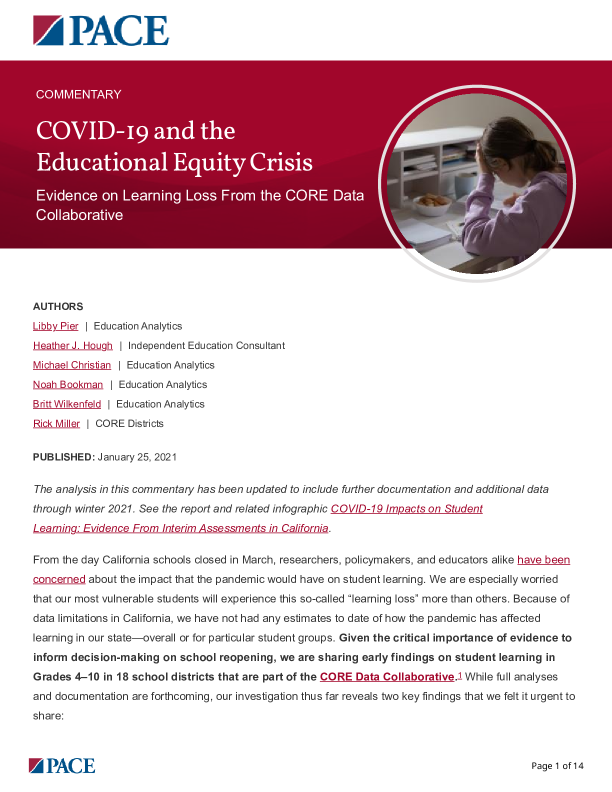
The impact of the pandemic on California students' learning, gauged from 18 school districts in the CORE Data Collaborative, highlights significant learning loss in English Language Arts (ELA) and Math, primarily affecting younger grades. The equity gap is pronounced, notably among low-income students and English language learners (ELLs), experiencing more substantial setbacks than their counterparts. Socioeconomically disadvantaged students faced slower growth, while others accelerated their learning, intensifying existing achievement disparities. Upper-grade ELLs encountered severe setbacks due to challenges in virtual language development. These findings underscore the urgent need for targeted support to redress these disparities, emphasizing the gravity of unequal experiences during the pandemic. Yet, data limitations call for deeper investigations into absent student groups to refine learning loss estimates. Addressing this crisis necessitates a student-centric approach, prioritizing social-emotional well-being and systemic educational reforms to accommodate diverse student needs.

Commentary author
Publication Type
Commentary
Summary

In response to the COVID-19 crisis, PACE Executive Director Heather Hough offers an approach involving multiple phases, transitioning from immediate action to re-entry and eventual recovery. The closure of schools due to the pandemic is expected to result in substantial learning loss, especially among disadvantaged students, necessitating a comprehensive assessment of their academic and emotional needs upon their return to school. This crisis has highlighted disparities in distance learning and accentuated existing inequalities, making it imperative to address diverse impacts and support students effectively. To address these challenges, proposing a state-level diagnostic assessment using existing resources like SBAC emerges as a unified and cost-effective means to identify learning gaps and guide resource allocation. The upcoming school term brings uncertainty, demanding clear guidelines, adaptability, and adequate resources for schools to embrace novel learning models. Immediate measures include safeguarding education funding, urging federal support, and targeting assistance for vulnerable students. Additionally, there is an opportunity to overhaul California's funding system to better reflect the critical importance of public education. This commentary is modified from testimony delivered to the California Assembly Budget Committee on April 28, 2020.

October 28, 2019 | Ed100

Each spring, California public school children in grades 3-8 and 11 take a set of tests known as the CAASPP (the California Assessment of Student Performance and Progress). In summer, families receive the results electronically. In autumn, schools and districts...

August 19, 2019 | Mendocino Voice

Every year, California schools are evaluated on a variety of measures, everything from students’ math and English skills to suspension rates and chronic absenteeism. When things don’t go well, school districts scramble to put new programs in place that will...

June 3, 2019 | InsideSEL.com

Transforming Education and Policy Analysis for California Education partnered to analyze data from over 500,000 students across 8 districts in California. This brief provides benchmarking data that is designed to allow practitioners to compare their aggregated data across grade levels...

Spotlight on Chronic Absenteeism Toolkit
Commentary author
Publication Type
Commentary
Summary

PACE research is prominently featured in the repository on chronic absenteeism established by the California Collaborative for Educational Excellence (CCEE). The collaborative serves as a valuable resource hub, offering toolkits, materials, and various other assets related to chronic absenteeism in educational settings. PACE's contribution to this repository includes two research briefs focusing on chronic absenteeism. The first brief involves PACE's in-depth analysis of student chronic absenteeism data from the CORE Districts, exploring the utilization of chronic absence metrics within a multi-metric accountability system. The second brief delves into the chronic absence performance levels of California's districts, schools, and student groups, utilizing recently released data from California's School Dashboard. This brief also investigates the pivotal role played by chronic absence in determining differentiated assistance, providing insights into the impact on school performance. Together, these research briefs offer valuable perspectives and data-driven insights into addressing and understanding chronic absenteeism in the context of California's educational landscape.