Summary

STANFORD, Calif. — California has enacted one of the most significant education governance reforms in state history, adopting legislation through the 2026–27 state budget that reflects three central recommendations from the Policy Analysis for California Education (PACE) report TK–12 Education Governance in California: Past, Present, and Future.

July 10, 2026 | LAist

Gov. Gavin Newsom has signed a bill that will vastly reshape the role of the state superintendent of public instruction, an elected position that currently oversees the California Department of Education.  Instead of leading the department, the new position will...

New Evidence From Los Angeles on Attendance, Reclassification, and the Path to Global California 2030
Publication Type
Commentary
Summary

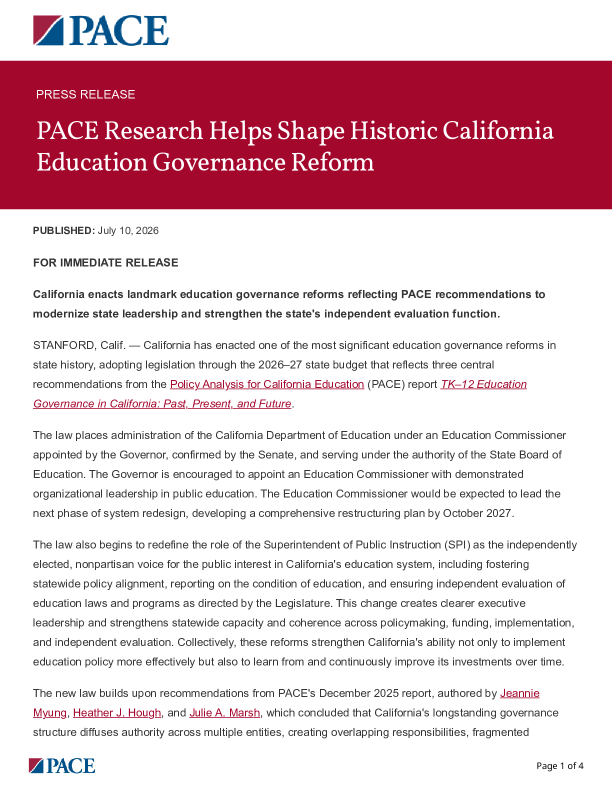
Global California 2030 has the bold aim of expanding multilingual education statewide. New evidence from a Los Angeles Unified School District study shows that dual language immersion (DLI) has positive outcomes for English learner students. DLI students attend school more often than comparable peers in English-only classrooms and reclassify as English proficient at similar rates. These findings can address parental concerns that DLI may delay English development and can boost enrollment in DLI programs. This new PACE commentary calls for California to make DLI central to strategies for supporting multilingual learners through strategic investment in expanding access, strengthening data systems and bilingual teacher pipelines, and communicating with families about positive outcomes.
June 30, 2026 | EdSource

In his eighth and final budget, the tax gods continued to smile upon Gov. Gavin Newsom, enabling him to cement funding for signature programs he started while salving grumbling districts that are wincing over the financial impacts of declining enrollment...

Commentary author
Publication Type
Commentary
Summary

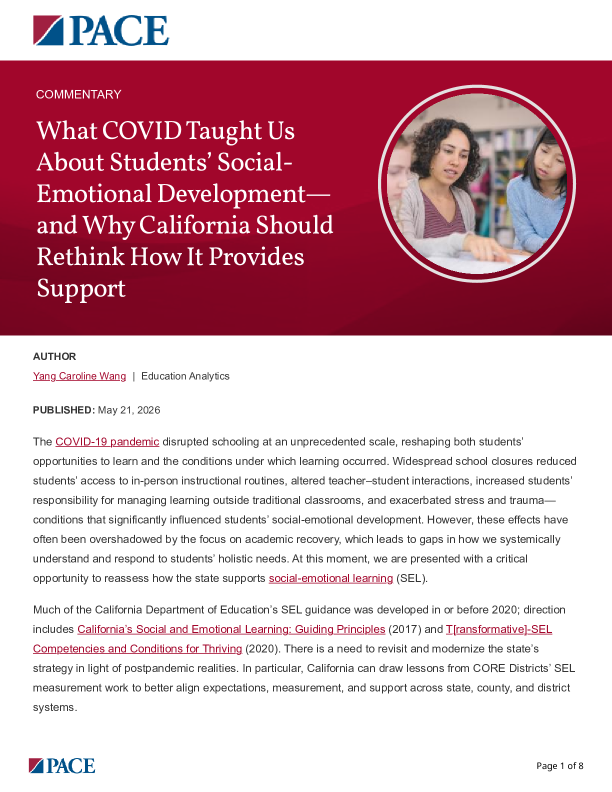
The COVID-19 pandemic disrupted schooling at an unprecedented scale. Widespread school closures reduced students’ access to in-person instructional routines, altered teacher–student interactions, increased students’ responsibility for managing their learning, and exacerbated stress and trauma—conditions that significantly influenced students’ social-emotional development. This commentary offers findings from CORE Districts’ large-scale longitudinal social-emotional learning (SEL) data. Students’ social-emotional competencies followed complicated developmental patterns rather than increasing steadily over time. The pandemic shifted many of those trajectories downward, especially for younger students—and students’ prepandemic competencies predicted the level of academic disruption they experienced. This disruption included changes in attendance, linking California’s high rates (20 percent) of chronic absenteeism—students missing 10 percent or more of the school year—to social-emotional competencies. Author Yang Caroline Wang suggests six considerations for California policymakers, including: prioritize the elementary-to-middle school transition; integrate SEL into core academic strategies; leverage the connection between attendance and SEL; and start longitudinal monitoring.