As schools grapple with declining enrollment and budget deficits, the only solution for many leaders is to consider closing schools. Here’s how leaders are handling those conversations. Hundreds of concerned family members recently entered Fort Worth ISD’s O.D. Wyatt High...
On February 10, as part of its mission to “maximize government efficiency,” the Trump administration announced its cancellation of roughly $1 billion in federal contracts for education research. These contracts were held under the Institute of Education Sciences (IES)—the research...
From private school vouchers to threats over “woke” curriculum, the Trump administration has launched a slew of reforms intended to reshape K–12 schools. But it’s still too soon to determine how—or if—those efforts will play out in California...
The SCALE Initiative is using text-based tutoring and research-driven insights to address key educational challenges, with generative AI as the next frontier. The next project for the SCALE Initiative is generative AI. Professor Susanna Loeb and her team, with input...
When I became president of the California State Board of Education in 1975 for the first of two stints in this role (1975–82), three different offices created state curriculum frameworks, instructional materials and assessments, without much coordination or integration. In...
California school districts would receive $2.5 billion through a small cost-of-living increase, plus additional funding to train math and reading coaches, expand summer and after-school programs, and help launch the state’s Master Plan for Career Education in the proposed 2025-26...
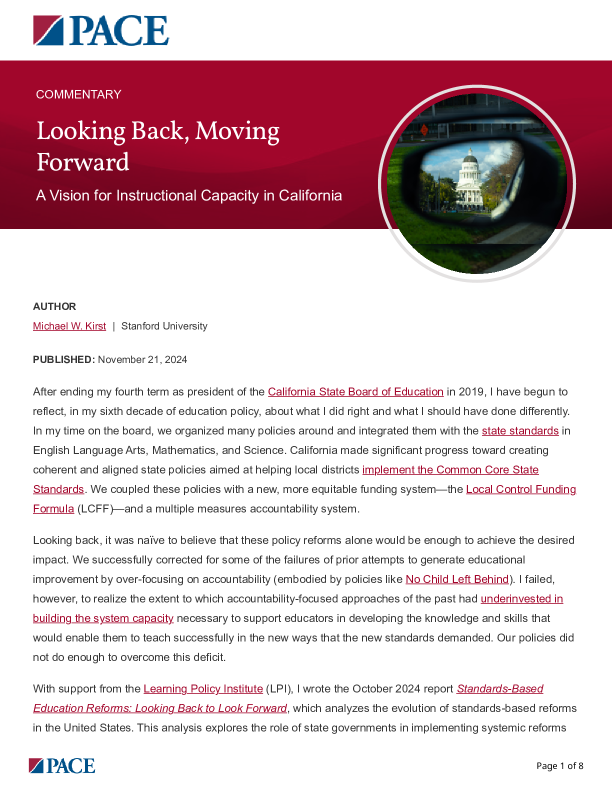
After ending my fourth term as president of the California State Board of Education in 2019, I have begun to reflect, in my sixth decade of education policy, about what I did right and what I should have done differently...
While an essential and very important part of USC Rossier’s mission is to prepare the next generation of education practitioners, leaders and scholars, we do so much more. Unlike many other academic schools or departments, a school of education is...
PACE co-founder Michael W. Kirst, former president of the California Board of Education (1977–1981 and 2011–2019), highlights in a new PACE commentary findings from his Learning Policy Institute report Standards-Based Education Reforms: Looking Back to Looking Forward, which analyzes the evolution of standards-based reforms in the United States. Kirst issues a call to action: California needs a strategic and tactical roadmap to improve instructional capacity in classrooms statewide. The commentary offers four recommendations: return the CDE to its former role of providing technical assistance on how to implement subject matter standards; strengthen COEs for effective capacity building; reorient the district role to focus on instructional capacity; and design the roadmap for targeted district support. Without a unified strategy, California risks more uneven progress. A comprehensive, coordinated approach is essential to equipping educators with the tools they need to deliver equitable, standards-aligned instruction to all students.
The re-election of former President Donald Trump is certain to bring a period of conflict,tension and litigation between his White House and California’s political and education leaders whose policies and values the president-elect castigates. It also could potentially have major...
Oakland mom Azlinah Tambu vividly remembers the moment that would transform her from the law-abiding, neighborhood school mom into a trespassing activist threatened with jail time. For months, Tambu, whose two children were then in elementary school, and others had...
San Francisco must do everything it can to avert a state takeover of its schools. That’s the stark message brought by Carl A. Cohn, the only outside educator to be brought in to help the team of city administrators set...
As the San Francisco Unified School District deliberates over a tentative list of school closures, it will have to account for the fact that the district’s enrollment has declined for several years—and could fall much further. But San Francisco’s public...
Falling enrollments and gloomy economics point to the inevitable: Many school districts in California will close schools over the next decade. So far, they have been mainly elementary and middle schools, but high schools, spared until now, won’t escape, a...
The wealth gap in California is wider than in most other states, and studies show that providing financial literacy education in school can result in a higher rate of fiscally responsible actions, including avoiding high risk loans, beginning a retirement...
California high school students may have an additional course added to the eight that are needed to graduate. These courses, such as the ethnic studies requirement passed in 2021, all entered the school curriculum at the direction of the State...
A conversation with Michelle D. Young, Dean of the Berkeley School of Education. Dean Young discusses the significance of leadership development and effective learning experiences for school leaders, particularly emphasizing the need for equity-oriented and culturally responsive leadership. Highlighting the...
No one wants to close schools. Not the communities that cherish their local school. Not the school boards that want to serve the needs of all their students. Not administrators and school district personnel who have to wade through the...
California is synonymous with innovation. Over decades and across sectors, California has been a leader—from tech start-ups to agricultural advances and environmental solutions. In the private sector, companies race to market with their ideas in order to capitalize on ingenuity.California...
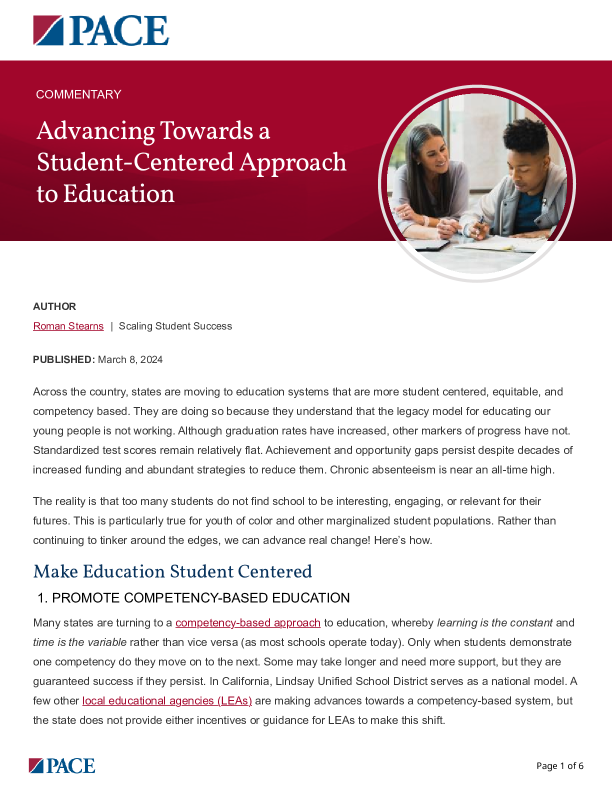
Across the country, states are moving to education systems that are more student centered, equitable, and competency based. They are doing so because they understand that the legacy model for educating our young people is not working. Although graduation rates have increased, other markers of progress have not. Standardized test scores remain relatively flat. Achievement and opportunity gaps persist despite decades of increased funding and abundant strategies to reduce them. Chronic absenteeism is near an all-time high. The reality is that too many students do not find school to be interesting, engaging, or relevant for their futures. This is particularly true for youth of color and other marginalized student populations. Rather than continuing to tinker around the edges, we can advance real change! Here’s how.
Closing or consolidating neighborhood schools is a painful decision that no school district or community ever wishes to face, but increasingly it may be on the table due to declining enrollment trends and budgetary pressures. In this episode, host Jason...
Preparation for college and a career is important to economic prosperity. How college and career readiness in schools is defined varies across the state. The College/Career Indicator, adopted by the State Board of Education, integrates eight pathways that demonstrate a...
While the vast majority of students in California—86% of seniors in 2023—graduate from high school, most—56% in 2023—do not complete their A-G requirements, according to an EdSource analysis of data from the California Department of Education. EdSource’s analysis found that...
A Hayward elementary school struggling to boost low test scores and dismal student attendance is spending $250,000 in federal money for an organization called Woke Kindergarten to train teachers to confront white supremacy, disrupt racism and oppression and remove those...
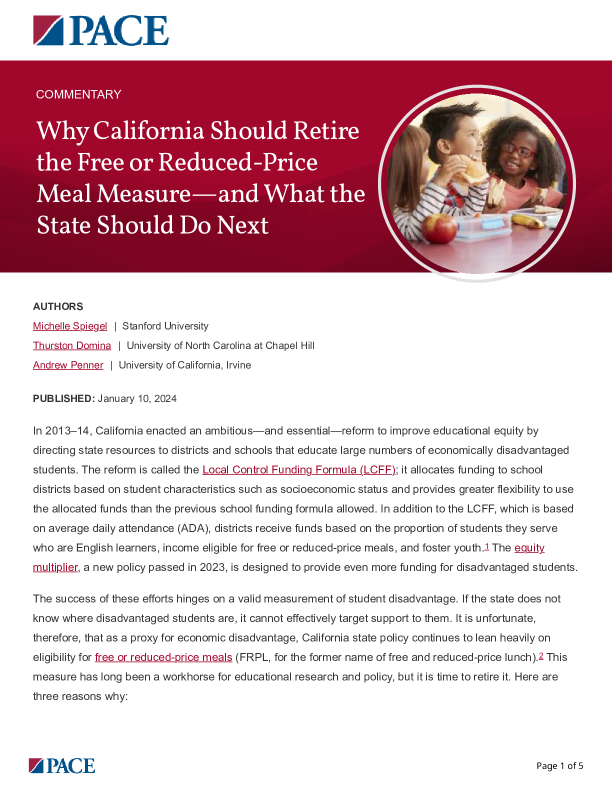
In 2013–14, California enacted an ambitious—and essential—reform to improve educational equity by directing state resources to districts and schools that educate large numbers of economically disadvantaged students. The reform is called the Local Control Funding Formula (LCFF); it allocates funding to school districts based on student characteristics such as socioeconomic status and provides greater flexibility to use the allocated funds than the previous school funding formula allowed. In addition to the LCFF, which is based on average daily attendance (ADA), districts receive funds based on the proportion of students they serve who are English learners, income eligible for free or reduced-price meals, and foster youth. The equity multiplier, a new policy passed in 2023, is designed to provide even more funding for disadvantaged students.