Dual Language Immersion Delivers for California’s English Learners



The Global California 2030 initiative sets an ambitious goal for multilingual education in the state: Half of all K–12 students will be enrolled in programs that develop proficiency in two or more languages by 2030, and 75 percent by 2040. Meeting this goal depends on convincing families—especially families of students designated as English learners (ELs)—that dual language immersion (DLI) will serve their children well. A new study of more than one million student records from Los Angeles Unified School District (LAUSD), the nation’s second-largest school district, offers strong evidence that it does. DLI students attend school at substantially higher rates than comparable peers (about 12 days more on average), and EL-designated students in DLI reclassify as English proficient at the same rates as EL-designated students in English-only classrooms by the end of elementary school—all while maintaining and developing their heritage or second language. For a state grappling with postpandemic absenteeism and a significant population of multilingual learners, these findings point towards DLI as a high-leverage equity strategy—if California invests in the infrastructure to scale it well.
Why This Matters for California Now
Two crises in California education worsened after the COVID-19 pandemic. Chronic absence among EL-designated students, historically not a major concern in California, spiked during COVID-19 and has not fully recovered. At the same time, a significant proportion of California’s EL-designated students have remained classified for 6 years or more (i.e., they have not moved from “English learner” to “fluent English proficient” designation), which means they are likely to be tracked into less rigorous coursework and have diminished academic opportunities in school.
California has a policy answer in motion. Global California 2030, the state’s commitment to multilingual education, envisions a dramatic expansion of DLI: a model in which EL and English-speaking students learn grade-level curriculum in both English and a partner language. Proposition 58, passed in 2016, cleared the way by reversing the state’s 2-decade restriction on bilingual education. LAUSD has responded aggressively, expanding from just a few dozen DLI programs a decade ago to more than 180 today.
But expansion depends on enrollment, and enrollment depends on parents. Recent survey data from parents found that, although they see bilingualism as a benefit for their children and support DLI schooling, many Latinx parents in California, particularly lower income parents, worry that learning in two languages will slow their children’s English-language development. If the state is going to meet its 2030 goal, it needs rigorous evidence, in California contexts and scale, to answer that concern directly.
Additionally, California public schools are facing steep enrollment declines because of decreases in the birth rate and immigration. These ongoing declines are extensive enough in many districts to create fiscal instability, leading to reductions in programs and teacher layoffs, all of which could negatively affect student outcomes. DLI programs have been found to help protect against declining enrollment. LAUSD, the setting for our study, has been particularly hard hit, losing more than 150,000 students over the last 2 decades; projections show an additional 30 percent decline in the coming decade. While enrollment declines have been widespread across LAUSD, schools offering DLI programs have proven considerably more resistant to these trends than their non-DLI counterparts (Figure 1).
Figure 1. Enrollment Growth in Elementary Schools With and Without DLI Programs, 2016–22
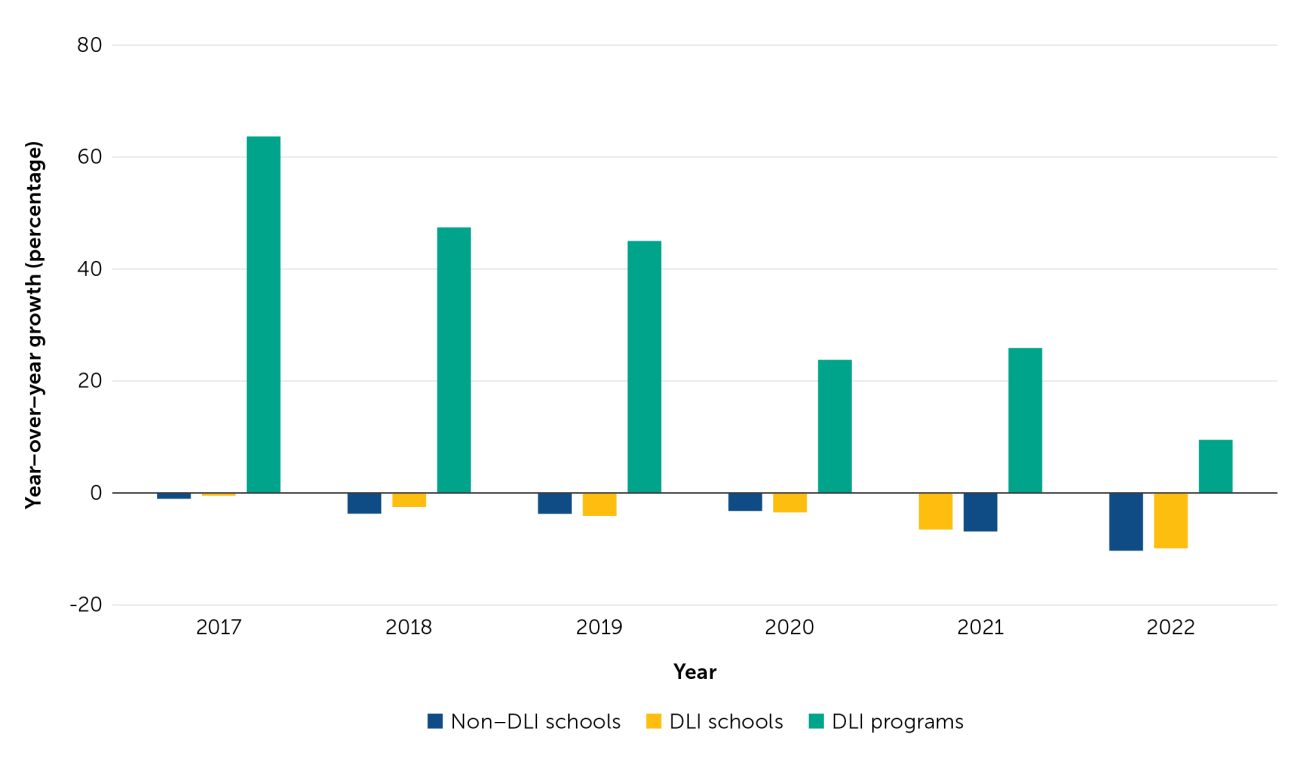
Note. Elementary schools only. DLI = dual language immersion. “DLI schools” bars show the decline in total enrollment in schools with a DLI program. “DLI programs” bars represent growth in DLI program enrollment within DLI schools.
What the Evidence Shows
Our research team used restricted student-level data from LAUSD spanning 2015 through 2022 to examine DLI’s effects on three outcomes that are critically important right now: enrollment retention, attendance, and reclassification. The study covers more than one million student-year observations across 138 elementary DLI programs—most of them offering Spanish as the partner language, with several programs offering Korean, Mandarin, and other languages as well. LAUSD is a majority Latinx district and one of the districts with the highest proportion of EL-classified students in the nation. Almost 40 percent of kindergartners in the district are EL designated; students speak more than 80 different languages. Close to one half of all students enrolled in DLI programs are classified as ELs. Because nearly every DLI program in LAUSD operates as a strand within a traditional neighborhood school, we were able to compare DLI and non-DLI students within the same schools, a comparison that accounts for school-level factors that confound simpler analyses. We also compared students from within the same attendance zones, which accounts for the family motivation associated with traveling out of zone to access DLI.
DLI students attend school significantly more. Students enrolled in DLI at kindergarten entry have substantially higher attendance than matched peers in English-only classrooms in the same schools (Figure 2), about 12 additional days of instruction each year (on average, students in this sample attend 150 days of the school year). The effect holds for every student subgroup we examined, including low-income EL students—the group for whom postpandemic attendance has been most fragile. The result is robust when we limit the sample to families living inside the school’s attendance zone, and it holds when we exclude pandemic-era cohorts entirely. It is worth noting that the period under analysis includes the pandemic years (2020–21 and 2021–22) when many schools in the district taught via online or hybrid models. That should not affect these differences, however, because DLI and non-DLI schools would have been similarly affected by district policy around school closures and remote instruction.
Figure 2. Predicted Marginal Estimates for DLI Program Enrollment Effects on Attendance
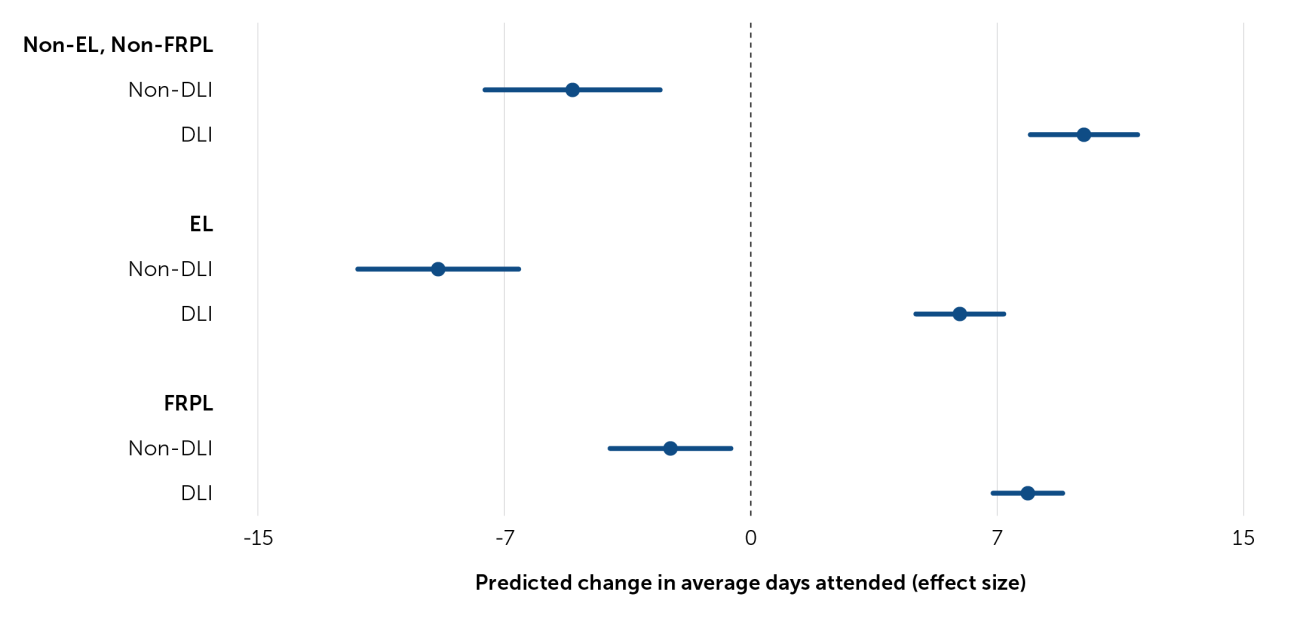
Note. EL = English learner; FRPL = free or reduced-price lunch; DLI = dual language immersion. Estimates shown are for predicted marginal effects of the attendance coefficient by student subgroup after running a doubly robust outcome regression on standardized attendance. Ninety-five percent confidence intervals are shown around predicted marginal estimates. Attendance is standardized by grade and year.
DLI does not impede reclassification. EL students in DLI programs have modestly lower reclassification rates in kindergarten through second grade—which makes sense because many DLI programs front-load partner-language instruction (80 or 90 percent partner language) during the early grades. But by third grade, reclassification rates for DLI students are statistically indistinguishable from ELs in English-only classrooms. By the end of elementary school, ELs in DLI reclassify at the same rates as their non-DLI peers, regardless of income status or whether their home language matches the program’s partner language. This directly answers the concern many parents raise: Their children are not being held back from English proficiency. They are acquiring English at the same pace as peers in English-only classrooms while also developing a second language or maintaining their heritage language.
The benefits hold at scale. Prior research on the benefits of DLI comes from programs that operated in only a handful of schools. Those settings leave open the question of whether DLI’s benefits persist when programs scale rapidly and reach tens of thousands of students. Our results suggest they do. During the period covered by our study, LAUSD went from having a few dozen DLI programs to more than a hundred. That matters because evaluation research consistently finds that promising small-scale programs often lose their effects when they scale, but DLI scaled rapidly and successfully in LAUSD.
Why DLI May Work This Way
The attendance finding is the most novel contribution of the study—no prior rigorous research on DLI has examined attendance as an outcome. There are two mechanisms by which DLI could improve attendance. DLI instruction centers students’ home languages and cultures as assets rather than deficits, making school feel like a place designed for immigrant-origin students rather than one they must adapt to. Most DLI teachers are bilingual themselves, which lowers the language barrier between school staff and families. This could result in higher family engagement, a well-established predictor of student attendance. For families navigating the compounding postpandemic stressors of housing insecurity, economic precarity, and—more recently—heightened immigration enforcement, a school environment that actively includes them may be a meaningful protective factor.
The reclassification finding is consistent with decades of research on language transfer: Skills developed in a student’s home language transfer to second-language acquisition, which is why front-loading partner-language instruction in the early grades does not ultimately slow English development. Students catch up, and by upper elementary, they have proficiency in two languages instead of one.
Recommendations for California
Make DLI Central to Long-Term EL Prevention Strategies
The combination of higher attendance and on-pace English reclassification makes a compelling case for positioning DLI as an explicit component of districts’ strategies to support multilingual learners. California’s Local Control and Accountability Plan (LCAP) framework and the English Learner Roadmap both call for asset-based approaches to EL education; DLI is the clearest operational expression of that principle. The State Board of Education, County Offices of Education, and district LCAP guidance should name DLI as a recommended long-term EL prevention strategy.
Fund Expansion Through Stable, Formula-Based Mechanisms
California previously offered DLI grants on a competitive basis, but the program was discontinued in 2022. Texas and several other states have moved towards dedicated, formula-based funding streams that give districts multiyear predictability for DLI program development. California should follow that model. Competitive grants advantage districts with grant-writing capacity; formula funding reaches the districts where most EL students actually are. The legislature should reinstate and expand ongoing DLI-specific funding as part of its Global California 2030 implementation.
Invest in the Bilingual Teacher Pipeline
DLI at scale requires bilingual teachers at scale, and California’s teacher pipeline is not yet built for the expansion the state has committed to. The Commission on Teacher Credentialing should continue to expand alternative pathways into bilingual authorization, including grow-your-own programs, bilingual teacher residencies, and streamlined credentialing for internationally trained teachers. The Golden State Teacher Grant and bilingual teacher recruitment incentives should be sustained and specifically targeted at partner-language shortage areas and areas of the state that wish to expand DLI programs but do not have ready access to programs that prepare bilingual teachers.
Expand Access for Low-Income EL Students
Most of the growth of DLI in LAUSD has occurred in areas of the city with high proportions of Latinx residents. Although close to one half of DLI enrollment in the district is composed of EL-designated students, only about 10 percent of all of LAUSD’s EL-designated elementary students are currently enrolled in DLI, suggesting substantial room for expansion. Our findings show that low-income EL-classified students benefit from DLI at rates comparable to their more advantaged peers. Districts should grow or maintain their commitment to EL-classified students by continuing to sustain DLI programs in culturally and linguistically diverse communities. This can be done through outreach in home languages, better communication with families, and enrollment processes that do not disadvantage families who may have difficulty navigating district choice.
Build the Data Infrastructure
California only recently began tracking DLI enrollment systematically in administrative data. Reclassification, program enrollment, and linguistic outcome data for DLI students are not available to researchers, districts, or the public in any consistent form. The California Department of Education should prioritize building longitudinal data capacity that follows all students through DLI programs from kindergarten through secondary school. This system should allow for disaggregation by EL designation and other student subgroups and should track the bilingual teacher workforce with comparable rigor. Without this infrastructure, the state cannot evaluate whether Global California 2030 is being implemented.
Provide Families With Clear, Evidence-Based Information About DLI Outcomes
District leaders and principals should communicate a clear, evidence-based message to multilingual families that although reclassification rates for DLI students may be slightly lower in the early grades, by the end of elementary school, students reclassify at the same rate as peers in English-only classrooms—while developing a second language or maintaining their heritage language. Because parental concern about English delay is one of the most cited barriers to DLI enrollment, transparent and evidence-based communication in families’ home languages is essential to building trust and supporting informed decisions.
Conclusion
California has set a bold goal for multilingual education, and the evidence from its largest urban district validates that strategy. DLI improves attendance for all students, including the low-income EL students whose school engagement was most disrupted by the pandemic. It does not delay English acquisition for EL students, and it can scale without losing its benefits. Future research should continue to study these programs, including their effects on outcomes such as academic achievement, high school graduation rates, and long-term educational attainment.
For a state confronting a postpandemic attendance crisis and a growing population of long-term ELs, these findings suggest that DLI could be a promising strategy for addressing both challenges simultaneously while developing the bilingual, biliterate workforce that California’s economy and civic life already demand. The path to Global California 2030 runs through classrooms where students’ home languages are treated as assets, and the evidence suggests that this approach is delivering on its goals. The work ahead is to fund, staff, measure, and expand DLI programs so that all students—but especially those who stand to benefit most—can access high-quality multilingual education and participate fully in California’s economic and civic future.
This commentary was adapted from a May 2026 working paper (Annenberg Institute, Brown University) by Lucrecia Santibañez, Clémence Darriet, Sarah Asson, Francesca López, Claudia Cervantes-Soon, and Erica Frankenberg. The research was funded by the Spencer Foundation. The authors thank the Los Angeles Unified School District’s Multilingual Multicultural Education Department and the CORE–PACE Research Partnership for data access and partnership.
Suggested citation
Santibáñez, L., Darriet, C., Asson, S., López, F. A., Cervantes-Soon, C., & Frankenberg, E. (2026, July). Dual language immersion delivers for California’s English learners: New evidence from Los Angeles on attendance, reclassification, and the path to Global California 2030 [Commentary]. Policy Analysis for California Education. https://edpolicyinca.org/newsroom/dual-language-immersion-delivers-californias-english-learners