Building Capacity for TK–8 Mathematics Improvement



Summary
This brief examines the capacity of California’s instructional support system to help districts improve TK–8 mathematics. The analysis draws on interviews with 94 district leaders and 32 state, county, provider, and policy leaders, along with site visits to 12 districts. Although California articulates an ambitious instructional vision, districts receive inconsistent support for realizing it. Competing priorities, uneven teacher preparation, limited sustained professional learning, inadequate curricular guidance, and fragmented regional and statewide assistance weaken local improvement efforts. These findings reveal a structural gap between state expectations and the capacity the system develops in districts. Closing that gap will require clearer priorities, stronger regional infrastructure, reciprocal accountability, and better alignment among teacher preparation, professional learning, curricula, and the state’s vision for instruction.
Introduction
California stands at an inflection point for education. The state is spending more than ever on its schools, yet student outcomes—particularly in mathematics—remain stubbornly below expectations. At the same time, a cadre of new education leaders will assume their posts in the coming year. Longstanding education governance problems and recent signs of an appetite to tackle them make this a particularly ripe time to explore how the state currently supports mathematics improvement and how those supports could be strengthened.
This brief reports on a study,1 conducted as part of the Getting Down to Facts III project, that examines the state’s role in supporting school districts’ capacity to improve instruction. We focus on districts because, in California’s local-control system, districts function as the primary engines of instructional improvement: They interpret state policy, make consequential local decisions, and shape the conditions under which teaching and learning occur. Districts are the organizational unit best positioned to create the coherent learning experiences students need to meet California’s high expectations for mathematics learning: high-quality, vertically aligned instruction that enables students to access the rigor of the state’s standards year after year.
We use mathematics instruction in transitional kindergarten (TK) through 8th grade as a case study to examine how the state supports districts’ instructional capacity more broadly. A deeper analysis required narrowing the scope to a specific subject and grade span, and mathematics offered an especially important window into this work. Strong mathematics instruction is critical for students’ long-term academic opportunities, and the timing of the study made mathematics particularly salient: California had recently released a revised Mathematics Framework, and a new list of adopted instructional materials was expected soon. For these reasons, TK–8 mathematics was both substantively important and likely to be, or at least should have been, top of mind for district leaders.
This brief is based on a study2 that includes:
- interviews with a random sample of 94 district superintendents or their designees, stratified by region and district size;
- interviews with 32 state agency leaders, County Office of Education (COE) leaders, external providers, and policy experts; and
- site visits to 12 districts, purposely selected from our district sample to reflect variation in math performance, region, size, and types of math supports in use.
Except where other studies are cited, the findings described in this brief are based on these data.
Findings
Key components of California’s accountability system are functioning poorly, leaving districts with diffuse priorities; mathematics is chronically deprioritized.
California’s accountability system is not successfully aligning incentives to desired outcomes.3 Most district leaders reported that two main features of the accountability system—the California School Dashboard (71 percent) and the Local Control and Accountability Plan (80 percent)—were only a minor driver or not a driver of their district’s priorities (Figure 1).
Figure 1. Extent to Which the Dashboard and LCAP Drive District Priorities
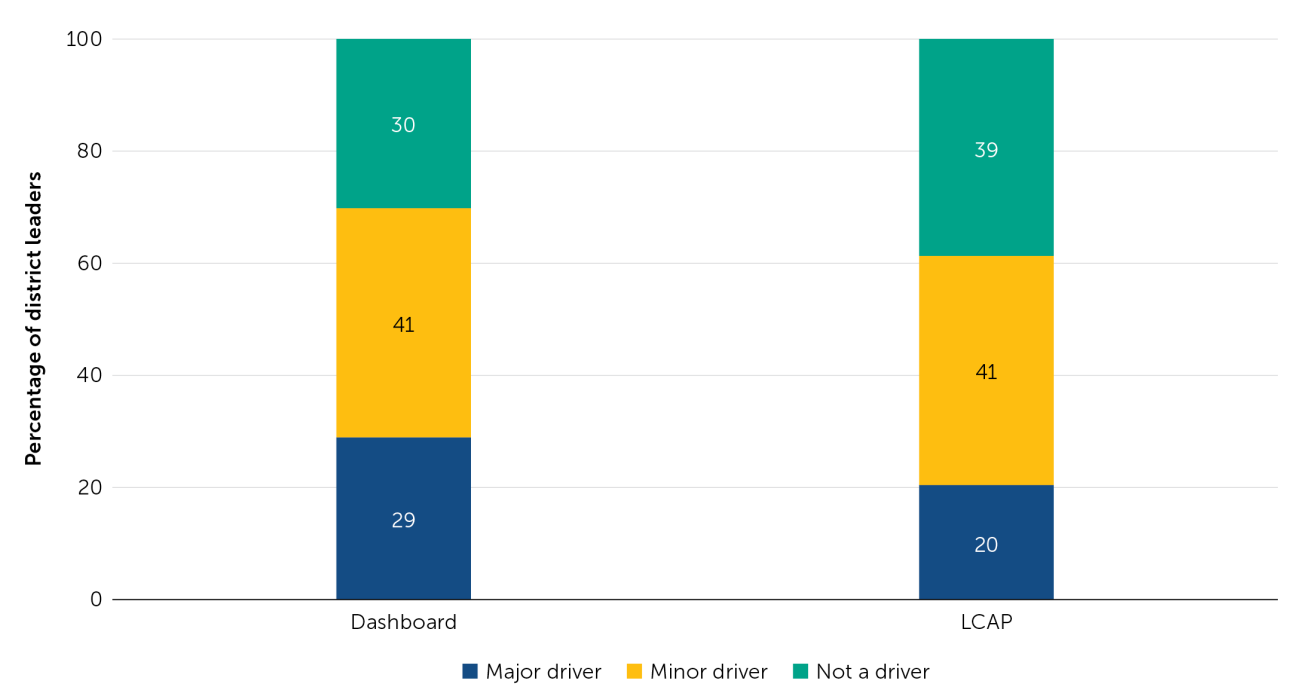
Note. Dashboard = California School Dashboard; LCAP = Local Control and Accountability Plan; N = 93.
District leaders invariably recognized mathematics as foundational, and many expressed concern about their students’ lack of mathematical proficiency. Yet when leaders were asked an open-ended question about their top priorities, nearly two thirds did not name mathematics in their responses. When asked to prioritize four important issues, more than half of district leaders ranked English language arts as their top instructional priority; mathematics was the lowest priority in one quarter of the districts (Figure 2).
Figure 2. Ranking by District Leaders of Top Instructional Priorities
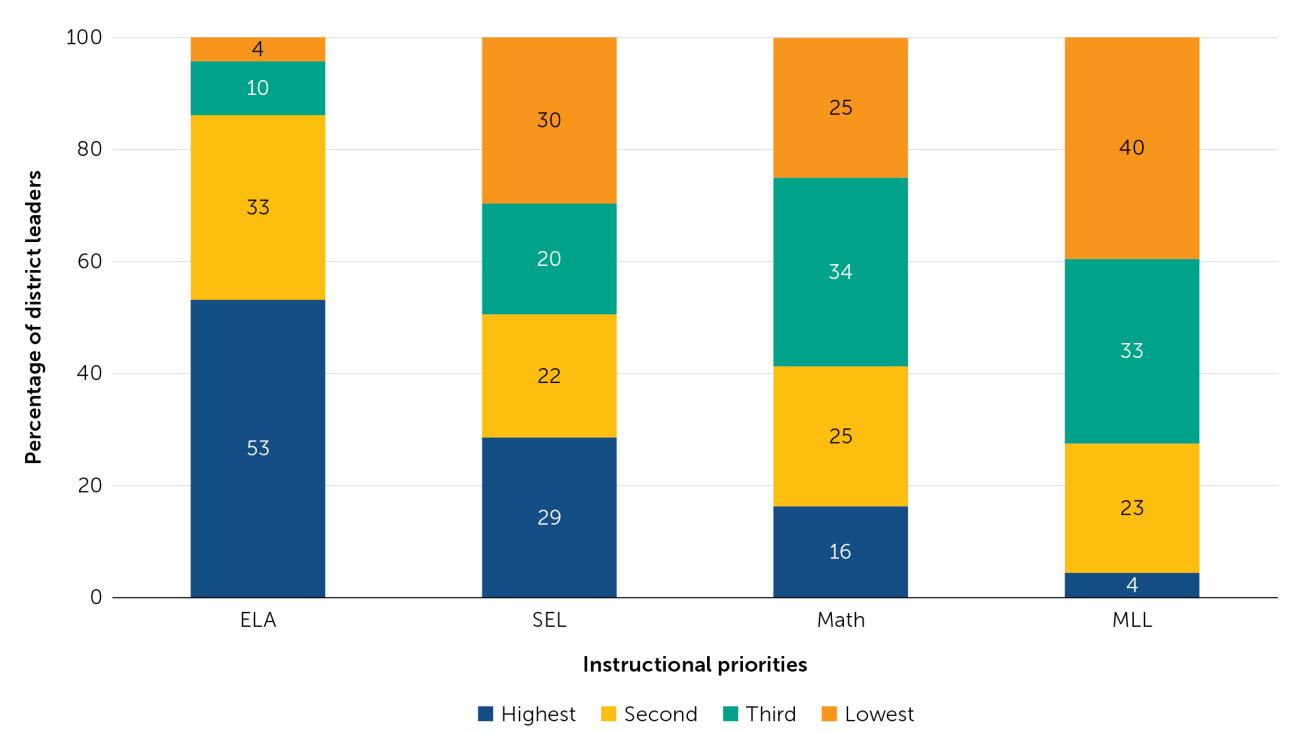
Note. ELA = English language arts; SEL = social-emotional learning; MLL = multilingual learners; N = 91. Percentages may not total 100 percent due to rounding.
A common theme in district leaders’ open-ended answers was that, despite continuously low student math proficiency, math remains a relatively low priority because of an overwhelming number of state initiatives and growing reporting requirements. This creates a cycle of administrative burden and educator overwhelm that makes it hard for districts to sustain focus on a small set of top priorities, including mathematics.4
Districts have uneven and often limited workforce capacity for high-quality TK–8 mathematics instruction.
A significant portion of teachers in the state are underprepared or misassigned (i.e., they do not hold a preliminary or clear credential aligned with their assignment), including 18 percent of multiple-subject teachers and 29 percent of mathematics teachers; higher need schools are more likely to have underprepared teachers.5 More than 40 percent of TK–8 district leaders reported relying on underprepared teachers for one or more middle school mathematics positions, with rates far higher in the central and northern regions of the state (55 percent) than in the southern regions (12 percent). When asked about the challenge of attracting and retaining credentialed and highly effective teachers overall, almost one fifth of district leaders described it as very difficult, with the challenge especially acute in rural and remote communities (Figure 3).
Figure 3. Overall Teacher-Staffing Difficulty by Region and District Size
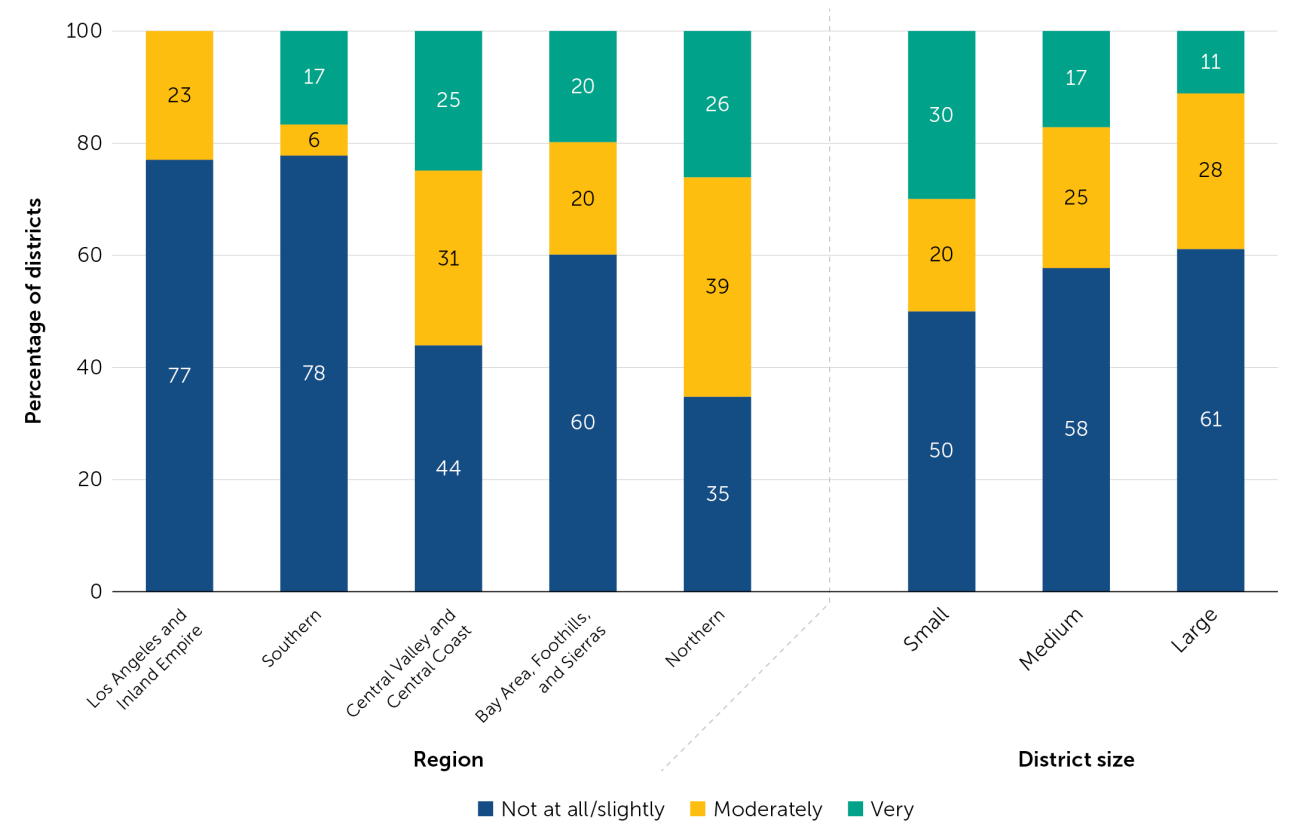
Note. N = 90. Percentages may not total 100 percent due to rounding.
Even when districts can hire credentialed teachers, leaders shared that many teachers arrive without the content knowledge and pedagogical skills needed to teach TK–8 mathematics effectively. California’s dominant credential model concentrates most pedagogical coursework and clinical training into a single postbaccalaureate year, leaving newly credentialed teachers—particularly those with multiple subject credentials—with insufficient knowledge and clinical experience.6 As one district leader explained, “Many of our elementary teachers do not have deep content knowledge in math, which makes it difficult to teach conceptually.”
Existing research has a clear consensus that sustained professional development, with opportunities for practice and feedback, is necessary for teachers to improve practice.7 Professional development that includes teacher collaboration is a particularly important feature for building a coherent approach among teachers in the same school or district.8 Yet few California districts offer teachers professional development in mathematics that includes these features. Professional development in TK–8 mathematics is scant and largely voluntary. Most teachers have between 1 and 5 days of teacher time without students, but about one in five districts have none (Figure 4). Because some student-free teacher release time is used for setting up classrooms at the start of the year, this also overestimates the number of days available for teacher professional development.
Figure 4. Distribution of Districts by Number of Professional Development Days
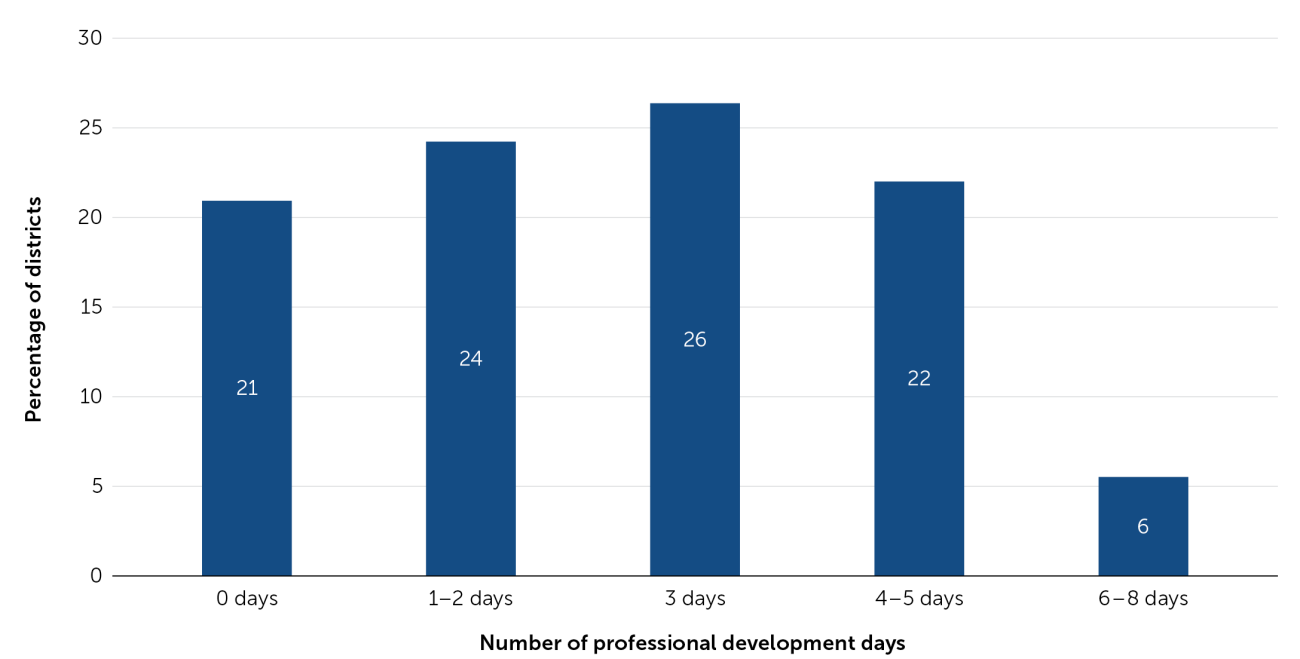
Note. Two districts reported half days (2.5 and 4.5), which we rounded up to the nearest whole day; N = 91.
Many districts try to supplement contract-required professional development days by using substitutes to create teacher release time and stipends for voluntary sessions, but district leaders described these efforts as piecemeal and dependent on inconsistent grant funding. One in five districts offered no consistent mathematics-specific professional learning during the 2024–25 school year, and when mathematics professional development was available, it was almost always optional.
One structure for professional learning that can support both teacher collaboration and differentiation based on teachers’ knowledge and skills is instructional coaching, which California districts sometimes staff using Teachers on Special Assignment (TOSAs). More than three quarters of districts reported having at least one TOSA, but dedicated mathematics TOSAs are relatively uncommon, as most in elementary and middle school grades cover multiple subjects and schools. The existence of TOSAs also varies substantially by region, district type, and district size (Figure 5).
Figure 5. Likelihood of Districts Having One or More TOSAs by Region, Type, and Size
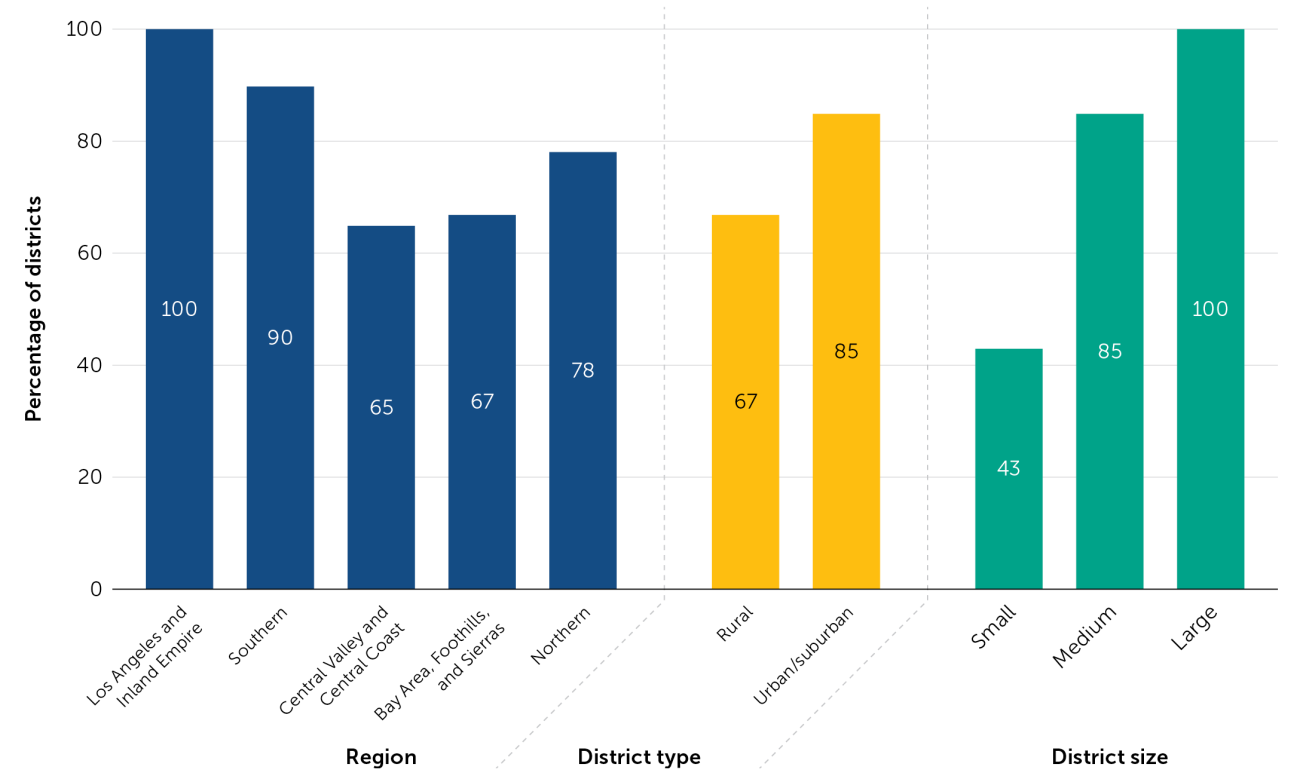
Note. N = 92.'
The state’s expectations for TK–8 mathematics far exceed what districts, teachers, and students currently experience.
California has a clear and ambitious vision for mathematics instruction. The Common Core State Standards for mathematics set high expectations for student learning, and the 2023 Mathematics Framework for California Public Schools articulates a detailed pedagogical vision grounded in conceptual understanding, student discourse, and equitable access. But a large gap separates that vision from typical classroom practice.
The Mathematics Framework calls for instruction that is conceptually rich, discourse driven, and grounded in problem-solving,9 but district leaders say that current classroom practice in most districts does not reflect that vision. The Framework is approximately 1,000 pages long and, as a result, requires extensive time to digest. More than 90 percent of superintendents in smaller districts (defined as having five or fewer schools), which tend to have fewer district office staff members, reported that the Framework was at best a minimal driver of instruction; even in larger districts, the number of districts reporting that the Framework was a major driver was less than one third (Figure 6).
Figure 6. How the Mathematics Framework Influences Instruction Decisions by District Size
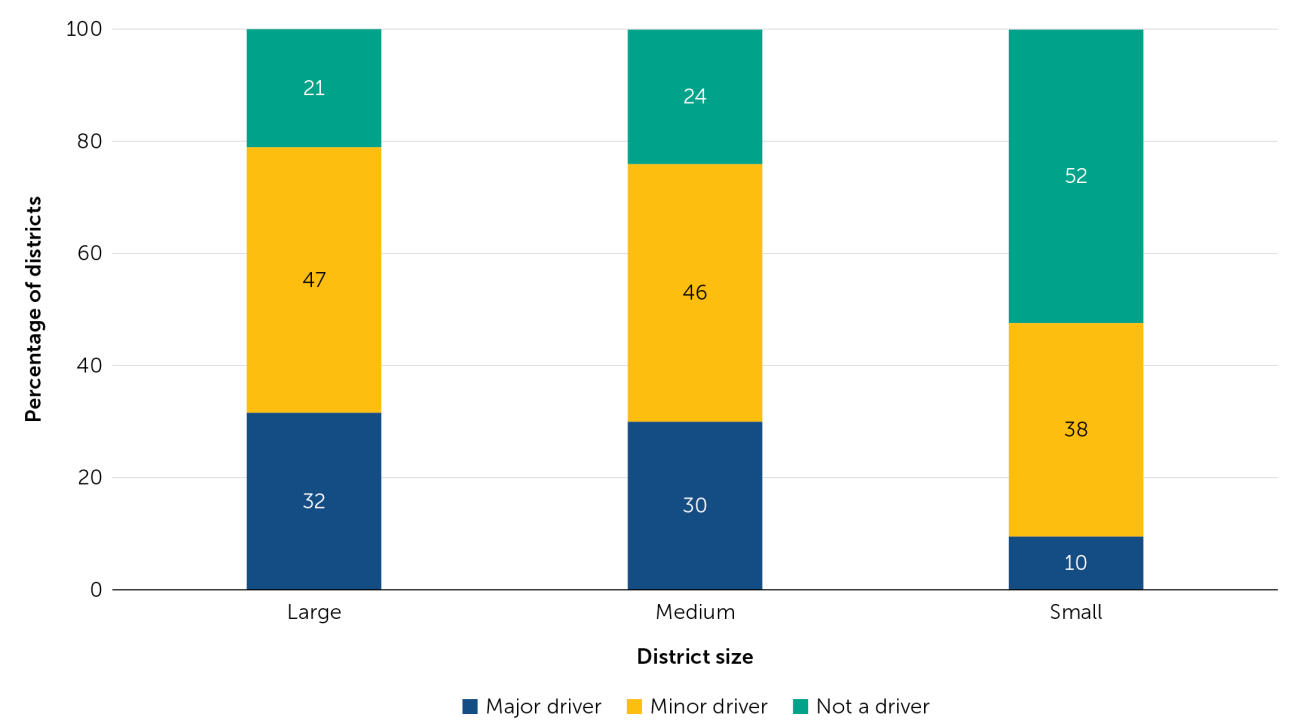
Note. N = 90.
Because of lengthy adoption cycles for instructional materials, many current mathematics curricula were adopted almost a decade ago. These curricula are widely viewed as imperfectly aligned with state expectations, driving widespread supplementation and fragmented instruction. Rather than wait for the state’s list of approved materials, about one third of districts have moved ahead with their own curriculum-adoption processes, citing outdated materials and the high cost to student learning from further delay.
In November 2025, the State Board of Education (SBE) adopted a long list of options without meaningfully distinguishing their quality or degree of alignment to adopted standards and the Framework, pushing the burden of rigorous vetting onto districts that lack the capacity to do it well. This burden is highest for small and midsize districts with few central office staff.
The number of adopted curricula increases the logistical challenges for COEs or state-level entities to provide support for using new materials effectively. One state leader explained the cost of not having high-quality professional development for new curricular materials: “Even high-quality materials fail when teachers lack support to understand the mathematics and pedagogy embedded in them.”
Finally, leaders pointed to the exclusion of TK from the K–8 curriculum-adoption process as a gap that leaves districts without guidance at a foundational grade level. The message was consistent: Districts want clearer guidance on the strongest TK–8 mathematics instructional materials and more support for implementing them. As one state leader noted, “The vision is strong, but the bridge to classrooms is weak.”
The state system of TK–8 supports for district improvement is fragmented, inconsistent, and insufficient.
The California Statewide System of Support for mathematics instruction operates primarily through partnership and influence rather than along clear, enforceable lines of authority. The SBE, the California Department of Education (CDE), the California Collaborative for Educational Excellence (CCEE), 58 COEs, the Commission on Teacher Credentialing, and the University of California system all play roles, but the formal connections among them are few, and informal relationships vary enormously across the state (Figure 7).
COEs, the primary regional support structure, are accountable to locally elected county superintendents and county boards. Other agencies within the Statewide System of Support (shown in light blue boxes in Figure 7) operate under different governance arrangements: The CCEE is governed by an appointed board, the CDE is led by the elected state Superintendent of Public Instruction, and the SBE consists of gubernatorial appointees. As one state leader told us, “There is no clear leader in the Statewide System of Support.” This complexity makes it difficult for district leaders to understand what support is available to them and who to turn to for what. Many leaders we interviewed were unaware of initiatives that could have served them.
Six statewide mathematics initiatives (shown in red boxes in Figure 7) operate within this structure, each with different funding streams, timelines, and organizational homes. These initiatives often target small cohorts of volunteer teachers rather than whole systems, and district leaders frequently did not know their own teachers were participating. As a result, the impact of these initiatives on district-level capacity is diffuse. Both district and state leaders called for the state to reduce the number of initiatives and set clearer, more stable priorities.
Figure 7. How State Entities Support District TK–8 Math Efforts
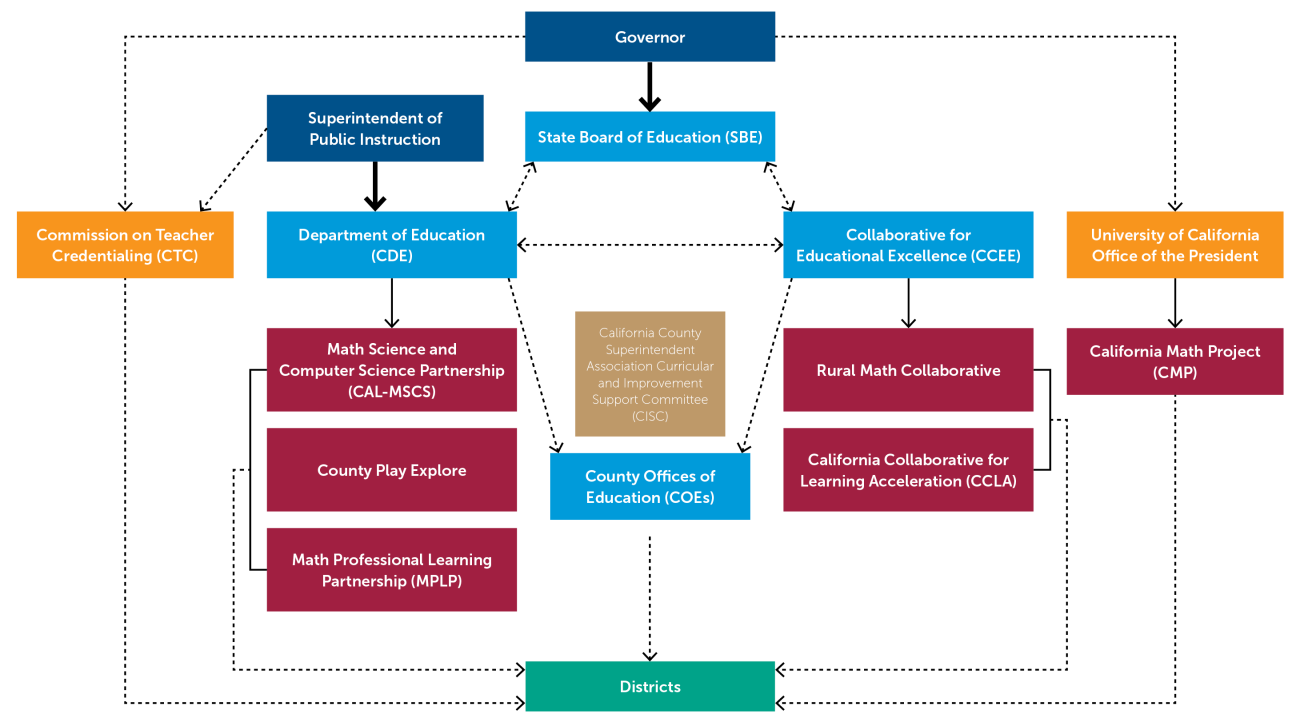
Note. Thick solid arrows represent formal authority, grounded in legally defined relationships. Dashed arrows represent mediated authority or influence among agencies. Thin solid arrows represent California’s math initiatives nested inside three distinct institutional homes.
District leaders reported relying on a broad range of organizations for support. Figure 8 shows that the CDE, CCEE, and California Mathematics Project are accessed by at most around one quarter of districts, and no more than 10 percent of districts reported receiving at least “moderately helpful” support from these sources.
Figure 8. Districts’ Use of Sources for Math Instructional Support and Their Perceptions of Helpfulness of Support
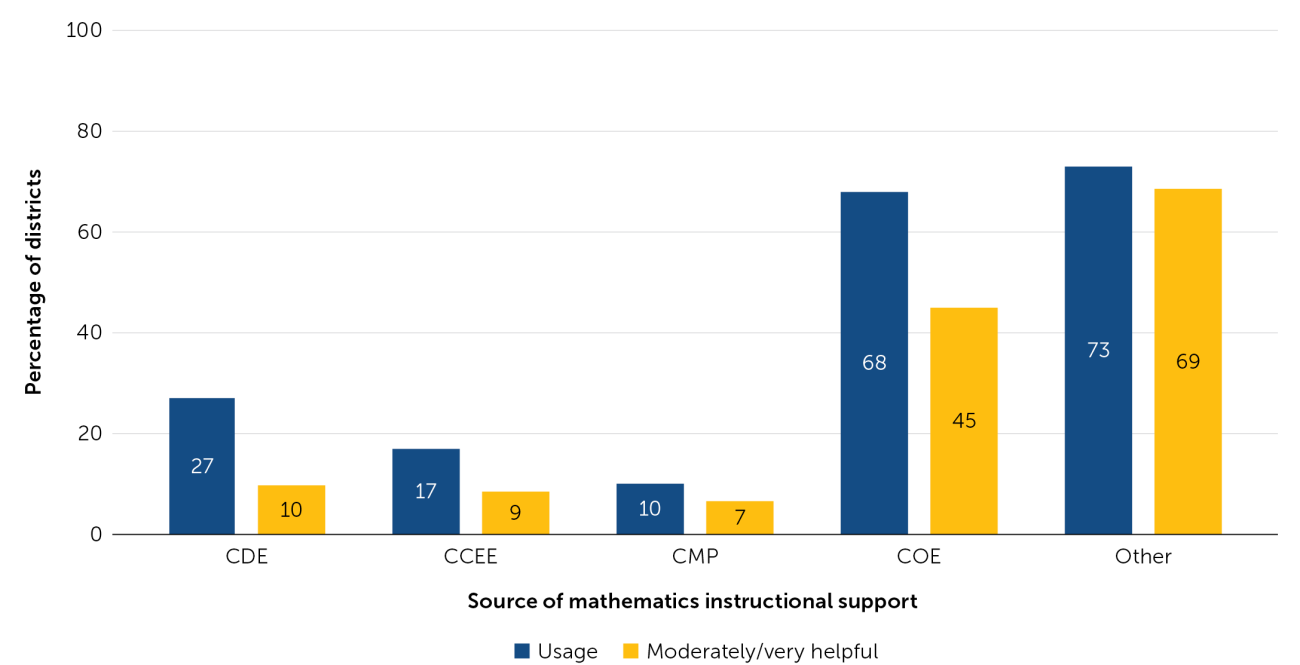
Note. CDE = California Department of Education; CCEE = California Collaborative for Educational Excellence; CMP = California Mathematics Project; COE = County Office of Education; N = 92.
District leaders primarily access support through entities outside the Statewide System of Support or their COEs, and they value it most when it is sustained, in person, and customized—features aligned with the research on effective professional development. COEs are not required to provide support for improved mathematics instruction, and many lack the capacity to do so.10 So, while about two thirds of districts received supports in mathematics from their COEs, less than half reported that this support was at least “moderately helpful.”
With needs unmet by the publicly funded system, most districts turned to external providers, often layering multiple organizations simultaneously. Districts valued these providers most when they offered intensive, multiyear support customized to their context, a type of support that the Statewide System of Support does not consistently provide. The onus of coordinating supports from multiple sources rests on district leaders, and much of the more intensive supports that some districts receive depends on unsustainable, one-time grant funding.
Conclusions
California has set high expectations for mathematics learning, but students will not consistently meet them without coherent educational experiences: high-quality, vertically aligned instruction that gives students access to the rigor of the state’s standards year after year. Districts are the organizational structure best positioned to create those experiences. Yet our data show that many districts have diffuse priorities, limited capacity to deliver expected results, and insufficient support for improvement. Drawing on evidence from this study and existing research, we identify three areas where California could focus to strengthen districts’ capacity for instructional improvement.
California has strong foundational assets for improving TK–8 mathematics, but those assets are not currently organized into a coherent system.
California has many of the ingredients needed to support high-quality mathematics instruction, including a strong instructional vision and committed leaders and organizations. However, these supports are unevenly connected and inconsistently available. Sustained professional learning, instructional coaching, and curriculum-aligned support often remain limited to specific initiatives, regions, or grant cycles, so access depends more on local leadership, geography, and resources than on a reliable system. The result is a pattern of accumulation without alignment: Individual programs demonstrate value in isolation but do not consistently reinforce one another or build towards shared statewide goals, producing pockets of progress rather than broad-based capacity for improvement. Better alignment and connection of existing assets could increase their collective impact.
Governance structures limit the system’s ability to translate instructional vision into consistent classroom practice.
A central theme of this brief is the distance between the state’s vision for mathematics instruction and classroom practice. That distance reflects competing priorities and initiative overload stemming from structural features of California’s governance system in which authority, oversight, and delivery are distributed across multiple entities, each with its own mandate, funding stream, and accountability structure, and none with clear, end-to-end responsibility for whether districts get the support they need.
A diffuse policy landscape weakens signals about the importance of mathematics; system incoherence leaves many districts without the capacity to improve mathematics instruction.
California’s policy environment sends multiple and often competing signals about its priorities, leaving district leaders to balance mathematics with other state priorities, such as literacy, social-emotional learning, and multilingual learner support. In this context, mathematics does not consistently receive the sustained attention or resources needed to position it alongside literacy as a central focus of instructional improvement, especially in the elementary grades. This diffusion of priorities, combined with limited capacity and fragmented supports, constrains district action and forces trade-offs in time, funding, and professional learning. As a result, curriculum adoption, teacher preparation, and professional learning do not consistently reinforce the state’s instructional vision or build towards sustained improvement in mathematics instruction. Clearer and more consistent policy signals—paired with resources that build district capacity—would make it easier for districts to launch and sustain meaningful efforts to improve mathematics instruction.
Implications
California is at a rare moment of leadership transition across the governorship and Superintendent of Public Instruction, and the state is already engaging in restructuring the reporting of the CDE. This would be an opportune time to reconsider key structures more broadly, strengthening formal lines of authority and accountability across agencies and entities (e.g., CCEE, COEs, etc.) to ensure coordination rather than fragmentation. With the Local Control Funding Formula (LCFF), California moved away from the more punitive accountability model of the No Child Left Behind Act, but the system enacted under LCFF does not provide sufficient capacity building or accountability. Making shifts in governance and policy could create “reciprocal accountability,”11 defined as clear goals aligned with incentives for district performance while also holding state and regional entities responsible for providing districts with the capacity-building supports to attain those goals. The data from this study show that none of these pieces is complete, leading to the following implications.
California needs to prioritize mathematics and a policy approach that builds coherence.
California is a local-control state. Yet district leaders did not tell us they wanted the state to step back; instead, a large majority want the state to adopt clearer, fewer priorities and to provide strong, coherent supports aligned with those priorities. Mathematics, along with literacy, should be explicitly named as one of a small number of state priorities, in recognition of the foundational role that both play in enabling students to access and thrive in all other content areas. Their prioritization would require sustained funding and state policies crafted to build coherence and maintain focus on the most important priorities over time, rather than layering new initiatives onto an already overwhelmed system.
California needs to improve both state- and regional-level supports for district capacity building and create accountability on all levels for improvement in high-priority areas.
The evidence suggests that reenvisioning regional support structures is critical to building district capacity for TK–8 instructional improvement. The state’s universal supports are typically documents, toolkits, and webinars. While these supports are useful, they are rarely sufficient to help districts build the instructional capacity and coherence needed to improve mathematics outcomes at scale. COEs have local presence, valued relationships, and existing infrastructure that make them an important regional resource, but they have no formal responsibility to provide the supports that research suggests are necessary to improve instruction, and many lack the capacity to do so consistently. As a result, access to meaningful support of instructional improvement varies considerably across the state.
Taken together, the research and interview findings suggest that districts are unlikely to improve mathematics outcomes at scale without access to sustained support that helps leaders build local instructional capacity and align curriculum, professional learning, assessment, and improvement efforts around a shared instructional vision. Given the scale of the challenge, policymakers could consider initially prioritizing intensive support for the state’s lowest performing districts.
Improving support systems could require stronger accountability at multiple levels. The CDE could play a larger role in articulating an instructional vision, establishing expectations for regional support, and monitoring implementation. Regional support entities could be charged with ensuring that districts have access to the expertise, coaching, professional learning, and technical assistance needed to improve instruction. Districts, in turn, would remain responsible for improving student outcomes. Such an approach would also require attention to the capacity of regional support providers themselves, suggesting a role for the state in ensuring that regional entities have the resources, expertise, and organizational capacity needed to meet expectations. Governance and funding mechanisms that align these responsibilities may help promote greater coherence among state goals, regional support efforts, and districts’ improvement work.
California needs to strengthen teacher preparation as part of a coherent system for improving TK–8 mathematics instruction.
California needs preparation models that produce TK–8 mathematics teachers with deeper training in content and pedagogy and that function as a connected continuum with ongoing professional learning. Shortcomings of current teacher preparation in California place a large burden on districts to build teachers’ knowledge and skills for teaching mathematics, which most districts lack the capacity to shoulder, resulting in variability in instructional quality across schools and districts. Grossman and Kaul12 recommend that California shift to credentialing most teachers through a 4-year concurrent bachelor’s degree and credential, which would provide preservice teachers with multiple years of clinical observation and practice and more time to build necessary knowledge and skills.
California needs to incentivize and support sustained, high-quality professional learning aligned to the state’s instructional vision for TK–8 mathematics.
Districts need professional learning systems that help all TK–8 mathematics teachers build the shared knowledge and instructional practices necessary to give students a coherent, high-quality learning experience across grades. Yet current professional learning is often voluntary, brief, and disconnected from classroom practice, primarily reaching teachers who already seek out additional support. As a result, students do not consistently experience high-
quality mathematics instruction as they progress through school. Although California has invested in mathematics professional learning through a variety of state and local initiatives, access to sustained, high-quality support remains uneven across districts. The evidence points to the need for a statewide system of sustained professional learning aligned to California’s instructional vision and supported with adequate resources, including helping teachers effectively use newly adopted instructional materials. Instructional coaching, which provides ongoing, job-embedded support tailored to teachers’ needs, should be a central component of such a system rather than an opportunity available only where local capacity or grant funding permits.
California’s curriculum-adoption process needs to include clearer information about quality instructional materials, prioritize a smaller set of high-quality options, and expand inclusion of TK.
The state should provide transparent, criteria-based evaluations that meaningfully distinguish the quality of instructional materials while identifying and elevating a smaller number of high-quality programs that are most aligned with California’s math standards and curriculum frameworks, rather than leaving districts to vet dozens of broadly equivalent options on their own. The state’s K–8 instructional materials adoption process should be expanded to include TK, establishing a coherent TK–8 adoption process and ensuring that TK materials are aligned with the state’s expectations for early mathematics learning.
We conclude by noting that there is a crucial difference between centralization and coherence. Centralization concentrates decision-making at the top; coherence ensures that decisions and supports at multiple levels align around shared goals, even as primary authority remains local. Similarly, local control means that local educational agencies have substantial decision-making authority; it does not mean that the state should not play a strong supportive role leveraging collective expertise to make it easier for district leaders to make good decisions. Nearly all the people we interviewed at the state, county, and district levels expressed a desire to move along the continuum, away from unstructured autonomy and towards greater system coherence, which will require a state-level role in California education that prioritizes supports for district improvement. Kirst,13 the architect of LCFF, argues that state investments in capacity building to date have produced “‘islands’ of high-capacity teachers surrounded by wide deserts” of low capacity. In the area of TK–8 mathematics, we find much truth in his words.
The building blocks for improvement exist. What is needed now is the coherence, sustained focus, and political will to assemble them into a system that works for every district, every school, and every student across the state.
Recommended Reading
Gallagher, H. A., Towne, L., Gomez, D. M., & Loeb, S. (2026, May). The California state role in supporting district capacity for TK–8 math improvement. SCALE Initiative, Stanford University.
Gallagher, H. A., Arshan, N., Darling-Hammond, L., Gomez, D. M., Grossman, P., Haderlein, S., Bustos Ito, A., Kaul, M., Klaus, K., Loeb, S., Meloy, B., Polikoff, M. S., Reardon, S., Ripma, T., Santibañez, L., Stipek, D., Towne, L., Trinidad, J. E., Wei, W., Willis, J., & Yu, E. J. (2026, May). Improving instruction in California: Capacity, coherence, and state support. Getting Down to Facts III, SCALE Initiative, Stanford University.
Kaul, M., Bruno, P., Carver-Thomas, D., Darling-Hammond, L., Grossman, P., Kightlinger, B., Kini, T., Laski, M., Li, Y., Leung-Gagné, M., Patrick, S. K., Rainey, L., Santibañez, L., Sorensen, L., Smith, T. M., & Tan, T. S. (2026, May). California’s teacher workforce: Progress and persistent structural challenges. SCALE Initiative, Stanford University.
Gallagher, H. A., Towne, L., Gomez, D., & Loeb, S. (2026, August). Building capacity for TK–8 mathematics improvement: Strengthening California’s support for districts [Policy brief]. Policy Analysis for California Education. https://edpolicyinca.org/publications/building-capacity-tk-8-mathematics-improvement
- 1
Gallagher, H. A., Towne, L., Gomez, D. M., & Loeb, S. (2026, May). The California state role in supporting district capacity for TK–8 math improvement [Report]. Stanford University Graduate School of Education. gettingdowntofacts.com/reports/california-state-role-supporting-district-capacity-tk-8-math-improvement
- 2
Gallagher et al., 2026.
- 3
Haderlein, S., & Polikoff, M. S. (2026, May). Public accountability in California: Evaluating the SARCs and the California School Dashboard (Getting Down to Facts III). Stanford University Graduate School of Education. gettingdowntofacts.com/reports/public-accountability-california-evaluating-sarcs-and-california-school-dashboard
- 4
Willis, J., & Loeb, S. (2026, May). The hidden, guiding hand of compliance in California public schools (Getting Down to Facts III). Stanford University Graduate School of Education. gettingdowntofacts.com/reports/hidden-guiding-hand-compliance-california-public-schools
- 5
Leung-Gagné, M., et al. (2026, May). Trends in California’s teacher workforce: Understanding supply, demand, and shortages (Getting Down to Facts III). Stanford University Graduate School of Education. gettingdowntofacts.com/reports/trends-californias-teacher-workforce-understanding-supply-demand-and-shortages
- 6
Grossman, P., & Kaul, M. (2026, May). Teacher certification policies: Balancing quality and access in the teaching profession (Getting Down to Facts III). Stanford University Graduate School of Education. gettingdowntofacts.com/reports/teacher-certification-policies-balancing-quality-and-access-teaching-profession
- 7
Cobb, P., Jackson, K., Henrick, E., & Smith, T. M. (Eds.). (2018). Systems for instructional improvement: Creating coherence from the classroom to the district office. Harvard Education Press; Darling-Hammond, L., Hyler, M. E., & Gardner, M. (2017, June 5). Effective teacher professional development [Report]. Learning Policy Institute. learningpolicyinstitute.org/product/effective-teacher-professional-development-report.
- 8
Gallagher, H. A. (2017). Professional development to support instructional improvement: Lessons from research. SRI International. sri.com/wp-content/uploads/2021/12/professional_development_to_support_instructional_improvementpdf; Griffith, P. L., Ruan, J., Stepp, J., & Kimmel, S. J. (2015). The design and implementation of effective professional development in early elementary and early childhood settings. In L. E. Martin, S. Kragler, D. J. Quatroche, & K. L. Bauserman (Eds.), Handbook of professional development in education: Successful models and practices, preK–12 (pp. 189–204). Guilford Press; Horn, I., Kane, B. D., & Garner, B. (2018). Teacher collaborative time: Helping teachers make sense of ambitious teaching in the context of their schools. In P. Cobb, K. Jackson, E. Henrick, & T. M. Smith (Eds.), Systems for instructional improvement: Creating coherence from the classroom to the district office (pp. 93–112). Harvard Education Press; Newmann, F. M., Smith, B., Allensworth, E., & Bryk, A. S. (2001). Instructional program coherence: What it is and why it should guide school improvement policy. Educational Evaluation and Policy Analysis, 23(4), 297–321. doi.org/10.3102/01623737023004297
- 9
California Department of Education. (n.d.). Mathematics framework. cde.ca.gov/ci/ma/cf
- 10
Trinidad, J. E., Klaus, K., Bustos Ito, A., & Yu, E. J. (2026, May). Re-envisioning California’s County Offices of Education (Getting Down to Facts III). Stanford University Graduate School of Education. gettingdowntofacts.com/reports/re-envisioning-californias-county-offices-education
- 11
Elmore, R. F. (2002). Bridging the gap between standards and achievement: The imperative for professional development in education. Albert Shanker Institute. shankerinstitute.org/sites/default/files/Bridging_Gap.pdf
- 12
Grossman & Kaul, 2026.
- 13
Kirst, M. W. (2024, November). Looking back, moving forward: A vision for instructional capacity in California [Commentary] (p. 2). Policy Analysis for California Education. edpolicyinca.org/newsroom/looking-back-moving-forward