California is synonymous with innovation. Over decades and across sectors, California has been a leader—from tech start-ups to agricultural advances and environmental solutions. In the private sector, companies race to market with their ideas in order to capitalize on ingenuity.California...
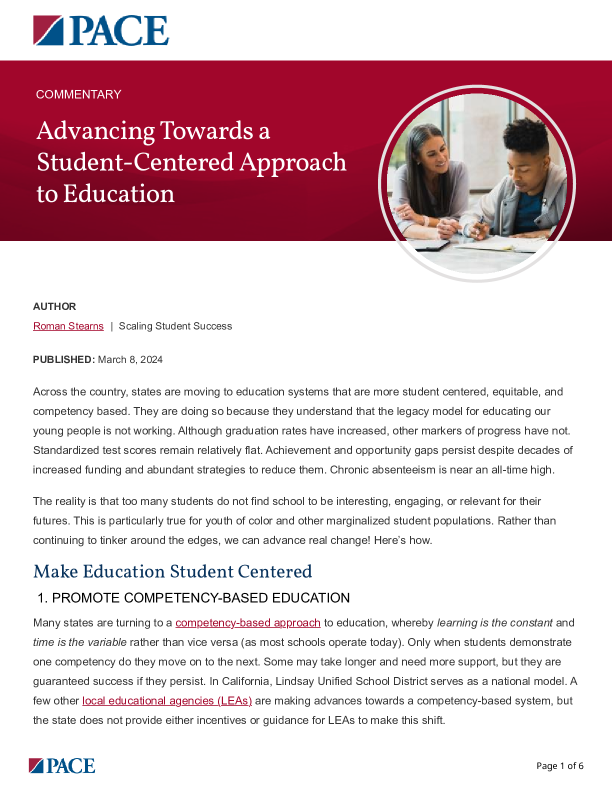
Across the country, states are moving to education systems that are more student centered, equitable, and competency based. They are doing so because they understand that the legacy model for educating our young people is not working. Although graduation rates have increased, other markers of progress have not. Standardized test scores remain relatively flat. Achievement and opportunity gaps persist despite decades of increased funding and abundant strategies to reduce them. Chronic absenteeism is near an all-time high. The reality is that too many students do not find school to be interesting, engaging, or relevant for their futures. This is particularly true for youth of color and other marginalized student populations. Rather than continuing to tinker around the edges, we can advance real change! Here’s how.
A Contra Costa County school district says it’s fully embracing artificial intelligence, but understands there’s still a lot of unknowns when it comes to the emerging technology.“I think I would step back and recognize that not all districts are embracing...
Closing or consolidating neighborhood schools is a painful decision that no school district or community ever wishes to face, but increasingly it may be on the table due to declining enrollment trends and budgetary pressures. In this episode, host Jason...
Between 2007 and 2022, California saw its K–12 public school enrollment decrease by more than 390,000 students, or more than 6 percent statewide, according to data from the state’s Department of Education. The baby bust is a large contributor to...
As districts consider closures to cope with budgetary declines, new research adds to concerns that schools with higher enrollments of Black students are more likely than other schools to be shut down. “The big picture is that race plays a...
Roughly four dozen Fort Worth ISD campuses are less than 70% occupied, making them likely targets for future closings.Fort Worth ISD officials have discussed the need to make some hard decisions due to challenges driven by dwindling enrollments and underutilized...
One of the only two states to provide schools with official guidance on artificial intelligence so far, Oregon published an explainer on its website with tips, definitions, references and links to helpful resources. The good news is that policy related...
A new resource produced by a group of organizations with expert knowledge on education and technology can serve as a starting point for local educational agencies as they look to integrate artificial intelligence (AI) safely, effectively and responsibly into classrooms...
The development of Artificial Intelligence (A.I.) is emerging at lightning speed — so much so that the Biden administration just issued its first ever A.I. executive order regarding safety, labor, and civil rights issues. A.I. is already changing education in...
Closing schools is, of course, often a turbulent experience for communities, families and students. But leaders can take some steps to reduce distress with an eye toward equity, says Carrie Hahnel, a senior associate partner for policy and evaluation at...
Whether it’s with artificial intelligence-powered 1:1 tutoring services for students or a course-building aide for teachers, ed tech companies are increasingly embracing AI — especially since ChatGPT entered the scene in November 2022. As education leaders and policymakers weigh the...
Each year about 2% of U.S. public schools permanently close their doors, a trend that has translated in recent years to roughly 1,000 school closures annually. Budgetary constraints or low academic performance are typically cited as justification, but advocates have...
Each year about 2 percent of U.S. public schools permanently close their doors, a trend that has translated in recent years to roughly 1,000 school closures annually. Budgetary constraints or low academic performance are typically cited as justification, but advocates...
Between 20-plus years of plunging birth rates and, more recently, the historically unprecedented fact that more Americans are now moving out of California than into it, state demographics are changing profoundly. This is why the Golden State lost 800,000 in...
Does your district have a dedicated point person on the role of artificial intelligence in K-12 education? Are you requiring vendors that use AI algorithms in their products to ensure they are free from bias? Do you have employees with...
Public school enrollment is declining across the country, and it won’t bounce back anytime soon. The steep drops in K-12 enrollment in the aftermath of COVID-19 exacerbated a much longer-term trend rooted in falling birth rates and slowing immigration. These...
With technology at the palm of your hand, you typically don’t hesitate to look up the answer to a question — and it’s often just a click away. For students, is there anything stopping them from doing the same? How...
Some liken the use of ChatGPT to generate answers from prompts to using a calculator to solve a knotty math problem. Both, proponents argue, are a time saving tool that expands what is possible. Adoption of the technology has been...
Many school districts spent the last academic year trying to seal students off from artificial intelligence. Now, they’re racing to establish AI-friendly classrooms as a new school year kicks off. They’ve crafted rules for AI use among students and trained...
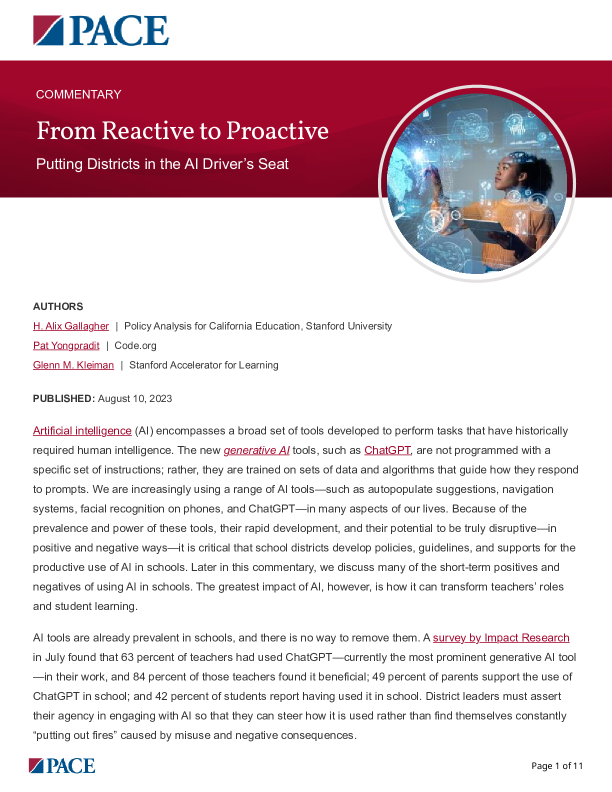
Artificial intelligence (AI) encompasses a broad set of tools developed to perform tasks that have historically required human intelligence. The new generative AI tools, such as ChatGPT, are not programmed with a specific set of instructions; rather, they are trained on sets of data and algorithms that guide how they respond to prompts. We are increasingly using a range of AI tools—such as autopopulate suggestions, navigation systems, facial recognition on phones, and ChatGPT—in many aspects of our lives. Because of the prevalence and power of these tools, their rapid development, and their potential to be truly disruptive—in positive and negative ways—it is critical that school districts develop policies, guidelines, and supports for the productive use of AI in schools. Later in this commentary, we discuss many of the short-term positives and negatives of using AI in schools. The greatest impact of AI, however, is how it can transform teachers’ roles and student learning.
he start of a new school year is soon approaching, but there is a major question left unresolved: What are schools going to do about generative AI? Since ChatGPT’s release on November 30, 2022, educators have been slow to address...
A few weeks ago, we took a look at generative AI’s potential to change teaching and learning on college campuses around the country. This week, I spoke with experts and educators in K-12 to see what they think about these...
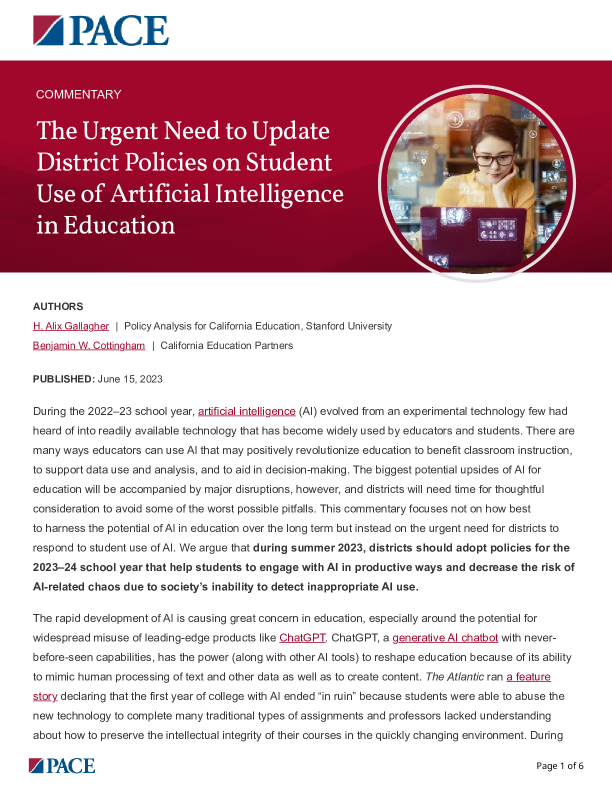
During the 2022–23 school year, artificial intelligence (AI) evolved from an experimental technology few had heard of into readily available technology that has become widely used by educators and students. There are many ways educators can use AI that may positively revolutionize education to benefit classroom instruction, to support data use and analysis, and to aid in decision-making. The biggest potential upsides of AI for education will be accompanied by major disruptions, however, and districts will need time for thoughtful consideration to avoid some of the worst possible pitfalls. This commentary focuses not on how best to harness the potential of AI in education over the long term but instead on the urgent need for districts to respond to student use of AI. We argue that during summer 2023, districts should adopt policies for the 2023–24 school year that help students to engage with AI in productive ways and decrease the risk of AI-related chaos due to society’s inability to detect inappropriate AI use.