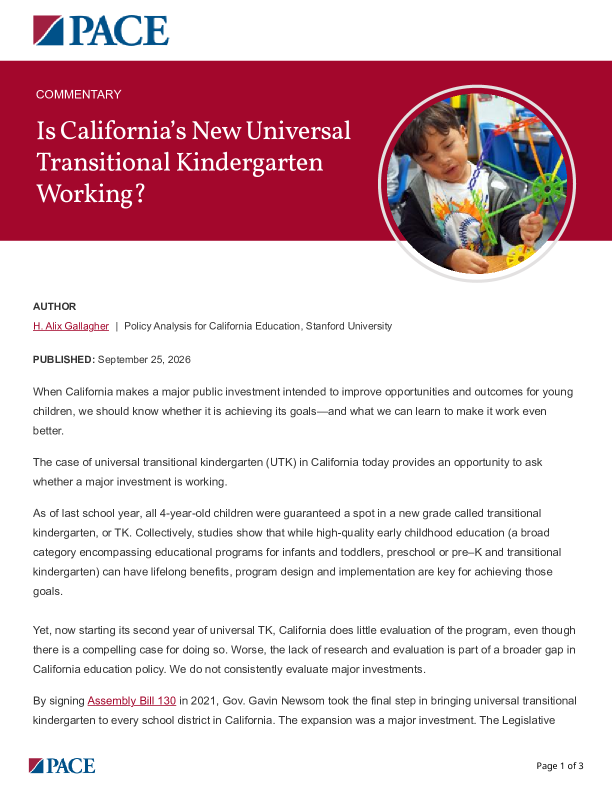
California has made a major public investment in universal transitional kindergarten (UTK), guaranteeing a seat for every 4-year-old. Yet the state lacks the detailed data needed to know whether the program is being implemented well or achieving its goals. Research shows that early education can have lasting benefits, but outcomes vary with program quality and design. Existing evaluations of UTK cannot fully assess those factors. Similar gaps exist with other major California education investments. To understand what works and improve these programs, lawmakers should require studies of implementation and impact when they authorize major investments.
When California makes a major public investment intended to improve opportunities and outcomes for young children, we should know whether it is achieving its goals — and what we can learn to make it work even better. The case...
The Getting Down to Facts III Central Valley Convening brought together educators, policymakers, and community leaders to tackle the region's most pressing educational challenges. From addressing teacher shortages to improving student outcomes in rural districts, expert presenters shared research-based strategies...
A first grader reads an entire page on her own after months of specialized instruction. A middle school student with autism delivers his first classroom presentation. These moments are not medical breakthroughs, they are educational ones. Unfortunately, our history...
STANFORD, Calif. — California has enacted one of the most significant education governance reforms in state history, adopting legislation through the 2026–27 state budget that reflects three central recommendations from the Policy Analysis for California Education (PACE) report TK–12 Education Governance in California: Past, Present, and Future.
Gov. Gavin Newsom has signed a bill that will vastly reshape the role of the state superintendent of public instruction, an elected position that currently oversees the California Department of Education. Instead of leading the department, the new position will...
SACRAMENTO – Governor Gavin Newsom today announced he has signed legislation to implement long-standing recommendations to strengthen California’s education governance system to better support its nearly 10,000 schools and approximately six million students. The legislation — Assembly Bill 181 by...
California lawmakers secured billions of dollars for public schools, community colleges, special education students and more in the 2026-2027 state budget. In all, the budget included $128 billion of the $350 billion budget package for a myriad of education priorities...
California’s Department of Education will soon be under the control of the governor’s office, drastically changing the role of the next state superintendent, who will be elected in November. The change, pushed through by Gov. Gavin Newsom as part of...
One of the offices on the November ballot is California’s Superintendent of Public Instruction. That elected official has led the state’s Department of Education and made sure policies passed by lawmakers are implemented. Next year, that will change. Under an...
The just-approved state budget strips authority from the elected state superintendent of public instruction, transferring power in January to an appointee of the governor, dramatically changing the oversight and management of a public school system serving more than 6 million...
Legislation for the big shift — moving the California Department of Education from the State Superintendent of Public Instruction’s control to a new chief executive of education under the governor — passed the Legislature Monday, though barely. With 15 lawmakers...
In his eighth and final budget, the tax gods continued to smile upon Gov. Gavin Newsom, enabling him to cement funding for signature programs he started while salving grumbling districts that are wincing over the financial impacts of declining enrollment...
California ranks 33rd in the nation in the well-being of its children and 34th in education, according to an annual report on children’s welfare released Monday. It marked the 15th straight year that California ranked in the bottom third of...
For Stanford Graduate School of Education (GSE) Professor Susanna Loeb, the work of bringing an incoming governor up to speed on the state’s education system begins with a listening tour. “There are a billion different things you could look at...
On May 7, 2026, the SCALE initiative at Stanford announced the release of Getting Down to Facts III, a trove of new research about California's education systems. It wasn't a surprise — this is the third time that Stanford has...
Stanford University on Thursday released a sweeping research project that takes a 360-degree, immersive look at all aspects and operations of public education in California, from preschool through high school, from special education to teacher certification, enrollment decline to high...
California K-12 schools have come a long way over the past 20 years, but according to an exhaustive overview of the state’s school system, further progress may require tinkering with a long-entrenched form of school governance: local control. That’s among...
A bill moving through the state legislature would require independent evaluations of any new education initiative that costs at least $500 million a year or $1 billion in one-time spending. The proposed requirement is part of a larger bill that...
Education is not a central issue in California’s crowded governor’s race, but the candidates addressing it offer sharply different visions, from expanding school funding and free college, to stricter teacher accountability and restrictions on transgender students in sports. Lupita Cortez...
In 2021, Gov. Gavin Newsom and state lawmakers set out a plan to create the largest universal preschool program in the country for 4-year-olds, through a massive ramp-up of an elementary grade known as transitional kindergarten, or TK. At a...
In 2021, Gov. Gavin Newsom and state lawmakers set out a plan to create the largest universal preschool program in the country for 4-year-olds, through a massive ramp-up of an elementary grade known as transitional kindergarten, or TK. At a...
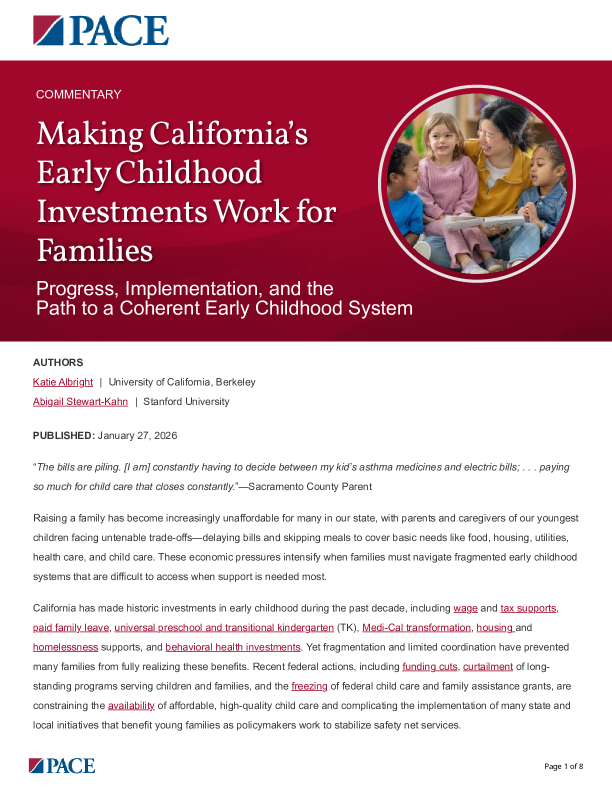
During the past decade, California has made historic investments in early childhood that span income supports, health care coverage, early learning, and family well-being. Yet 3 years of research listening to parents show that families with young children continue to face severe, interconnected economic hardships, with rising costs for housing, child care, health care, and basic needs outpacing available supports. The authors recommend three strategies to support families: simplify governance and shared accountability across the 0–5 ECE system; expand investments for children ages 0–3, where unmet need and system strain are greatest; and leverage existing investments by investing in the workforce, aligning existing funding streams, and addressing facility and infrastructure constraints for greater impact. Together, these actions can help translate California’s commitments into a more coherent and equitable early childhood ecosystem that better supports families and young children.