Examining the Effect of the Early Assessment Program at California State University
Article
Published
Summary
This study analyzes the impact of the Early Assessment Program (EAP) on the college-going behavior and remediation needs of California high school juniors. Results show that EAP participation reduces the need for remediation at California State Universities by 6.1 percentage points in English and 4.1 percentage points in mathematics. The program does not discourage poorly prepared students from applying to college but rather encourages them to increase their academic preparation in high school.
California’s Quality Education Investment Act
Case study
Published
Summary
This working paper examines the use of Quality Education Investment Act (QEIA) funds, which allocated $2.6B over seven years to California's lowest-performing schools. The authors conducted a study of four Los Angeles high schools to investigate how QEIA dollars were spent in the first year, who made the decisions, and how funds were used to improve teaching and the instructional program. The study found that district officials and principals had discretion in allocating funds, consistent with recent efforts to deregulate categorical-aid programs and give local educators fiscal discretion.
Assessing the Impact of the California Governor’s Teaching Fellowship
Policy brief
Published
Summary
This brief evaluates the effectiveness of CA's Governor's Teaching Fellowship, which aimed to recruit and retain highly qualified teachers in low-performing schools by providing a $20K fellowship to individuals enrolled in traditional teacher licensure programs who agreed to teach in designated schools. The study found that financial incentives can attract skilled professionals to work with underserved populations, but alternative policy designs should also be explored for cost-effectiveness. The results of the evaluation have important implications for state and national education policy.
A Guide for Citizens and Candidates
Guide
Published
Summary
PACE has published a policy book to support informed debates about the issues facing California education. The book includes recommendations to improve education quality, targeting resources to those who need it most, giving local schools more flexibility, and designing policies for continuous improvement. While there's no one solution to fix public education, a series of good policies can bring about fundamental reform and improve outcomes for schools and students.
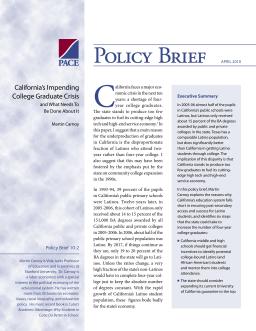
Policy brief
Published
Summary
This brief discusses the significant disparity between the Latino population in California's public schools and their representation among college graduates. The author suggests that this may lead to a shortage of graduates for California's economy and outlines six steps the state could take to improve access and success for Latino students in higher education.
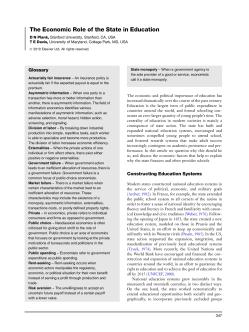
Article
Published
Summary
This article explores the reasons why education has become a central focus of modern societies and the largest public expenditure around the world. The state has built and expanded national education systems, made attending school mandatory, and linked adult success to academic performance. The article delves into the economic factors behind state financing and provision of schools.
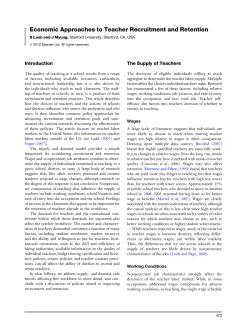
Article
Published
Summary
This article discusses how teacher recruitment and retention affect the quality of teaching in schools. The supply and demand model, including wages and non-pecuniary job attributes, influences the supply of potential and current teachers. The demand for teachers depends on factors such as student enrollment and institutional constraints such as hiring authorities' skill and efficiency. The article identifies common policy approaches to improve recruitment and retention and summarizes current research on their effectiveness.
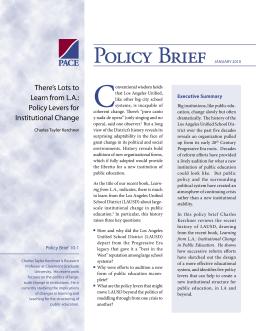
Policy Levers for Institutional Change
Policy brief
Published
Summary
The Los Angeles Unified School District has undergone decades of reform, resulting in an unstable atmosphere rather than institutional stability. A recent book, "Learning from L.A.: Institutional Change in Public Education," identifies five policy levers that can create a more effective educational system and a new institutional structure for public education, both in LA and beyond.
Article
Published
Summary
Policymakers aim to improve student outcomes through the hiring of highly qualified teachers, but there is little consensus on what qualities make a teacher "good." Research on teacher characteristics that impact student achievement is inconclusive. This article examines recent empirical evidence on teacher quality in education production.
Article
Published
Summary
Economics of education has grown in importance over the past two decades, as education is viewed as a critical factor in a nation's economic success. Economics can help improve the productivity of educational institutions by focusing on incentives, choice, and competition. The article reviews important theoretical concepts in the economics of education, including human capital, markets, and education production, and how they have been used in empirical studies.