Every state is experiencing a significant increase in high and extreme levels of chronic absenteeism across schools and districts, according to a nationwide analysis of 2021–22 federal data released Jan. 31 by Attendance Works and Johns Hopkins’ Everyone Graduates Center...
Closing or consolidating neighborhood schools is a painful decision that no school district or community ever wishes to face, but increasingly it may be on the table due to declining enrollment trends and budgetary pressures. In this episode, host Jason...
When the state published last year’s batch of post-pandemic school data, alarm bells went off. It was our first glimpse into where kids stood after years of virtual learning, and it was bleak. The data showed that student performance on...
Chronic absenteeism has risen dramatically in our country. A close look at 2021-22 school year data reveals that every state in the country is experiencing a substantial increase in the number of schools and districts with high and extreme levels...
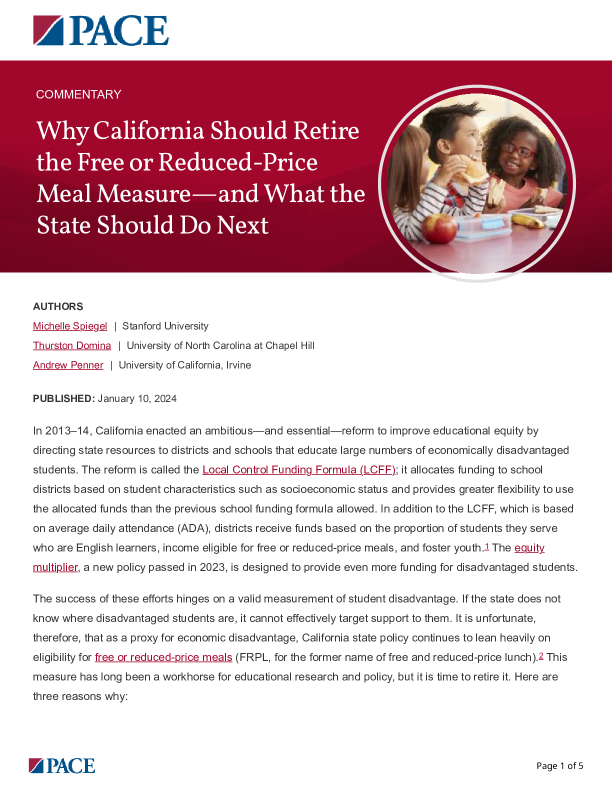
In 2013–14, California enacted an ambitious—and essential—reform to improve educational equity by directing state resources to districts and schools that educate large numbers of economically disadvantaged students. The reform is called the Local Control Funding Formula (LCFF); it allocates funding to school districts based on student characteristics such as socioeconomic status and provides greater flexibility to use the allocated funds than the previous school funding formula allowed. In addition to the LCFF, which is based on average daily attendance (ADA), districts receive funds based on the proportion of students they serve who are English learners, income eligible for free or reduced-price meals, and foster youth. The equity multiplier, a new policy passed in 2023, is designed to provide even more funding for disadvantaged students.
When then-Gov. Jerry Brown and the Legislature created the Local Control Funding Formula a decade ago, their professed goal was to close the achievement gap separating poor and English-learner K-12 students from their more privileged contemporaries by providing more targeted...
Between 2007 and 2022, California saw its K–12 public school enrollment decrease by more than 390,000 students, or more than 6 percent statewide, according to data from the state’s Department of Education. The baby bust is a large contributor to...
The pandemic had a devastating impact on learning, experts say, with lasting ramifications for the world of education at large. During the chaotic period when California families were running scared, public schools were shuttered and playgrounds off-limits, an estimated 152,000...
Truancy rates for students in the state of California and across the country are again an area of concern. Since the earliest days of the Corona pandemic educators, parents, government and community organizations have monitored the effects of chronic absenteeism...
In its ongoing commitment to foster development of science, technology, engineering and math (STEM) identities in girls and nonbinary youth, the Fleet Science Center proudly showcases three key programs that San Diegans can engage with now. Expanded learning initiatives allow...
As districts consider closures to cope with budgetary declines, new research adds to concerns that schools with higher enrollments of Black students are more likely than other schools to be shut down. “The big picture is that race plays a...
Roughly four dozen Fort Worth ISD campuses are less than 70% occupied, making them likely targets for future closings.Fort Worth ISD officials have discussed the need to make some hard decisions due to challenges driven by dwindling enrollments and underutilized...
Ventura County public school students continued to miss school at historic rates during the 2022-23 school year, further crystallizing a post-pandemic trend. Across the county, 22% of students were chronically absent last school year, a small improvement from 2021-22, but...
The surge in chronic absenteeism among California students during the 2020–21 and 2021–22 school years was initially attributed, quite reasonably, to the challenges posed by the ongoing pandemic. There was optimism that these rates would eventually begin to decline as schools returned to normal. When new chronic absenteeism numbers came out in October—along with California Assessment of Student Performance and Progress (CAASSP) data for 2022–23—the findings indicated that rates are down from the soaring absenteeism of 2021–22; 25 percent of K–12 students in California schools were chronically absent in 2022–23, down from 30 percent the year before. However, more than three years after the initial onset of the pandemic, chronic absenteeism among California students is still double the rate of prepandemic levels, and there are no signs of this trend abating.
Today's guest is Hayin Kimner. Hayin is a practitioner, a researcher and a policy advocate with a focus on the whole child, community school systems and partnerships that support the healthy development and youth in their communities. And she currently...
Closing schools is, of course, often a turbulent experience for communities, families and students. But leaders can take some steps to reduce distress with an eye toward equity, says Carrie Hahnel, a senior associate partner for policy and evaluation at...
Each year about 2% of U.S. public schools permanently close their doors, a trend that has translated in recent years to roughly 1,000 school closures annually. Budgetary constraints or low academic performance are typically cited as justification, but advocates have...
Each year about 2 percent of U.S. public schools permanently close their doors, a trend that has translated in recent years to roughly 1,000 school closures annually. Budgetary constraints or low academic performance are typically cited as justification, but advocates...
Between 20-plus years of plunging birth rates and, more recently, the historically unprecedented fact that more Americans are now moving out of California than into it, state demographics are changing profoundly. This is why the Golden State lost 800,000 in...
A bill signed over the weekend by Gov. Gavin Newsom, Assembly Bill 714, will begin to provide much-needed guidance and data for teachers like King, who often don’t have training or experience in how to teach newcomer students — defined...
Public school enrollment is declining across the country, and it won’t bounce back anytime soon. The steep drops in K-12 enrollment in the aftermath of COVID-19 exacerbated a much longer-term trend rooted in falling birth rates and slowing immigration. These...
Absenteeism has grown in recent years and hit a new high in 2021-22 when a staggering one-third of students in California’s public schools were chronically absent – missing 18 or more days of school a year. This is three times...
Every day a student is absent is a lost opportunity for learning. Too many absences not only can affect achievement for the absent student but also can disrupt learning for the entire class. While no absence is beneficial to student...
If the organization you’re running suddenly finds itself with 30% of its nominal clients chronically no longer engaging with your services, you’ve got a problem.An existential one, as even the non-philosophers among us now term anissue that could lead to...
Ethnic studies is designed to benefit all students. Ethnic studies scholar Christine Sleeter posits, “rather than being divisive, ethnic studies helps students to bridge differences that already exist in experiences and perspectives,” highlighting that division is antithetical to ethnic studies...