K–16 Partnerships



Summary
Although college enrollment rates have slowly risen over time, too few students complete a degree program in California. As such, improving college completion rates is a focus of numerous education policy and practice efforts across the state. This includes the Regional K–16 Education Collaboratives Grant Program, which aims to support pandemic recovery and address persistent social and economic inequities in higher education and workforce participation through the development of regional intersegmental partnerships statewide. This brief explores the role that the University of California, Davis, plays as a Regional K–16 Education Collaborative partner in three California regions and examines its actions and activities through a collective impact framework, offering a unique lens through which to consider the development and ongoing commitment required of such partnerships.
Introduction
Improving college enrollment and completion rates has profound benefits for both individuals and society at large, as higher education not only is key for individual mobility but also fuels economic growth. Although 4-year college enrollment rates have slowly risen over time, too few students complete a degree program.1 For example, in California, evidence indicates that only about 30 percent of high school graduates earn a degree or certificate within 8 years.2 As such, improving college completion rates is a focus of numerous education policy and practice efforts across the state, including the articulation of a statewide target for college completion;3 blueprints for education recovery from the COVID-19 pandemic, K–16 alignment, and career-focused education, among others; and funding to align K–12, higher education, and the workforce. Efforts related to K–16 alignment include the Regional K-16 Education Collaboratives Grant Program, which aims to support pandemic recovery and address persistent social and economic inequities in higher education and workforce participation through the development of regional intersegmental partnerships statewide.
This brief explores the role that the University of California (UC), Davis, plays as a Regional K–16 Education Collaborative partner in three regions of California, offering a unique lens through which to consider the development and ongoing commitment required of such partnerships. This unique lens is a result of the expansive geographic area served by UC’s northernmost campus and the numerous institutional differences that UC Davis navigates as a multiregion partner. Moreover, UC Davis is one of only two UC campuses currently engaged in more than one collaborative, with its partnerships in three regions spanning 22 of California’s 58 counties, including urban, suburban, and rural locales as well as several tribal communities.
Policy Context: Intersegmental Partnerships
Prior research indicates that several factors can affect degree attainment for students.4 These include institutional factors, which shape many of the policies, practices, and overall context of students’ schooling experiences. In California, one reason for low educational attainment rates may be the siloed nature of the state’s public education segments, including its K–12 schools and three public higher education systems—UC, California State University (CSU), and California Community Colleges (CCC)—and the limited coordination across these systems. Potential misalignment with local workforce needs may also be a factor. Because each education segment serves a distinct population of students and is beholden to different accountability structures, each segment acts independently;5 this independence can lead to fragmentation, which, in turn, may negatively affect the pathways available to students and the processes that allow them to access and persist in higher education.6 As such, one key to improving alignment—and consequently, educational outcomes—is intersegmental partnerships,7 which can help to establish the communication needed to target systemic challenges, identify common perspectives and commitments, and formalize collaboration.8 Moreover, research suggests that such partnerships tend to be more effective over time, since the longer a partnership is in operation, the more likely it is to have the knowledge and resources necessary to effect change,9 underscoring the strong social ties and trust required in relationships between partners.10
Over the years, California has invested heavily in intersegmental collaboration efforts to increase alignment across its K–16 system, bridging some of the unintended gaps that such operational siloes have fostered. For example, in 2016 Assembly Bill (AB) 288 facilitated collaboration between high schools and community colleges to expand dual enrollment programs, which allow students to enroll and earn credit in college courses while still in high school. To improve alignment between the state’s higher education systems, the transfer process between CCCs and 4-year colleges has also been a policy focus. Notably, Senate Bill 1440 (2010) ensures that students who earn an associate degree for transfer from a CCC are guaranteed admission to a CSU baccalaureate program if they meet specific requirements, while AB 132 (2021) requested the UC and CSU systems establish dual admissions programs as separate transfer pathways for first-time first-year applicants. Other initiatives aim to smooth students’ pathways to college and career more broadly, such as the Golden State Pathways Program (2022), which provides local educational agencies with resources to promote pathways in critical industry areas (e.g., technology, health care, education) and ease transitions from high school to college and career.
In addition to broader intersegmental collaboration efforts, the state formalized collaboration across education sectors through the state-funded Regional K–16 Education Collaboratives Grant Program. Established in 2021, the program encouraged the development of regional intersegmental partnerships across the state to support pandemic recovery, improve education-to-workforce pathways and participation, and address persistent inequities in educational opportunities and outcomes.11 In total, 13 regions received funding through the program: Bay Area, Central Coast, Central San Joaquin Valley, Eastern Sierra, Inland Empire, Kern County, Los Angeles County, Northern San Joaquin Valley, North State, Orange County, Redwood Coast, Sacramento, and Southern Border. Each region is required to develop and maintain an intersegmental partnership that
- includes at least one K–12 school district, one UC campus, one CSU campus, and one CCC district;
- establishes a steering committee in which at least 25 percent of members are local employers;
- commits to participate in the California Cradle-to-Career Data System;12
- implements at least four recommendations from the Recovery with Equity report;13 and
- commits to creating occupational pathways in employment sectors that are critical to California (i.e., health care, education, business management, and engineering and computing).14
Within the Collaboratives, each education sector is instrumental for pooling various state and local resources, sharing facilities and equipment, and collaborating to support smoothing the educational pathways for students throughout its regions. As some of the state’s most selective public universities, UC campuses are not necessarily designed for broad access, since admission is competitive and not every student who wishes to attend can do so. However, by contributing to students’ access to information and outreach events, college preparation programs that target traditionally underserved students (e.g., TRIO, Upward Bound), early experiences in specific career fields, and comprehensive transfer pathways, among other efforts, UCs can play a role in ensuring that all students who want to pursue higher education have that opportunity.
As a partner, UCs expand the capacity of each Collaborative in a range of ways, including access to resources (e.g., libraries, research facilities, expert faculty), 4-year college outreach programs and information, and early college experiences for specialized professions. In turn, UC partners receive valuable insights about the policies and practices of other education sectors, which can help to identify the institutional and social pressures that school districts and other college partners may be facing and garner a bigger picture of the educational landscape that students navigate regionally. Importantly, California’s regional collaboratives offer space for local partners to improve educational attainment and address workforce needs within their communities, while the variety of its members ensures an array of perspectives, resources, and action plans.
Case Study: UC Davis Partners With Three Regional K–16 Collaboratives
Background
As the northernmost UC campus, UC Davis is deeply involved in three regional K–16 Education Collaboratives: North State, Redwood Coast, and Sacramento (see Figure 1). Across all three regions, $54 million in funding was distributed among the Collaboratives’ many partners, including K–12 school districts, CCCs, CSUs, and UC Davis. At UC Davis, funding supports a team of core staff and a diverse advisory team that represents departments and programs from across the university, such as professional schools and campus student organizations,15 expanding the reach of the Collaborative throughout the UC Davis campus. UC Davis’s involvement in multiple regions results in the linkage of efforts across separate Collaboratives, the expansion of networks, and the establishment of a broad coalition of partners aiming to make a collective impact for almost 900,000 students enrolled across northern California, including about 587,000 K–12 students, nearly 200,000 community college students, and more than 113,000 4-year college students. At the K–12 level, nearly 40 percent of students enrolled across the three Collaboratives are from historically underrepresented groups, while 60 percent are lower income and 14.5 percent have been designated as English learners. Representation at the college level looks a bit different, as each segment tends to serve a different population, with community colleges often serving students from the local area and CSUs and UCs drawing students from across the state.16
Figure 1. Regional K–16 Education Collaboratives Partnering With UC Davis
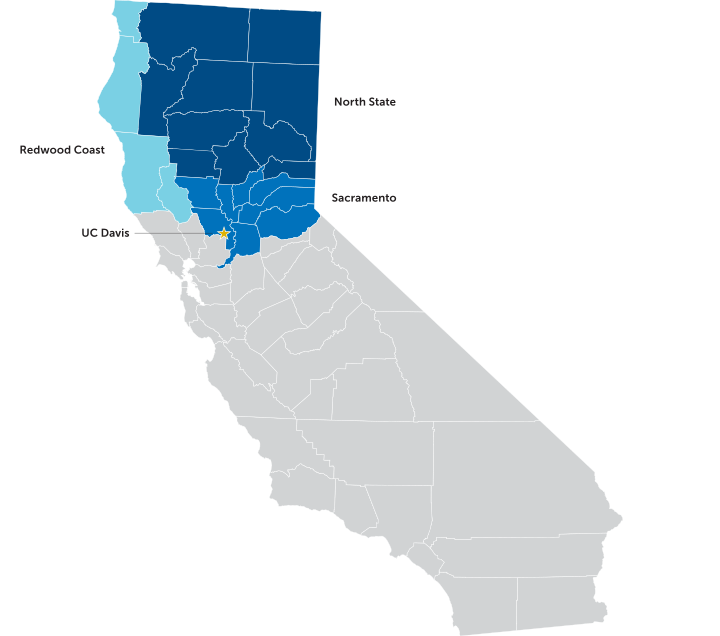
Note. Each shade of blue indicates a region designated by the Regional K–16 Education Collaboratives Grant Program in which UC Davis is a partner (North State, Redwood Coast, and Sacramento). The yellow star denotes where UC Davis is located.
Given the breadth of each Collaborative and the scale of the work, UC Davis has adopted a collective impact framework in which “a network of community members, organizations, and institutions advance equity by learning together, aligning, and integrating their actions” in order to effect change.17 Collective impact initiatives are distinguished by five factors, which parallel many of the critical components of intersegmental partnerships:18
- a common agenda, shaped by collectively defining the problem and creating a shared vision to solve it;
- shared measurement systems, in which partners jointly agree to track and share progress the same way;
- mutually reinforcing activities, wherein members’ roles and activities are coordinated to maximize progress;
- continuous communication among partners, which reinforces trust and strengthens relationship building; and
- a core team that aligns and coordinates the work of the group.19
Because collective impact requires continuous commitment and coherence across people, processes, and programs, we explore each factor in the context of the actions and activities of the three Collaboratives in which UC Davis plays a part.
A Common Agenda: Aligning Regional Goals
Each regional Collaborative that UC Davis partners with (North State, Redwood Coast, and Sacramento) has its own set of localized goals in addition to the goals that each Collaborative commonly reports on.20 These goals can be categorized into five broad areas: (a) postsecondary readiness in high school, (b) postsecondary access for priority student populations,21 (c) expansion of occupational pathways, reengagement of adult learners, and (e) partnership sustainability. More specifically, the Collaboratives aim to
- increase college readiness and high school graduation rates for all students;
- proffer inclusive and equity-oriented assistance to broaden postsecondary access;
- develop and improve the alignment of career pathways in key fields (e.g., education, engineering, health care);
- support the degree attainment of adult learners, including “comebackers” (those who exited college and reenrolled); and
- establish policies and practices across institutions and systems to strengthen collaboration.
For the team at UC Davis, it was critical to identify how ongoing initiatives at the university could be scaled to support regional goals, which was done in partnership with the advisory team. This included broadening outreach and awareness activities at the university and intentional, ongoing coordination across education sectors. Importantly, these actions and activities coalesce around increasing awareness, access, and success as they relate to both occupational and postsecondary pathways. In this case, UC Davis plays a role in bridging the goals and work of the three Collaboratives as they advance educational equity and workforce opportunities by strengthening college and career pathways.
Shared Measurement Systems: Regional Data-Sharing Agreements
The common agenda identified across Collaboratives is underscored by commitments to adopt shared data, including participation in California’s Cradle-to-Career Data System (c2c.ca.gov) as well as data-sharing agreements between regional Collaborative members, separate from those managed by the state. For example, UC Davis joined its education partners in the Sacramento K–16 Collaborative in a data-sharing agreement in October 2024.22 This regional data-sharing initiative is one of the largest in California and initially included Elk Grove Unified School District, the Sacramento County Office of Education, Los Rios Community College District, Sacramento State, and UC Davis, linking student-level data from each segment of education in the Sacramento region.23 This agreement is critical for regional partners as it (a) provides colleges and universities with additional information to offer targeted supports to students, (b) enables K–12 school districts to track students after graduation and refine academic programs as needed, and (c) eases the expansion and development of dual enrollment and career technical education opportunities in the area.24 Broadly, this strategic data partnership enhances student access to higher education, streamlines transitions between education segments, and promotes equitable outcomes throughout the region, ultimately ensuring that institutions have access to all the information necessary to support decision-making around policies and practices as they prepare students for college and career.
Activities Coordination: Awareness and Access
One of the key goals across all three regions—and a core component of the Regional K–16 Education Collaboratives Grant Program—is to expand occupational pathways and improve the coordination between segments in service of an educated workforce in high-demand fields, including childcare and K–12 education (North State and Redwood Coast), engineering (Sacramento), and health care (North State, Redwood Coast, and Sacramento).25 Activities and programs hosted by UC Davis bolster students’ awareness of and access to occupational pathways leading to careers in these fields. Through intentional coordination and funding from the K–16 Education Collaborative, UC Davis widened the capacity and reach of programs and events in its partner regions. This includes events such as Fostering the Future, an annual 2-day experience that offers high school students the opportunity to explore careers in health care and research. Additional activities offered by the university provide high school students from each regional Collaborative with college preparation, career exploration, and hands-on learning as well as personal and professional development opportunities.26
Intentional coordination within regional partnerships also resulted in the clear mapping of education transitions and related supports as well as education-to-career pathways. For example, the Warm Hand-Offs Framework was born of regular convenings between UC Davis and Collaborative partners in the Sacramento region to ease transitions for students from K–12 to community colleges and 4-year institutions. The framework is intended to aid students, schools, and educational partners by visualizing the overall process and identifying the points along students’ educational trajectories at which navigational supports may be critical. At each critical transition point, student success supports are detailed in several areas, highlighting when a warm hand-off may support students as they transfer between systems. The framework underscores the need to strengthen these transition points, emphasizing the integral role of advisers and counselors in connecting students navigating the system with key resources, including dual enrollment opportunities, outreach programs (e.g., Sacramento Area Youth Speaks [says.ucdavis.edu]), and transfer and career supports (such as the Avenue programs)27 among many others. As this framework is piloted, coordination between partners is ongoing to resolve potential roadblocks and improve students’ transitions throughout their educational journeys.
Continuous Communication: Building Relationships
Threaded throughout all three partnerships is a commitment to build relationships, deepen the networks, and expand the resources available across the Collaboratives. For the team at UC Davis, this includes regular in-person and remote convenings with campus and regional members of the Collaboratives for coordination and planning purposes. Regular meetings have fostered collaboration, meaningful relationships, and the sharing of challenges, accomplishments, and ideas. Shared projects (such as the Warm Hand-Offs Framework and regional data-sharing initiative) have encouraged cooperation and eased discussions related to processes and practices where increased alignment may be possible.
One notable outcome of these meetings has been the K–16 project inventory requested by regional partners and now available on the UC Davis website (excellence.ucdavis.edu/k16-collaborative): a “one-stop hub” detailing the many UC Davis programs available to support students and schools that partners can distribute throughout their networks. This resource connects students and families exploring college and career readiness programs, teachers and counselors seeking professional development and college information for their students, initiatives aligned with high-need career pathways, and programs designed to assist students after admission or enrollment at UC Davis, among other efforts.
Core Teams: Coordinating the Work of the Collaborative
In addition to the many partner institutions and organizations that make up each K–16 Collaborative, an important component is the supporting infrastructure that helps the partnership run smoothly. Each Collaborative has a team of dedicated staff to oversee and coordinate activities—helping to plan, manage, and guide the initiative through ongoing facilitation, technology and communications support, and data collection and reporting as well as logistical and administrative details. At UC Davis, the university has a team of core staff to guide meetings, track progress, and manage resources, providing essential infrastructure and support to each of the university’s regional partnerships.
Conclusion
In California, regional K–16 partnerships aim to bridge a siloed education system with a new set of workable relations that combine the interests of school districts, higher education institutions, and local employers. Because collective impact requires commitment and coherence, it also takes time to cultivate interactions, build trust, and formulate collaborative efforts that can transform a series of interactions into institutional connections that lead to lasting change.
The work of the Collaboratives highlights several early lessons for improved alignment among systems both within and across intersegmental partnerships, reflecting the components of the collective impact framework:
- Allow time to build plans and partnerships. Establishing partnerships, particularly those being built from the ground up, takes time.. The first year is foundational and may be primarily dedicated to workplan development, which includes defining roles and responsibilities, organizing staff, aligning timelines, establishing communication networks and cadence, coordinating activities, and allocating resources. For example, workplans may include building a logic model to provide a clear roadmap for the larger team in addition to creating new positions and/or hiring additional staff. Because this work is extensive and complex, identifying ongoing support early is paramount. A core team can offer continued support by setting meeting agendas and organizing logistics, taking notes, following up after meetings, researching and developing budgets, and maintaining the workplan, among other critical activities.
- Embrace flexibility and innovation. Because resource and program changes can affect workplans, Collaboratives have had to adapt frequently to identify solutions to sometimes unanticipated challenges. One such hurdle is organizational transitions, since staff and leadership changes can affect budding partnerships and recruitment efforts as well as the bandwidth of current staff. Cross-training at all levels may mitigate such capacity shifts and improve staff transitions. Alternatively, institutional changes beyond the team’s purview, such as the migration to a new financial system, could produce delays. Here, planning ahead as well as continuous communication with partners and sponsors will help to alleviate unknowns and remain on schedule as much as possible while the system is updated.
- Make time for face time. As the K–16 Education Collaboratives bring education segments together across each region, this distance is often felt in online meetings, during which it may be challenging to feel connected to the broader group or the work. Scheduling regular in-person meetings, even if they occur only once a month or once every quarter, can improve relationship building and engagement. Moreover, setting aside time at these meetings to foster nonwork dialogue can strengthen cross-team collaboration and encourage participation more broadly.
As the UC partner to three K–16 Education Collaboratives, UC Davis occupies a unique position in its ability to leverage existing networks as well as to offer a broad range of supports that increase students’ awareness, access, and success in postsecondary and occupational pathways. Each region has its own approach and operates differently by design; however, within each region, K–12 and higher education segments work in tandem across each partnership to improve outcomes for students, strengthen workforce development, and align education with industry needs to redress educational and economic inequities; the segments are drawn together by UC Davis in its distinct role as a multipartner institution. Through this cooperation, institutional policies and practices that may impede degree attainment for students are identified, and efforts to improve these policies and practices lead conversations throughout the Collaborative.
As the Regional K–16 Education Collaboratives Grant Program draws to a close, sustaining partnership relationships and engagement, programmatic activities, and supporting infrastructure is a present focus for UC Davis and its partners. While AB 121 offers additional time for Collaboratives to use grant funds, for the regions that will exhaust funds at the end of this fiscal year, active planning is ongoing to identify alternative funding streams. As the sunset of the grant and broader sustainability have been recurring points of conversation, this crucial stage is buoyed by continuous communication, established trust among partners, and efforts to increase impact visibility beyond the Collaborative to expand the network of support. Evidence suggests it may take as long as 10 years before strong positive effects are realized,28 so continued investment in intersegmental efforts such as the regional collaboratives ensures that over time strong partnerships are a long-term strategy rather than a short-term fix, ultimately leading to more equitable educational outcomes to support the needs of both the students and the state.
Hurtt, A., Bennett, S. R., & Duyan, C. (2026, March). K–16 partnerships: UC Davis aligns education and workforce [Practice brief]. Policy Analysis for California Education. https://edpolicyinca.org/publications/k-16-partnerships
- 1
Cuellar Mejia, M., Alesi Perez, C., Hsieh, V., & Johnson, H. (2025, April). Is college worth it? Public Policy Institute of California. ppic.org/publication/is-college-worth-it; Kurlaender, M., Reed Bennett, S., & Hurtt, A. (2019, August). Improving college readiness: A research summary and implications for practice. [Report]. Policy Analysis for California Education. edpolicyinca.org/publications/improving-college-readiness-research-summary-and-implications-practice
- 2
College Futures Foundation. (2025, February). Reaching California’s college attainment goals. [Report]. collegefutures.org/wp-content/uploads/2025/06/College-Futures_Reaching-Attainment_February2025.pdf
- 3
Governor Newsom set a goal detailing that by 2030, 70 percent of California adults between the ages of 25 and 64 would hold a postsecondary degree or credential (see Newsom, G. (n.d.). The California blueprint: Strengthening our world-class higher education system [Fact sheet]. gov.ca.gov/wp-content/uploads/2022/01/Higher-Education-Fact-Sheet.pdf). Currently, just 56 percent of California adults hold a degree or credential (see Lumina Foundation. (2023). A stronger nation: Credentials of value [Report]. luminafoundation.org/stronger-nation/report/#/progress).
- 4
Arbona, C., & Nora, A. (2007). The influence of academic and environmental factors on Hispanic college degree attainment. The Review of Higher Education, 30(3), 247–269. doi.org/10.1353/rhe.2007.0001; College Futures Foundation, 2025.
- 5
Friedmann, E. Z. (2017, June). Building intersegmental partnerships. [Practice brief]. Policy Analysis for California Education. edpolicyinca.org/publications/building-intersegmental-partnerships; Reed Bennett, S., Lee, P., Kurlaender, M., & Hernandez Negrete, A. (2018, July). Intersegmental partnerships and data sharing: Promising practices from the field. [Practice brief]. Policy Analysis for California Education. edpolicyinca.org/publications/intersegmental-partnerships-and-data-sharing
- 6
California for All. (2021, February). Recovery with equity: A roadmap for higher education after the pandemic. California Governor’s Council for Post-secondary Education. careereducation.gov.ca.gov/wp-content/uploads/sites/18/2021/03/Recovery-with-Equity_2021Mar25-12pm.pdf
- 7
Domina, T., & Ruzek, E. (2011). Paving the way: K–16 partnerships for higher education diversity and high school reform. Educational Policy, 26(2), 243–267. doi.org/10.1177/0895904810386586; Friedmann, 2017; Reed Bennett et al., 2018; Rippner, J. A. (2014). State P–20 councils and collaboration between K–12 and higher education. Educational Policy, 31(1), 3–38. doi.org/10.1177/0895904814558008
- 8
Henig, J. R., Riehl, C. J., Rebell, M. A., & Wolff, J. R. (2015). Putting collective impact in context: A review of the literature on local cross-sector collaboration to improve education [Working paper]. Department of Education Policy and Social Analysis, Teachers College, Columbia University. wallacefoundation.org/sites/default/files/2023-09/Putting-Collective-Impact-Into-Context.pdf; Kania, J., & Kramer, M. (2011). Collective impact. Stanford Social Innovation Review, 9(1), 36–41. doi.org/10.48558/5900-KN19
- 9
Domina & Ruzek, 2011.
- 10
Mokher, C. G., & Jacobson, L. (2019). A partnership model approach to understanding challenges in collaboration around college readiness. Educational Policy, 35(3), 450–480. doi.org/10.1177/0895904818823742
- 11
For more information on the Regional K–16 Education Collaboratives Grant Program, see grants.ca.gov/grants/regional-k-16-education-collaboratives-grant-program
- 12
The California Cradle-to-Career Data System (c2c.ca.gov) is a statewide longitudinal data system presently in development that aims to provide tools to support students and families and offer critical information on education and workforce outcomes.
- 13
The February 2021 Recovery with Equity report detailed seven recommendations to support student success: (a) improve faculty, staff, and administrator diversity; (b) cultivate an inclusive, engaging, and equity-oriented learning environment; (c) retain students through inclusive support; (d) provide high-tech, high-touch advising; (e) support college preparation and early credit; (f) subsidize internet access for eligible students; and (g) improve college affordability.
- 14
Foundation for California Community Colleges. (2026). Regional K–16 Education Collaboratives Grant Program. k16collaborative.org
- 15
The UC Davis advisory team includes personnel from the College of Engineering, College Opportunity Programs, Financial Aid and Scholarships, Inclusive Excellence, Retention Initiatives, School of Education, School of Medicine, Undergraduate Admissions, and Undergraduate Education, among many others. For a complete list of the UC Davis advisory team members, see excellence.ucdavis.edu/k-16-education-collaborative-project
- 16
For K–12s and CCCs, the results reflect the authors’ analysis based on publicly available 2024–25 enrollment data from the Education Data Partnership (ed-data.org) and California Community Colleges Chancellor’s Office Management Information Systems Data Mart (datamart.cccco.edu/DataMart.aspx), respectively. For 2024–25 CSU enrollment per campus, see California State University. (2025). Factbook 2025. calstate.edu/csu-system/about-the-csu/facts-about-the-csu/Documents/facts2025.pdf. For 2024–25 UC enrollment per campus, see University of California Office of the President. (2025). UC student data. ucop.edu/institutional-research-academic-planning/content-analysis/ug-admissions/ug-data.html
- 17
Kania, J., Williams, J., Schmitz, P., Brady, S., Kramer, M., & Juster, J. S. (2022). Centering equity in collective impact. Stanford Social Innovation Review, 20(1), 38–45. doi.org/10.48558/rn5m-ca77
- 18
Friedmann, 2017; Reed Bennett et al., 2018.
- 19
Kania & Kramer, 2011; Kania et al., 2022.
- 20
For a detailed overview of the goals for each region, see UC Davis Inclusive Excellence. (n.d.) The K–16 Regional Education Collaborative Project. excellence.ucdavis.edu/k-16-education-collaborative-project
- 21
Priority populations for the K–16 Collaboratives include students from low-income families, students from rural areas, first-generation students, and adult learners.
- 22
Sacramento K–16 Collaborative. (2024, October 8). Innovative data sharing agreement expands regional workforce pathways [Press release]. sacramentok16.org/innovative-data-sharing-agreement-expands-regional-workforce-pathways
- 23
Since the announcement of the data-sharing initiative, additional institutions of higher education and K–12 school districts have signed on or expressed interest in joining. In November 2025, ten institutions joined the data-sharing initiative, including Sierra College, the Yolo County Office of Education, Center Joint Unified School District, Folsom Cordova Unified School District, Natomas Unified School District, Sacramento City Unified School District, San Juan Unified School District, Twin Rivers Unified School District, Winters Joint Unified School District, and Woodland Joint Unified School District, pending final authorizations.
- 24
Data are currently reported back through individual data-sharing agreements between each institution. For more information about the Sacramento K–16 Collaborative data-sharing initiative, including how data sharing will work and what security measures are in place, see Sacramento K–16 Collaborative. (n.d.) Data sharing agreement. sacramentok16.org/data-sharing-agreement
- 25
Additional information about the activities and events organized by the regional collaboratives that UC Davis partners with is available on their websites: North State (northstatetogether.org/k-16-education-collaborative), Redwood Coast (redwoodcoastk16.org), and Sacramento (sacramentok16.org).
- 26
For a list of events and programs funded by the UC Davis K–16 Collaborative, see excellence.ucdavis.edu/k-16-education-collaborative-project.
- 27
Broadly, the Avenue programs offer support to transfer students in their transition to UC Davis and in their entry into a career in a specific field. There are two Avenue programs at UC Davis: Avenue E, for careers in engineering and computing, and Avenue M, for careers in medicine; the latter also supports students interested in enrolling at Cal Poly Humboldt and CSU Sacramento.
- 28
Domina & Ruzek, 2011.