TOPIC

Supporting students’ social-emotional, mental & physical health

Social Emotional Health

There is increasing recognition among educators, researchers, policymakers, and the broader public that schools should play a role in students’ mental, physical, and social-emotional health.

This “whole child” approach is designed to ensure that all students in California, particularly those who are historically underserved, have the opportunities and supports they need to thrive academically, socially and emotionally, and in college, career, and life.

A key part of PACE’s research in this area is driven by the CORE Districts’ surveys of students in grades 4–12 on their school’s culture and climate (CC) and their own social-emotional learning (SEL), including growth mindset, self-management, self-efficacy, and social awareness. Our work aimed to better understand SEL/CC measurement and to provide guidance for how schools can better serve students needs in this area. 
    Recent Topic Publications
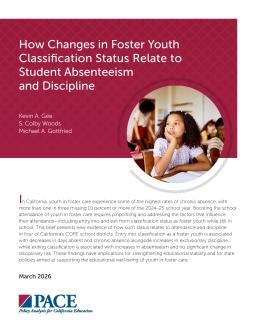
    How Changes in Foster Youth Classification Status Relate to Student Absenteeism and Discipline
    This brief examines how changes in foster youth classification status relate to student absenteeism and discipline in four California CORE districts. Drawing on longitudinal data, it finds that entering foster care is associated with reduced…
    thumbnail
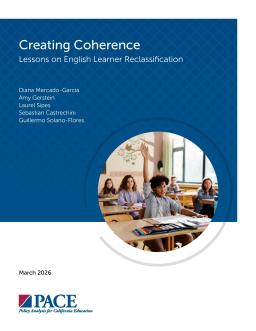
    Lessons on English Learner Reclassification
    This report examines how California’s policies and local practices shape the reclassification of students designated as English learners. Drawing on a nine-year research–practice partnership, it analyzes how locally determined criteria—particularly…
    Thumbnail
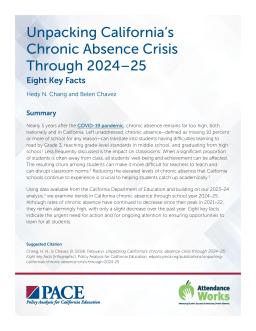
    Eight Key Facts
    This infographic examines chronic absence trends in California through 2024–25, nearly five years after the COVID-19 pandemic. Although rates have declined from their 2021–22 peak, nearly one in five students remains chronically absent—well above…
    thumbnail
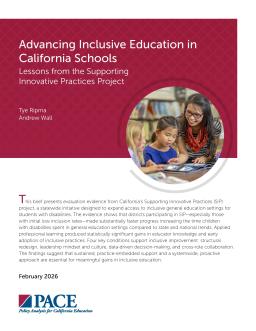
    Lessons from the Supporting Innovative Practices Project
    This brief presents evaluation findings from California’s Supporting Innovative Practices (SIP) project, a statewide effort to expand inclusive general education access for students with disabilities. SIP participation is associated with faster…