
A COVID-19 Recovery Strategy
Policy brief
Published
Summary
The brief argues that community school strategies can help address the social and learning impacts of COVID-19, by reforming underlying classroom, school, and district behaviors and systems that prevent student-centered collaboration, partnership, and teaching. The focus should be on student-centered learning, integrated teacher and student supports, collaborative leadership and practice, and the centrality of family and student relationships. The brief encourages all schools to adopt a community school approach, which can serve as a sustainable and successful investment.
Research to Guide Distance and Blended Instruction
Report
Published
Summary
This suite of publications provides 10 recommendations based on the PACE report to help educators and district leaders provide high-quality instruction through distance and blended learning models in the 2020-21 school year. Despite the challenges of COVID-19, research can guide decisions about student learning and engagement. These recommendations can be used as a framework to prioritize quality instruction.
A Rural District’s Response to COVID-19
Practice brief
Published
Summary
COVID-19 has disrupted California’s education system in fundamental ways. Districts across the state are quickly creating strategies to serve all students, and many are designing their response around the needs of their most vulnerable students. This brief highlights the response of Mother Lode Union School District (MLUSD) to the COVID-19 pandemic, in which district staff and teachers were able to collaborate—despite the unprecedented crisis—to meet student needs.
A Summary of the PACE Policy Research Panel
Policy brief
Published
Summary
Over 725,000 California K-12 students received special education services in 2018-19, but the system is not always equipped to serve them. Early screening, identification, and intervention, as well as better transitions, educator support, and mental/physical health services, need improvement. A Multi-Tiered System of Supports (MTSS) framework in schools could address SWDs' needs, but it requires additional resources and policy support to improve educator capacity and collaboration between agencies while systematizing data on SWDs.
Policy brief
Published
Summary
This brief explains that while the California Common Core State Standards in Mathematics require rigorous instruction for all students, those with disabilities do not always have equal access to this instruction. It recommends the use of Universal Design for Learning (UDL), a research-based framework that enables expert learners within classroom settings and maximizes engagement for all students, including those with disabilities, to provide access to rigorous, standards-based mathematics instruction for all students in California.
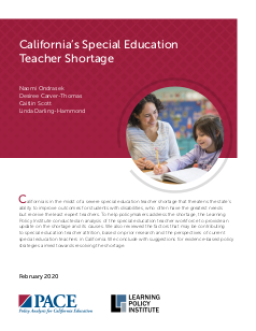
Report
Published
Summary
The Learning Policy Institute analyzed the special education teacher workforce in California and found a severe teacher shortage that could harm students with disabilities who need expert teachers the most. The report identifies the causes of the shortage and potential reasons for teacher attrition. Evidence-based policy strategies are suggested to address the issue.
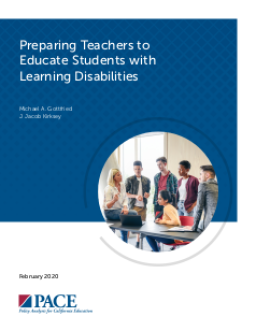
Report
Published
Summary
The effectiveness of general education teachers in supporting students with learning disabilities is a concern, and there is little understanding of what components of teacher preparation programs relate to teachers’ perceptions of readiness. Two studies examined survey responses from preservice teachers in the University of California’s TPPs to identify the components of preservice preparation associated with perceived readiness. The study provides recommendations for policymakers and teacher educators to improve teacher preparation programs.
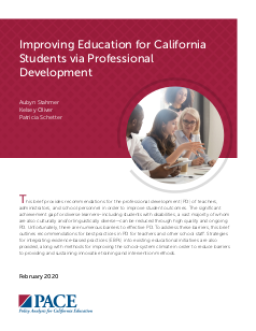
Policy brief
Published
Summary
This brief suggests recommendations for improving student outcomes by providing high quality and ongoing professional development to teachers, administrators, and school personnel. It identifies the achievement gap for diverse learners, including culturally and linguistically diverse students with disabilities, and offers strategies for integrating evidence-based practices into existing educational initiatives. Additionally, it outlines methods for improving the school-system climate to reduce barriers to providing and sustaining innovative training and intervention methods.
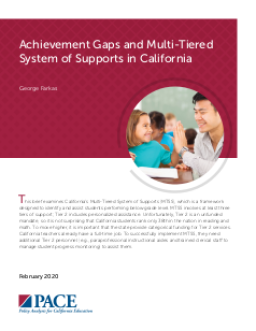
Policy brief
Published
Summary
This brief highlights California's Multi-Tiered System of Supports (MTSS), which assists struggling students. The inadequate resourcing of Tier 2 services is nevertheless preventing progress in reading and math, as California ranks 38th in the nation. Categorical funding is necessary to provide additional personnel, such as instructional aides and clerical staff, to assist teachers with implementing MTSS effectively.
Policy brief
Published
Summary
This brief outlines the necessary steps to integrate care systems and improve outcomes for California's children. It suggests forming a statewide interagency leadership council and recommends policy reforms to promote collaboration, integration, and service delivery. The goal is to create a "Whole System" approach that integrates child-serving agencies and organizations. A full commitment from the state administration is needed to achieve these solutions at scale.
Views from the 2020 PACE/USC Rossier Poll
Report
Published
Summary
In the run-up to 2020 elections, where do California voters stand on key education policy issues? This report examines findings and trends from the 2020 PACE/USC Rossier poll. Key findings include rising pessimism about California education and elected officials, continued concern about gun violence in schools and college affordability, and negative opinions about higher education. However, there is substantial support for increased spending, especially on teacher salaries.
A Progress Report One Year After Getting Down to Facts II
Report
Published
Summary
The 2018 Getting Down to Facts II research project drew attention to California’s continued need to focus on the achievement gap, strengthen the capacity of educators in support of continuous improvement, and attend to both the adequacy and stability of funding for schools. Based on the nature of the issues and the progress made in 2019, some clear next steps deserve attention as 2020 unfolds.