Policy brief
Published
Summary
This brief examines a three-year pilot of the California Collaborative for Education Excellence’s Intensive Assistance Model in five districts. It finds stronger educator collaboration and promising school-level gains, though achievement effects were not statistically significant and districtwide scaling remained uneven. The brief recommends sustained instructional coaching, protected teacher collaboration time, and a sharper focus on core academic outcomes to build district capacity and support lasting improvements in teaching and learning.
Getting Down to Facts III Policy Recommendations
Policy brief
Published
Summary
This brief draws on Getting Down to Facts III to recommend three priorities for strengthening California’s education system: clear student goals, reliable instructional support for every district, and stronger, more affordable teacher preparation. It calls for aligned policy and funding, reduced compliance burdens, sustained support for improving teaching, and expanded four-year preparation pathways to help promising reforms reach more classrooms.
A Governance Case Study in Accountability, Balance, and Capacity
Policy brief
Published
Summary
This brief examines the first phase of California’s Community Schools Partnership Program. It finds that unclear roles, limited statewide guidance, and a lack of shared measures made it difficult to coordinate support and assess progress. As California commits $1 billion in ongoing funding, the brief calls for clearer responsibilities, quality standards developed with practitioners and communities, and stronger evidence to guide statewide certification.
A Cross-District Study of Principal Pipelines
Report
Published
Summary
This report examines how five California CORE member districts built principal pipelines to develop effective school leaders. The study, a collaborative effort between CORE-PACE and university researchers, aims to describe the policies, procedures, and practices that make up participating districts’ efforts to establish and maintain principal pipelines and understand the role of principal pipelines in attaining key objectives, including diversifying school leadership, retaining excellent school leaders, and improving student outcomes.
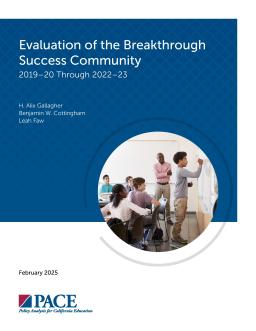
2019–20 Through 2022–23
Report
Published
Summary
This report examines the CORE Districts’ Breakthrough Success Community (BTSC), which focused on improving ninth-grade on-track rates through evidence-based changes in daily practice. Some schools effectively adapted BTSC strategies, fostering strong relationships and engagement. While implementation varied and overall impact on student outcomes was not detected, schools valued key BTSC measures, and later adjustments may strengthen results. This report highlights promising practices and offers recommendations to enhance future education improvement efforts.
Policy brief
Published
Summary
Declining student enrollment is leading to a loss of revenue in many California school districts. To address ongoing budget shortfalls, many districts have consolidated or shuttered schools,and others are contemplating doing so. A new report and working paper, summarized in this brief, explore the racial dimensions of school closures and how to address them.
Report
Published
Summary
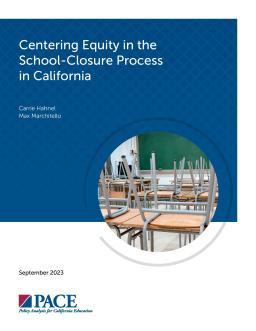
Enrollment in California public schools has been declining and is projected to fall even more steeply during the next decade. Because funding for school districts is largely based on average daily attendance rates, a decline in enrollment results in a loss of funding. To address budget shortfalls and align services with student counts, many districts have consolidated or closed schools, or they are contemplating doing so.
Working paper
Published
Summary
This study investigates racial disparities in school closures both within California and nationally. Findings highlight an alarming pattern: Schools enrolling higher proportions of Black students are at significantly increased risk of closure relative to those enrolling fewer Black students, a pattern that is more pronounced in California than elsewhere in the United States. The findings underscore that school closures in California and elsewhere reflect racial inequalities that require adequate policymaking to ensure equitable and fair school-closure proceedings.
Improvement Team Leads’ Perspectives on Fitting Improvement Work to Their Sites
Article
Published
Summary
This chapter in an edited book focuses on the work of two improvement network hubs in California as they tried to support participating districts and schools to improve the proportion of students “on-track” for post-secondary success. California has a particular stake in figuring out how to support districts in consistently using continuous improvement (CI) to achieve measurable gains in student outcomes because state policy (e.g., Local Control Funding Formula, California’s Every Student Succeeds Act Plan) prescribes CI as the approach to improvement in its accountability system.