TOPIC

College access & postsecondary success

College Access and postsecondary success

Preparation for college and career is critical for both individual and societal economic prosperity. Yet, educational attainment is not sufficient to meet economic demand and educational opportunities are not equally distributed. State policymakers and education leaders across the state are working to increase opportunity and improve student outcomes.

At the heart of these efforts is better alignment of California’s K–12 education system with higher education systems and the labor market to ensure successful transitions for young adults between high school and postsecondary pursuits.

In this topic area, PACE researchers investigate students’ educational trajectories and the state and local endeavors to decrease disparities in access to educational opportunities and improve student success in college and career.
    Recent Topic Publications
    2012 WP Grubb
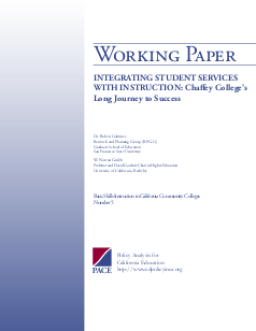
    Chaffey College’s Long Journey to Success
    Chaffey College in California's Inland Empire is renowned for its "risk tolerant change-oriented culture" and impressive student support programs, which have led to exceptional outcomes for Chaffey students. In this working paper, researchers…
    2011 WP Grubb
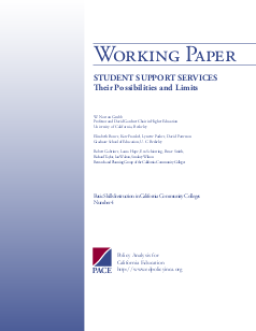
    Their Possibilities and Limits
    The voluntary nature of student support services in California Community Colleges means that many students who need them do not use them, due to competing demands or stigma. The lack of funding for student services and the prevalence of adjunct…
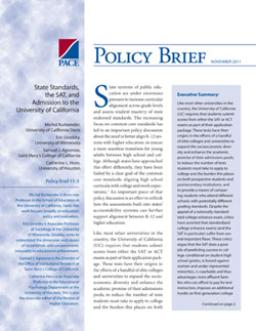
    Publication cover: State Standards, the SAT, and Admission to the University of California
    The University of California (UC) requires the SAT or ACT as part of their admissions process, but critics argue that these tests have flaws and are biased. This brief suggests that state-mandated standardized tests used to monitor student progress…
    wp
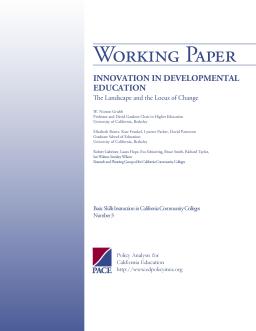
    The Landscape and the Locus of Change
    This PACE working paper examines six types of innovations to improve developmental education in California Community Colleges: individual practitioner efforts, departmental developments, learning communities, K-12 initiatives, Faculty Interest…