TOPIC

Continuous school improvement & support

Continuous School Improvement and Support

California and the nation are at the crossroads of a major shift in school accountability policy. At the state level, California’s Local Control Funding Formula (LCFF) and Local Control and Accountability Plan (LCAP) process encourage the use of multiple measures of school performance used locally to support continuous improvement and strategic resource allocation. Similarly, the federal Every Student Succeeds Act (ESSA) reinforces this local control, requiring more comprehensive assessment of school performance and a less prescriptive, local approach to school support.

Calls for “continuous improvement” in California’s K–12 education system are central to current discussions about school improvement in the state. Yet, definitions of continuous improvement vary, and knowledge of what continuous improvement looks like in practice is limited.

PACE research in this area addresses the challenges of those working in this changing accountability landscape by providing descriptions of continuous improvement in diverse educational organizations and by identifying the supports and challenges necessary to take new improvement approaches to scale.
    Recent Topic Publications
    Thumbnail
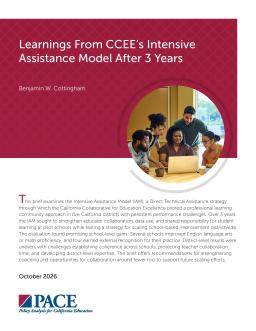
    This brief examines a three-year pilot of the California Collaborative for Education Excellence’s Intensive Assistance Model in five districts. It finds stronger educator collaboration and promising school-level gains, though achievement effects…
    Thumbnail
    Getting Down to Facts III Policy Recommendations
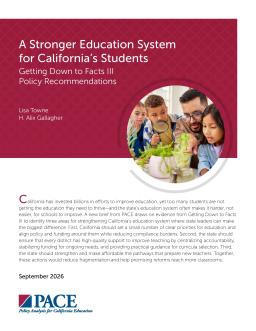
    This brief draws on Getting Down to Facts III to recommend three priorities for strengthening California’s education system: clear student goals, reliable instructional support for every district, and stronger, more affordable teacher preparation.…
    When AI Use Outpaces District Strategy
    Building Educator Capacity for Thoughtful Integration
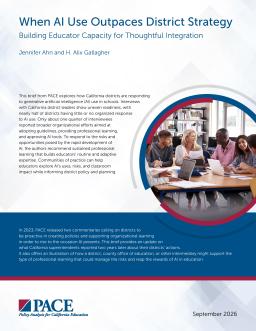
    This brief examines California districts’ responses to generative AI, finding that individual use often outpaces coordinated policy and support. Drawing on district interviews and a Lead by Learning example, it recommends sustained, collaborative…
    Thumbnail
    A Governance Case Study in Accountability, Balance, and Capacity
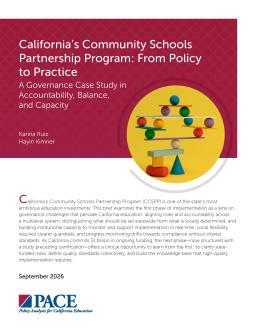
    This brief examines the first phase of California’s Community Schools Partnership Program. It finds that unclear roles, limited statewide guidance, and a lack of shared measures made it difficult to coordinate support and assess progress. As…