UC Davis Aligns Education and Workforce
Practice brief
Published
Summary
This brief examines the role of the University of California, Davis, in the Regional K–16 Education Collaboratives Grant Program, a statewide initiative designed to support pandemic recovery and address persistent inequities in higher education and workforce participation through regional partnerships. Focusing on UC Davis’ work in three California regions, the brief explores how intersegmental collaboration is structured and sustained across institutions.
Practice brief
Published
Summary
Many districts struggle to scale lasting instructional improvement; their systems—structures and processes—are key to successfully scaling improvement initiatives. Drawing on data from districts’ work with California Education Partners, this brief contrasts effective district system engagement with common pitfalls: delegating leadership, relying on informal networks, and maintaining too many priorities. District leaders play a pivotal role as only they have the authority to repurpose existing system resources, create new structures, and monitor systemwide progress.
Learning from California Education Partners’ Collaborations
Practice brief
Published
Summary
This brief introduces a three-part series describing California Education Partners’ multistage approach to supporting school districts with improving their students’ outcomes in literacy and mathematics. The approach addresses persistent barriers to improvement by building capacity in the district, piloting reforms, and focusing on scaling changes systemwide in sustainable ways. PACE authors highlight the successes and challenges of Ed Partners’ approach, emphasizing the fundamental importance of leadership at the teacher, school, and district levels to drive change throughout the district.
Translating Sierra House Elementary School’s Pilot Practices Across Lake Tahoe Unified School District
Practice brief
Published
Summary
This case study explores how Lake Tahoe Unified School District worked to improve math instruction, starting a pilot at Sierra House Elementary School. Partnering with California Education Partners, LTUSD addressed stagnant test scores by developing pacing guides, essential standards, and open-ended math tasks. Sierra House used these tools to create a collaborative system for analyzing student learning and refining instruction. While scaling districtwide remains a challenge, the Sierra House model highlights leadership and resource use with collaboration in advancing instructional coherence.
Grass Valley School District’s Progress Towards P–3 Coherence in Literacy
Practice brief
Published
Summary
Grass Valley School District (GVSD) partnered with California Education Partners through an initiative to improve literacy instruction. Over three years, GVSD implemented new literacy assessments and phonics practices, emphasizing teacher leadership, data use, and accountability. That shifted the district’s culture toward continuous improvement, enabling districtwide adoption of literacy initiatives and improved student outcomes. This case study highlights the need for stronger systems to build adult capacity and sustain leadership and collaboration.
CORE’s Approach
Practice brief
Published
Summary
Educators face a dilemma of staying up-to-date with evidence-based practices while dealing with superficial ideas. Continuous improvement methods can help in testing new ideas but if seen as add-ons, they may not yield sustained improvement. This brief describes the CORE Districts’ five-driver model that deepens educators’ ownership and sustains improvement over time.
A Key Investment for COVID-19 Recovery
Policy brief
Published
Summary
A healing-centered community school approach prioritizes students' physiological and safety needs to support their cognitive development. Complementary investments in policy, funding, and resources across education, health, and community development are necessary to sustain this approach. This guidance aims to help policymakers and educators use state and federal recovery resources to address immediate student needs and advance equity through sustainable systems and practices.
Practice brief
Published
Summary
This brief is one in a series aimed at providing K–12 education decision makers and advocates with an evidence base to ground discussions about how to best serve students during and following the novel coronavirus pandemic. Learn more about the EdResearch for Recovery Project and view the set of COVID-19 response-and-recovery topic areas and practitioner-generated questions here. The central question of this brief is: How can schools and districts monitor students’ social and emotional well-being across the year?
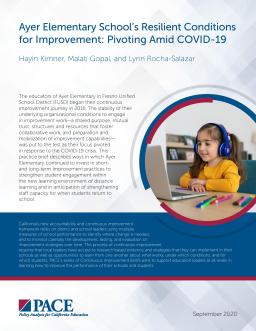
Pivoting Amid COVID-19
Case study
Published
Summary
This brief outlines Ayer Elementary's journey of continuous improvement since 2016 and how their organizational conditions were tested during the COVID-19 crisis. Despite the challenges, the school invested in improvement practices to strengthen student engagement in distance learning and build staff capacity for when students return to school.
Practice brief
Published
Summary
This brief discusses how traditional methods of grading have been disrupted due to the pandemic and suggests flexible grading and assessment practices that can support student learning and measure it meaningfully. The goal is to improve both learning and reporting during this time of disruption.
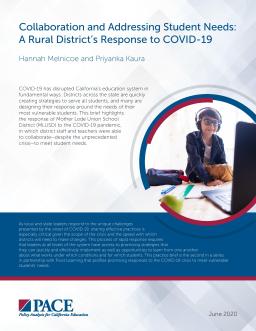
A Rural District’s Response to COVID-19
Practice brief
Published
Summary
COVID-19 has disrupted California’s education system in fundamental ways. Districts across the state are quickly creating strategies to serve all students, and many are designing their response around the needs of their most vulnerable students. This brief highlights the response of Mother Lode Union School District (MLUSD) to the COVID-19 pandemic, in which district staff and teachers were able to collaborate—despite the unprecedented crisis—to meet student needs.
Practice brief
Published
Summary
COVID-19 school closures may intensify the typical academic "slide" observed in math and reading over the summer break. Schools can consider online summer programs, ramped-up assessment, targeted instruction, and one-to-one tutoring to mitigate learning losses.
Case study
Published
Summary
This brief discusses how the Pajaro Valley Unified School District (PVUSD) in California is addressing the challenges of COVID-19 through family engagement and instructional access for English learners. The district has a history of serving all students through bilingual programming and a whole-child approach, and over 40% of its population are classified as English learners. PVUSD is a member of the national League of Innovative Schools and is known for its inclusive, data-driven decision-making.