Policy brief
Published
Summary
California cannot afford to ignore or postpone questions of how to support the academic success of English Learners (ELs) in the state’s K-12 education system. Language-minority students already represent more than 40 percent of the state’s K-12 public education students, and their share of enrollment is growing. How well California serves these students will help determine the vitality of the state’s economy and society in the years ahead.
Policy brief
Published
Summary
The University of California (UC) requires the SAT or ACT as part of their admissions process, but critics argue that these tests have flaws and are biased. This brief suggests that state-mandated standardized tests used to monitor student progress in secondary education, such as the CST exam in California, could be a suitable substitute for college entrance exams. The analysis in this brief shows that the CST exam offers similar predictive power for college performance and persistence at UC, compared to the SAT.
The Case for Contextualized Developmental Math
Policy brief
Published
Summary
This brief analyzes the effectiveness of contextualized developmental math in California Community Colleges, where fewer than 10% of students who enter at the basic math level complete college-level math. These integrated courses focus on math required in specific occupations and have higher success rates than traditional math courses. However, the pressure for traditional academic courses has eliminated many of these courses, hindering students' ability to acquire occupational skills and complete advanced courses or degrees.
Structuring School District Discretion over Teacher Employment
Policy brief
Published
Summary
This brief analyzes the relationship between teacher employment, collective bargaining laws, and school district policies in California. The authors examine the extent to which California's legal structure constrains or facilitates district-level discretion over teacher employment policies and practices. They classify various aspects of the teacher-school district employment relationship into four categories, and conclude that California statutory law is somewhat more constraining of administrative decision-making in teacher employment matters than in four other large and diverse states.
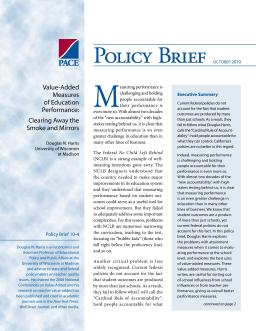
Clearing Away the Smoke and Mirrors
Policy brief
Published
Summary
This brief examines the strengths and weaknesses of value-added measures, which are useful for separating out school influences from other factors when evaluating teacher and school performance. Although value-added assessments give a summative picture of teacher performance, they do not provide guidance on how to improve. The author explores best uses and practices for value-added measures and discusses the limitations of attainment measures in evaluating school performance. The "Cardinal Rule of Accountability" is to hold people accountable for what they can control.
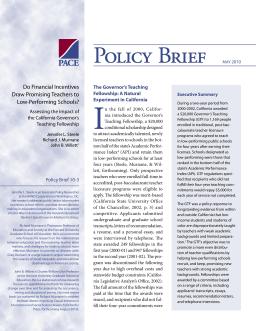
Assessing the Impact of the California Governor’s Teaching Fellowship
Policy brief
Published
Summary
This brief evaluates the effectiveness of CA's Governor's Teaching Fellowship, which aimed to recruit and retain highly qualified teachers in low-performing schools by providing a $20K fellowship to individuals enrolled in traditional teacher licensure programs who agreed to teach in designated schools. The study found that financial incentives can attract skilled professionals to work with underserved populations, but alternative policy designs should also be explored for cost-effectiveness. The results of the evaluation have important implications for state and national education policy.
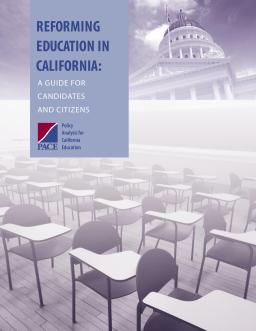
A Guide for Citizens and Candidates
Guide
Published
Summary
PACE has published a policy book to support informed debates about the issues facing California education. The book includes recommendations to improve education quality, targeting resources to those who need it most, giving local schools more flexibility, and designing policies for continuous improvement. While there's no one solution to fix public education, a series of good policies can bring about fundamental reform and improve outcomes for schools and students.
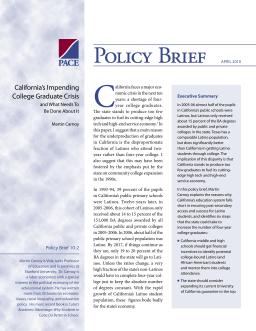
Policy brief
Published
Summary
This brief discusses the significant disparity between the Latino population in California's public schools and their representation among college graduates. The author suggests that this may lead to a shortage of graduates for California's economy and outlines six steps the state could take to improve access and success for Latino students in higher education.
Policy Levers for Institutional Change
Policy brief
Published
Summary
The Los Angeles Unified School District has undergone decades of reform, resulting in an unstable atmosphere rather than institutional stability. A recent book, "Learning from L.A.: Institutional Change in Public Education," identifies five policy levers that can create a more effective educational system and a new institutional structure for public education, both in LA and beyond.
Policy brief
Published
Summary
This brief examines the use of student test scores in teacher evaluations in CA. It argues that current evaluation methods are not effective, and that alternative methods of measuring teacher effectiveness, such as peer evaluations and student surveys, should be explored. The brief also discusses the potential consequences of over-reliance on test scores, such as teaching to the test and neglecting non-tested subjects. It concludes that teacher evaluations should be designed to provide useful feedback for professional development, rather than being used solely for accountability purposes.
Policy brief
Published
Summary
The brief discusses California's current school funding system and how it needs to be reformed to ensure equity and adequacy for all students. The current system is inadequate, unfair, and difficult to understand. The brief recommends a new system that is transparent, flexible, and based on student needs. The new system should also be aligned with state and local priorities, and provide incentives for districts to improve student outcomes. Finally, the brief emphasizes the importance of engaging stakeholders and building public support for the new funding system.
Lessons Learned
Policy brief
Published
Summary
This policy brief examines the recent development and approval of Proposition A in the San Francisco Unified School District, which included a parcel tax for increasing teacher salaries, introducing flexibility to the salary schedule, and strengthening accountability for teacher performance. The author describes how the district and union worked together to increase compensation and align school district goals with teacher salaries.
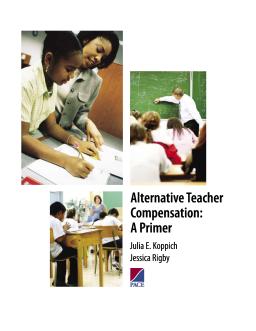
A Primer
Policy brief
Published
Summary
The report is a primer on alternative teacher compensation, which provides information about different models for teacher pay, and analyzes the benefits and challenges of each model. It highlights the reasons for the interest in alternative compensation, such as improving teacher quality, increasing teacher retention, and addressing teacher shortages. The report also examines the potential impact of alternative compensation on student outcomes, and offers recommendations for policymakers and practitioners considering implementing such programs.
Moving Beyond the Stereotype
Policy brief
Published
Summary
This brief examines how Collective Bargaining Agreements (CBAs) between school districts and teachers’ unions vary across California's 464 districts, suggesting that local flexibility is being used to solve specific problems. However, CBAs in high-need student districts are less likely to include unconventional provisions. The author suggests three policy levers the state can use to ensure local flexibility is used to benefit students: sharing best practices, incentives for innovation, and sanctions for abusing flexibility.
Continuous Improvement in California’s Education System
Policy brief
Published
Summary
This policy brief emphasizes the need for California's education system to become a continuously improving system that fosters innovation, measures the impact of policies and practices, and learns from experience. The authors identify key features of a continuously improving system, including clear goals, reliable data, change-supportive capacity, flexible decision-making, and aligned incentives. They explain how each of these features supports continuous improvement and highlight the differences between the current education system and a continuously improving one.
Reforming California School Finance
Policy brief
Published
Summary
This policy brief proposes a more rational and equitable school finance system for California that links district revenue to student needs and regional costs. The proposal aims to ensure that all districts are held harmless at current funding levels while providing essential backdrop for broader reform issues. The brief discusses the problems with the current finance system, the principles and concepts that guide the reform, and simulations of how it might work in practice. The report shows that significant improvement in the finance system can be achieved with modest new investment.
Policy brief
Published
Summary
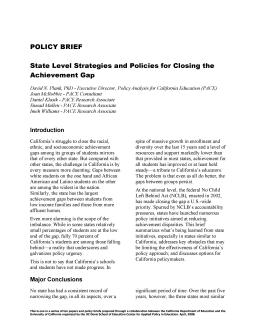
California faces significant challenges in closing the achievement gap between different student groups, including wide disparities based on race, ethnicity, and socioeconomic status. While progress has been made, the gaps persist. This report summarizes what is being learned from state initiatives to reduce these disparities, addresses obstacles limiting effectiveness, and provides options for policymakers to address this urgent issue.
Policy brief
Published
Summary
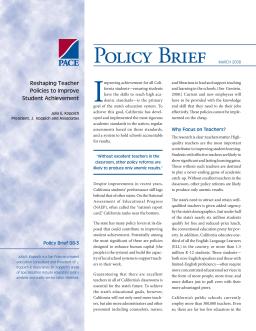
This policy brief proposes policy recommendations to improve teaching quality in California schools by experimenting with new policies in professional development, evaluation, compensation, and teacher career structure. It includes descriptions of innovative programs in each area being implemented across the US. The state can play a critical role in providing incentives, evaluating effectiveness, and developing partnerships to share knowledge about effective policies and practices.
Policy brief
Published
Summary
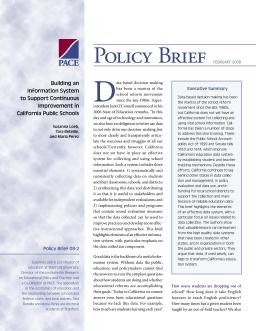
California needs to improve its education data system to collect and use vital school information for continuous improvement. The state is behind in data collection, management, evaluation, and funding compared to other states. The report suggests learning from other high-quality data systems and using data to transform California's education system.
Performance Trends in California Schools
Policy brief
Published
Summary
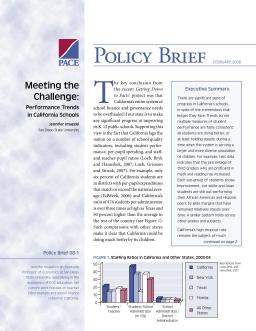
California's education system faces financial and demographic challenges, with per pupil spending below the national average and a majority of students living in poverty or English Learners. However, recent state and national assessments show improved academic performance, particularly for poor and minority students. More students are taking advanced math and science courses and meeting university admission requirements. While the state falls short of its goals, systemic reforms are needed, but the gains are a result of hard work and commitment from California's educators.

Data Systems and Policy Learning
Policy brief
Published
Summary
This report advocates for a continuous improvement approach to education in California, emphasizing the need for a comprehensive data system to inform decision-making and evaluation at all levels of the education system. It also recommends the use of research-based practices and the development of partnerships between schools and community organizations to support student success. The report emphasizes the importance of equity and suggests strategies for addressing achievement gaps and providing more resources to under-resourced schools.

Policy brief
Published
Summary
This report examines personnel policies in California schools and their impact on teacher quality and student outcomes. It finds that many districts have ineffective policies and recommends reforms, such as performance evaluations and professional development. The report also emphasizes the need to attract and retain high-quality teachers, provide support for them, and promote collaboration between districts and unions.

How the First Semester Matters for Community College Students’ Aspirations and Persistence
Policy brief
Published
Summary
This policy brief argues that expanding access to community college alone will not prepare California's workforce for the 21st century. It shows that many high school graduates who enter community college with the goal of transferring to four-year colleges do not make it through their first semester with their goals intact. Providing additional guidance and support during the first semester could improve student persistence and transfer rates, as the first semester is crucial in shaping students' post-secondary academic careers.

Options for California
Policy brief
Published
Summary
This policy brief examines accountability in California's education system, calling for a comprehensive approach that measures student outcomes and addresses systemic factors. The authors emphasize stakeholder engagement and local capacity building, and suggest a balanced approach that promotes continuous improvement for California's diverse student population.

Options for California
Policy brief
Published
Summary
This policy brief advocates for the expansion of career-technical education (CTE) in California's high schools through a CTE/multiple pathways approach. The authors argue that this approach integrates academic and occupational content, is more effective for students, and addresses criticisms of high schools. They propose building on existing CTE practices and providing funding, technical assistance, professional development, curriculum development, work-based learning opportunities, and data monitoring to support the expansion of CTE/multiple pathways.