Policy brief
Published
Summary
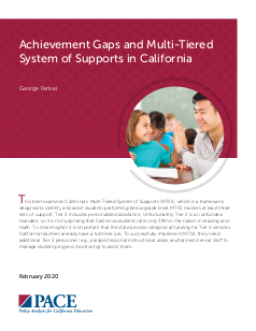
This brief highlights California's Multi-Tiered System of Supports (MTSS), which assists struggling students. The inadequate resourcing of Tier 2 services is nevertheless preventing progress in reading and math, as California ranks 38th in the nation. Categorical funding is necessary to provide additional personnel, such as instructional aides and clerical staff, to assist teachers with implementing MTSS effectively.
Policy brief
Published
Summary
This brief outlines the necessary steps to integrate care systems and improve outcomes for California's children. It suggests forming a statewide interagency leadership council and recommends policy reforms to promote collaboration, integration, and service delivery. The goal is to create a "Whole System" approach that integrates child-serving agencies and organizations. A full commitment from the state administration is needed to achieve these solutions at scale.
Views from the 2020 PACE/USC Rossier Poll
Report
Published
Summary
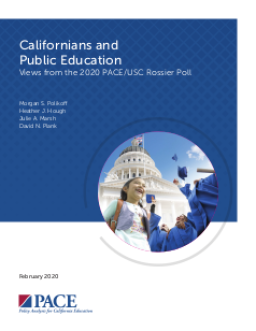
In the run-up to 2020 elections, where do California voters stand on key education policy issues? This report examines findings and trends from the 2020 PACE/USC Rossier poll. Key findings include rising pessimism about California education and elected officials, continued concern about gun violence in schools and college affordability, and negative opinions about higher education. However, there is substantial support for increased spending, especially on teacher salaries.
A Progress Report One Year After Getting Down to Facts II
Report
Published
Summary
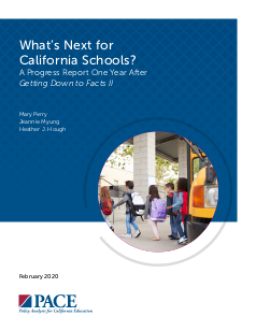
The 2018 Getting Down to Facts II research project drew attention to California’s continued need to focus on the achievement gap, strengthen the capacity of educators in support of continuous improvement, and attend to both the adequacy and stability of funding for schools. Based on the nature of the issues and the progress made in 2019, some clear next steps deserve attention as 2020 unfolds.
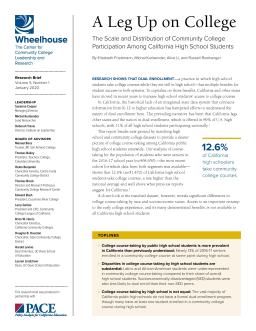
The Scale and Distribution of Community College Participation Among California High School Students
Policy brief
Published
Summary
California has sought to increase high school students’ access to college courses through dual enrollment. This brief matches high school and community college datasets, revealing that 12.6% of state high school students take college courses, higher than the national average. However, Latinx and African American students, as well as socioeconomically disadvantaged students, were underrepresented in community college course-taking. The vast majority of California public high schools lack formal dual enrollment programs, limiting access to an important onramp to the early college experience.
Implementation Challenges and Successes from Two District Cases
Report
Published
Summary
The Local Control Funding Formula (LCFF) in California was designed to increase flexibility, transparency, and equity in school districts. This report examines how Los Banos Unified School District and Chino Valley Unified School District used the LCFF to serve English Language Learners (ELLs). Both districts used the LCFF to create advocacy spaces and develop internal coherence to benefit ELLs with locally devised mechanisms and structures.
Challenges and Opportunities in California
Report
Published
Summary
California Governor Gavin Newsom prioritized early childhood education with new funding. However, sustaining and building on preK progress remains challenging. PreK–3 alignment has shown to be effective in coordinating standards, curricula, instruction, assessments, and professional development. This study examines California’s preK–3 alignment landscape to better understand the challenges and recommends policy implications to prioritize alignment, offer training, and streamline licensing requirements.
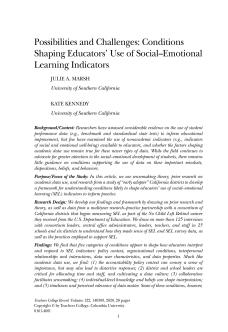
Conditions Shaping Educators’ Use of Social-Emotional Learning Indicators
Article
Published
Summary
This article explores the use of nonacademic indicators such as social and emotional well-being in educational improvement. The authors suggest that while there is little guidance on using these indicators, understanding the conditions that shape the use of academic data can help develop a framework for using social-emotional learning (SEL) indicators to inform practice. The article draws from sensemaking theory and research from a study of early adopter districts in California to develop this framework.