Crafting Standards to Track Quality
Working paper
Published
Summary
This paper investigates the effects of class size reduction (CSR) on student achievement in California's K-3 classrooms. Using data from the state's Standardized Testing and Reporting program, the authors find that smaller class sizes improve student achievement in English-language arts and have a stronger effect on low-income and minority students. However, the authors caution that the full benefits of CSR may be realized only with sustained implementation, quality teaching, and alignment with curriculum and instructional strategies.
Rekindling Reform
Report
Published
Summary
This report discusses key education policy challenges in California, including funding, teacher quality, achievement gaps, and school accountability. The report highlights the need for equitable funding and effective teacher training and retention programs to address these issues. It also emphasizes the importance of holding schools accountable for student achievement and providing targeted support to struggling schools. The report concludes by calling for sustained attention to these critical education issues to ensure that all California students have access to a high-quality education.
Issues, Evidence, and Resources
Policy brief
Published
Summary
This policy brief provides an overview of California's existing network of preschool centers and the potential impact of Proposition 82, which would provide funding for half-day preschool programs for 70% of the state's four-year-olds. PACE, an independent research center, aims to clarify evidence informing education policy options. A 2005 PACE review focused on enrollment patterns and policy options for improving access and quality of local preschools.
The Reliability of How States Track Achievement
Working paper
Published
Summary
This working paper analyzes the impact of the No Child Left Behind Act on the state's funding system and notes that it exacerbated inequities by penalizing schools that did not meet annual progress targets without providing sufficient resources to help them improve. The authors suggest that a more equitable funding system based on student needs and costs would better serve all students, including those who are struggling to meet academic standards.
Full Report
Report
Published
Summary
The Teaching and California's Future initiative provides policymakers with data on the teacher workforce and labor market. The initiative's annual report details teacher development policies and their impact on teacher quality and distribution. The goal is to help policymakers make informed decisions about strengthening the state's teacher workforce.
Report
Published
Summary
The quality of teaching and the need to expand California's ranks of excellent teachers demand urgent public discussion. We must attract the best and brightest to teaching, prepare them effectively, and support and retain them. Solutions require bipartisan leadership, not spin. This report presents the latest research and projections, highlighting that while some numbers are improving, we're likely to face severe shortages again soon and the pipeline for recruiting, preparing, and training teachers has substantial problems.
Shaping the Landscape of Equity and Adequacy
Article
Published
Summary
This report focuses on California's school governance system and how it affects schools' ability to provide an adequate and equal education. The author examines who is responsible for ensuring adequate resources, how to assess adequacy, how to determine school performance, and how to address deficiencies. The report argues that California's state-controlled governance system is irrational, incoherent, and limited in efficacy, contributing to substandard school conditions, as seen in the Williams v. California case.
Article
Published
Summary
This article presents a summary of a report prepared for the Williams v. State of California lawsuit, highlighting the achievement gap for English learners in California and seven areas where they receive an inequitable education compared to their English-speaking peers. It also documents the state's role in perpetuating these inequities and proposes remedies to reduce them.
Promising Benefits, Unequal Access
Policy brief
Published
Summary
This policy brief examines how California's education governance has shifted from local control to centralized, administrative accountability over the past 30 years, including changes in school finance. It primarily focuses on categorical program funding, assessing its impact on equity, adequacy, flexibility, choice, efficiency, predictability, stability, rationality, and accountability. The authors also propose alternative models to the existing system of categorical funding.
Case study
Published
Summary
The Bridge Project, a study of K-16 issues, presents three papers on college transition. The first finds a widespread lack of knowledge about college requirements and readiness among California students and parents. The second analyzes how students receive vague signals about academic college readiness. The third provides an example of how to improve K-16 transition and send clearer academic standards signals. Policy implications include low or no-cost recommendations to address these issues.
Successes, Challenges, and Opportunities for Improvement
Policy brief
Published
Summary
California's accountability system, PSAA, has been examined by three independent studies, revealing five key issues. The system established specific performance targets, rewards, and sanctions for schools, but budget constraints and differences with NCLB require changes. The STAR testing and school assessment system needs review, and Governor Schwarzenegger proposed simplifying the school finance system. The brief aims to inform policymakers, clarify complex accountability issues, highlight educators' views, and outline four major implications.
California’s Teaching Force, 2004—Key Issues and Trends
Report
Published
Summary
California's aging teacher workforce will lead to a significant demand for teachers, with shortages particularly in special education and secondary education. The number of underprepared teachers in low-performing schools serving minority, poor, and ELL students is disproportionate. Budget cuts have reduced funding for recruitment and professional development programs, and California's induction system needs refinement. Curriculum-based professional development programs have mainly targeted elementary school teachers, neglecting the training needs of secondary teachers.
Similar Test Scores, but Different Students, Bring Federal Sanctions
Policy brief
Published
Summary
California schools with more demographic subgroups are less likely to meet their growth targets and face federal sanctions, even when students have similar average test scores. Schools with many low-income Latino students are particularly unlikely to hit growth targets. Is it fair to label diverse schools as failing when their overall achievement level is not necessarily lower?
Unequal Resources, Unequal Outcomes
Article
Published
Summary
This article discusses the inequitable education provided to English language learners in California, arguing that there are seven areas where these students receive an inferior education compared to English speakers. That includes having less qualified teachers, inferior curriculum, and being assessed with invalid instruments. The article provides suggestions for addressing these issues.
Year Two Progress Report, 2002–03—Executive Summary
Report
Published
Summary
This report highlights findings from a 2002-03 progress report on First 5 California's childcare retention incentive programs, aimed at improving retention and increasing training among early care and education staff. Data were collected from ten counties through a phone survey of participants and site visits. Initial findings related to program design and implementation, program participation, training and professional development, and retention are summarized.
Evaluation Findings and Implications
Policy brief
Published
Summary
This report evaluates California's Public Schools Accountability Act of 1999, which aimed to hold schools accountable for student results. The brief summarizes the main findings and implications of the legislatively mandated, independent evaluation of the Act, with the aim of helping states understand and learn from preceding accountability efforts.
Constructions of Gender and Sexuality in California’s Single Gender Academies
Article
Published
Summary
This article examines the impact of heterosexist assumptions and homophobia on students' experiences in California's public "Single Gender Academies." Interviews with students reveal a critical link between sexuality, masculinity, and femininity, and the ways in which assumptions about sexuality are embedded in school policies, practices, and peer relations. The article provides an analysis of homophobia among students and the influence of academy assumptions on students' attitudes towards gender and sexuality.
Working paper
Published
Summary
The No Child Left Behind Act of 2001 mandates all states to demonstrate “adequate yearly progress” towards state proficiency goals. This report explores how to measure sustained improvement in California public schools, and how demographic and school-level variables relate to student achievement. Annual Academic Performance Index scores alone do not indicate sustained improvement, so it is recommended to consider student progress over a longer time frame and all known variables that impact it.
National Disparities in Funding, Teacher Quality, and Student Support
Working paper
Published
Summary
Charter schools were intended to close the achievement gap and create tight-knit communities that motivate students and teachers. The assumption is that charter schools can avoid the disparities that public schools face. Recent data from the National Center for Educational Statistics (NCES) allows for comparison between charter and public schools. The survey data illuminates similarities and differences between the two types of schools.
Bay Area Childcare Retention Incentive Programs Evaluation—Year One Progress Report, 2001–02
Policy brief
Published
Summary
The First 5 California Children and Families Commission has funded the Childcare Retention Incentive (CRI) to improve the quality of early care and education (ECE) staff training and retention. An evaluation funded by First 5 California assesses the efficacy of CRI programs in San Francisco and Alameda counties. This report summarizes the preliminary findings from the first year of the Alameda Child Development Corps and San Francisco CARES programs, which examine whether CRI recipients are more likely to participate in training and be retained compared to non-participating ECE staff.
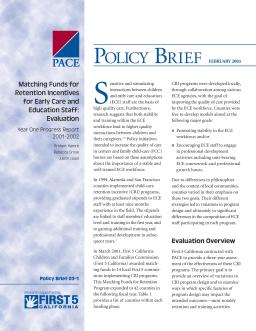
Year One Progress Report, 2001–2002
Policy brief
Published
Summary
This policy brief examines the effectiveness of childcare retention incentive (CRI) programs in selected California counties. It assesses program design, participant characteristics, training activities, and retention rates among early care and education staff. The study aims to identify the impact of CRI programs on the stability and training of the ECE workforce, which is critical for improving the quality of care for children.
Article
Published
Summary
This paper examines the incidence, causes, and consequences of student mobility in the US. Mobility not only harms the students who change schools, but also the classrooms and schools they attend. The causes and consequences of mobility are more complicated than many people assume. The authors suggest ways for parents, schools, districts, and policymakers to address this growing educational problem.
Summary Report
Report
Published
Summary
This report argues that the state of California needs to prioritize better education for all children with a sustained long-term investment of resources and leadership. Despite political upheaval and fiscal problems, there is a consensus for better education. The authors suggest that the issue requires a response as intense and sustained as the state's response to natural disasters, and calls for a system of teacher development to ensure all teachers have the necessary knowledge and skills to meet academic standards.
The Early Impacts of Welfare Reform for California's Children, 1998–2000
Working paper
Published
Summary
This report examines the effects of welfare-to-work and childcare capacity building on the childcare system in California, prompted by changes in the childcare system and welfare reform. The study was requested by the California Department of Social Services, and this paper provides an overview of the findings.
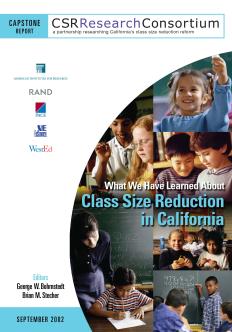
Report
Published
Summary
This report discusses the implementation and impact of class size reduction in California's K-3 classrooms. The initiative was prompted by concerns over falling standardized test scores in the mid-1990s. The report includes findings from a consortium of evaluators, including PACE, and provides policy recommendations and lessons learned.