Policy brief
Published
Summary
Public education in California shows progress, yet challenges remain in providing equal opportunities for all students. Poverty rates persist, and schools are highly segregated by race, ethnicity, family income, and language. While student outcomes are improving, significant achievement gaps exist, and California students perform worse than their peers in other states. Career technical education programs provide opportunities for diverse students, but there are gaps in tracking students' educational trajectories.
Report
Published
Summary
The use of social-emotional learning (SEL) and school culture/climate (CC) measures is a promising way to understand school performance. SEL and CC measures are reliable, distinguish between schools, and relate to academic and non-academic measures. They can identify areas for improvement within schools, such as subgroup gaps. Incorporating these measures into higher stakes accountability systems requires further research.
Learning from the CORE Districts' Focus on Measurement, Capacity Building, and Shared Accountability
Report
Published
Summary
California and the US are undergoing a cultural shift in school accountability policies towards locally-determined measures of school performance. Lessons can be learned from the CORE districts, which developed an innovative accountability system, emphasizing support over sanctions, and utilizing multiple measures of school quality. The CORE districts' measurement system and collaboration hold promise for improving local systems, but efforts to build capacity remain a work in progress.
Multiple Measures and the Identification of Schools Under ESSA
Policy brief
Published
Summary
This report examines the Every Student Succeeds Act (ESSA) and how schools can be identified for support and improvement using a multiple measures framework. The authors find that different academic indicators measure different aspects of school performance and suggest that states should be allowed to use multiple measures instead of a summative rating. They also find that non-academic indicators are not given enough weight and suggest a clarification in federal policy.
Obstacles and Opportunities
Report
Published
Summary
Over the past several years, there has been much attention and advocacy around “PreK-3 Alignment,” both in California and nationwide. The push for alignment comes in the face of a growing body of research documenting the benefits of attending high quality preschool, along with concerns about the fading of the benefits of preschool by third grade that has been found in many studies. Supporters of preK-3 alignment note that child development is a continuous process, and that skills developed in one grade must be built upon and reinforced in later grades.
Comparing Different Student Subgroup Sizes for Accountability
Policy brief
Published
Summary
This policy brief analyzes the implications of using various subgroup sizes for school-level reporting under the ESSA. Data from the CORE Districts shows that a subgroup size of 20+ offers clear advantages in representing historically underserved student populations. The authors also produced a supplementary report comparing subgroup sizes of 20+ and 30+ in response to new ESSA regulations.
Policy brief
Published
Summary
To support policymaker discussions on including chronic absenteeism data in California's accountability system, PACE analyzed the CORE Districts' student chronic absenteeism data. It is feasible to include chronic absence as a measurement using the state's approach for rating school achievement based on outcome and improvement or by simply looking at performance in a given school year.
Time to Reaffirm the Grand Vision
Report
Published
Summary
The Local Control Funding Formula (LCFF) replaced categorical funding for schools in California in 2013, providing flexibility, targeted student funding, and local accountability. Two years in, research shows optimism and concern. The Local Control and Accountability Plan (LCAP) faces challenges, stakeholders need more engagement, and implementation requires capacity and overcoming the emerging teacher shortage. Public awareness of LCFF lags at 65%.
Findings from School District-University Collaborative Partnerships
Policy brief
Published
Summary
Policy changes in California create an opportunity to improve education for 1.4 million English learner students. Research suggests improving classification and alignment between services, systematic data collection and improving opportunities in schools. This could benefit large numbers of students without requiring large investments.
Early Implementation of California's Local Control Funding Formula
Policy brief
Published
Summary
California's Local Control Funding Formula (LCFF) represents a major shift in the state's education system by empowering school districts to allocate funding based on the needs of their students, with added funds for disadvantaged students. The LCFF eliminates categorical funding streams and promotes local democracy by requiring stakeholder engagement. The implementation of the LCFF is still in its early stages, and this study examines how school districts are using their newfound budget flexibility and engaging stakeholders, as well as identifying opportunities and challenges.
What California's Beginning Teachers Experience
Policy brief
Published
Summary
California's policies for beginning teachers assume a uniform path of completing a preparation program, BTSA, earning a Clear Credential and tenure. However, a recent study shows that the policies fail to recognize the reality of a longer, bumpier and more circuitous path faced by the majority of beginning teachers.
Using Existing Tools to Increase College-Readiness Now
Policy brief
Published
Summary
California can increase college readiness for community college-bound students by using existing tools such as the California High School Exit Exam and Academic Performance Index to identify and provide remediation for 10th-graders who need it, as well as reward high schools for encouraging all students to enroll in appropriate Grade 12 mathematics. This policy brief explains the benefits of these changes alongside the implementation of the Common Core State Standards and Smarter Balanced assessments.
Rethinking Budget Priorities Under the LCFF
Policy brief
Published
Summary
The passage describes the implementation of the Local Control Funding Formula (LCFF) in California, which is expected to bring new revenues to school districts. The report suggests that strategic decision-making and goal-setting based on research-based strategies are crucial to realizing the potential benefits of the LCFF. Recommendations include an investment in four key areas that can produce real gains in school and student performance.

Key Design Elements for Meaningful Teacher Observation
Policy brief
Published
Summary
Teacher evaluation is a powerful tool for improving public education, with classroom observations being essential. However, using student test scores and value-added measures is controversial. This brief recommends four key principles for observation-based assessment, including the use of standards-based instruments and non-administrator assessors. By partnering with teacher unions, California can successfully reform its evaluation system to improve instructional practice and accountability.
Policy brief
Published
Summary
The policy brief examines the impact of QTEA on teacher recruitment, retention, and overall teacher quality in the San Francisco Unified School District. It provides evidence of the effectiveness of salary increases in attracting and hiring higher-quality teachers, and the importance of strategic hiring and retention efforts. The brief also highlights the need for teacher confidence in the longevity of such policies, and suggests the Local Control Funding Formula as a means to ensure sufficient funds for competitive teacher salaries.
Policy brief
Published
Summary
Internet technology can transform the education system in three ways: individualizing learning, making it smart with adaptive software, and creating an open network for learning production. California can lead the way by adopting policies to leverage digital technologies and online resources for Learning 2.0. This would improve the performance of schools and students, and create opportunities for teachers, small enterprises, and individuals to contribute to the production of learning.
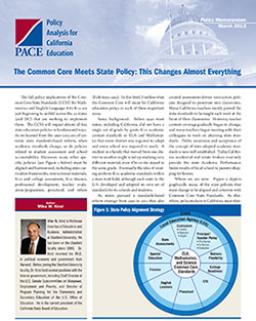
This Changes Almost Everything
Policy brief
Published
Summary
Common Core State Standards (CCSS) will impact many state education policies in fundamental ways. Before 1990, most states did not have uniform K-12 academic standards, and each state developed its own. To align policies with CCSS, CA must eliminate contradictions, look for gaps where no policy exists, and ensure sufficient breadth and depth of newly aligned policies. Common Core will transform instruction by focusing on fewer, higher, and deeper standards. However, current state assessment and accountability systems in CA are not aligned with the CCSS's specific instructional approach.
How High Schools Can Be Held Accountable for Developing Students' Career Readiness
Policy brief
Published
Summary
Preparing every high school graduate for postsecondary education and fulfilling work is the goal of common core standards. Career readiness and college readiness share many of the same skills, knowledge, and dispositions. Being ready for professional life requires additional transferable skills to support success throughout a lifetime of changing circumstances. The importance of transferable skills is emphasized by many groups and observers.
Can It Support California’s College and Career-ready Goal?
Policy brief
Published
Summary
California’s school finance system has been criticized for being irrational, inequitable, and inefficient. The proposed Local Control Funding Formula aims to simplify funding and give local leaders more control, but raises questions about balancing transparency with improved outcomes, providing meaningful incentives, and effectively allocating funds.
Policy brief
Published
Summary
The California Academic Performance Index (API) is limited by demographics, instability, and narrow focus on test scores. Experts recommend tracking individual students' progress, measuring achievement growth over multiple years, and using alternative performance measures. Improving API could enhance accountability systems and target educational improvements.
Strong Returns from a $19.5 Billion Investment
Policy brief
Published
Summary
The LAUSD invested over $19B to build 130 new facilities to relieve overcrowded schools. A PACE policy brief analyzed its effects on student achievement and found robust gains for many elementary-school pupils who switched from old to new facilities. However, significant gains were limited to elementary school students and new high school facilities produced weak and inconsistent achievement gains. The report also tracked thousands of students who moved from overcrowded to new facilities over the 2002-2008 period.
Policy brief
Published
Summary
California cannot afford to ignore or postpone questions of how to support the academic success of English Learners (ELs) in the state’s K-12 education system. Language-minority students already represent more than 40 percent of the state’s K-12 public education students, and their share of enrollment is growing. How well California serves these students will help determine the vitality of the state’s economy and society in the years ahead.
Policy brief
Published
Summary
The University of California (UC) requires the SAT or ACT as part of their admissions process, but critics argue that these tests have flaws and are biased. This brief suggests that state-mandated standardized tests used to monitor student progress in secondary education, such as the CST exam in California, could be a suitable substitute for college entrance exams. The analysis in this brief shows that the CST exam offers similar predictive power for college performance and persistence at UC, compared to the SAT.
The Case for Contextualized Developmental Math
Policy brief
Published
Summary
This brief analyzes the effectiveness of contextualized developmental math in California Community Colleges, where fewer than 10% of students who enter at the basic math level complete college-level math. These integrated courses focus on math required in specific occupations and have higher success rates than traditional math courses. However, the pressure for traditional academic courses has eliminated many of these courses, hindering students' ability to acquire occupational skills and complete advanced courses or degrees.
Structuring School District Discretion over Teacher Employment
Policy brief
Published
Summary
This brief analyzes the relationship between teacher employment, collective bargaining laws, and school district policies in California. The authors examine the extent to which California's legal structure constrains or facilitates district-level discretion over teacher employment policies and practices. They classify various aspects of the teacher-school district employment relationship into four categories, and conclude that California statutory law is somewhat more constraining of administrative decision-making in teacher employment matters than in four other large and diverse states.