Characteristics, Outcomes, and Transitions
Policy brief
Published
Summary
The CORE districts studied characteristics, outcomes, and transitions of students with disabilities (SWDs). Specific learning disability was the most common type. Males, African Americans, English learners, and foster youth were overrepresented. Chronic absence was higher for SWDs with multiple disabilities. Most SWDs entered special education in K-4 and exited in grades 8-12. These results help identify who may need targeted support.
Policy brief
Published
Summary
Only 10% of eligible infants and toddlers with developmental delays nationwide receive early intervention services, and CA serves fewer children than the national average. This is due to challenges such as spotty screening, tenuous linkages to referral and evaluation, and crossing multiple agencies. Massachusetts has a unified early childhood data system and robust interagency linkages, resulting in a greater percentage of their infant and toddler population served. Implementing a unified data system and interagency streamlining in CA could increase the number of children and families served.
Policy brief
Published
Summary
Students with disabilities should be included in programs that prepare them for life after high school. This can be achieved through a K-14 work-based learning model, which involves strengthening expectations, leveraging opportunities, and integrating supports. Early implementation of these actions is encouraged, along with specific policy recommendations for California.
Policy brief
Published
Summary
Preparing youth with disabilities for adulthood can be challenging, requiring additional supports and coordinated planning. Effective practices, such as family involvement, inclusion in general education, and interagency collaboration, can facilitate successful transitions to employment, postsecondary education, and community living. School districts must work with families, employers, and community agencies to implement these practices.
Policy brief
Published
Summary
This brief discusses how California's System of Support uses differentiated assistance (DA) to provide support to districts and boost student group performance levels. It analyzes the districts eligible for DA in 2019 based on their students with disabilities' (SWD) performance on State Priority Areas (SPAs) and indicators. The findings show that over half of the 333 eligible districts were driven by SWD performance in SPAs 4 (Pupil Achievement) and 5 (Pupil Engagement), highlighting intersectional challenges facing SWD that districts can address through their continuous improvement process.
Policy brief
Published
Summary
This brief highlights California's Multi-Tiered System of Supports (MTSS), which assists struggling students. The inadequate resourcing of Tier 2 services is nevertheless preventing progress in reading and math, as California ranks 38th in the nation. Categorical funding is necessary to provide additional personnel, such as instructional aides and clerical staff, to assist teachers with implementing MTSS effectively.
Views from the 2020 PACE/USC Rossier Poll
Report
Published
Summary
In the run-up to 2020 elections, where do California voters stand on key education policy issues? This report examines findings and trends from the 2020 PACE/USC Rossier poll. Key findings include rising pessimism about California education and elected officials, continued concern about gun violence in schools and college affordability, and negative opinions about higher education. However, there is substantial support for increased spending, especially on teacher salaries.
A Progress Report One Year After Getting Down to Facts II
Report
Published
Summary
The 2018 Getting Down to Facts II research project drew attention to California’s continued need to focus on the achievement gap, strengthen the capacity of educators in support of continuous improvement, and attend to both the adequacy and stability of funding for schools. Based on the nature of the issues and the progress made in 2019, some clear next steps deserve attention as 2020 unfolds.
Implementation Challenges and Successes from Two District Cases
Report
Published
Summary
The Local Control Funding Formula (LCFF) in California was designed to increase flexibility, transparency, and equity in school districts. This report examines how Los Banos Unified School District and Chino Valley Unified School District used the LCFF to serve English Language Learners (ELLs). Both districts used the LCFF to create advocacy spaces and develop internal coherence to benefit ELLs with locally devised mechanisms and structures.
Conditions Shaping Educators’ Use of Social-Emotional Learning Indicators
Article
Published
Summary
This article explores the use of nonacademic indicators such as social and emotional well-being in educational improvement. The authors suggest that while there is little guidance on using these indicators, understanding the conditions that shape the use of academic data can help develop a framework for using social-emotional learning (SEL) indicators to inform practice. The article draws from sensemaking theory and research from a study of early adopter districts in California to develop this framework.
California’s College Readiness Standards and Lessons from District Leaders
Report
Published
Summary
This report summarizes efforts to align California's K-12 and postsecondary education systems to address disparities in educational attainment. Based on district leaders' interviews and quantitative data, the report finds that rigorous academic preparation is crucial to college success, and that participation and performance on college admissions exams are key indicators of college readiness. However, substantial inequality exists across all measures of readiness, and district leaders emphasize the importance of engaging families and the community in supporting postsecondary success.
Findings From the First Large-Scale Panel Survey of Students
Article
Published
Summary
This article discusses the use of standardized tests as the primary tool for assessing school-level growth in student outcomes, despite the emerging importance of social-emotional learning (SEL). It presents results from large-scale surveys of students on SEL constructs, and finds significant differences across schools in SEL growth, with magnitudes of differences similar to those for academic achievement. However, caution is recommended in interpreting measures as causal impacts of schools on SEL, as the goodness of fit of the value-added model was considerably lower for SEL measures.
Policy brief
Published
Summary
California does not use a student-level growth model to measure school performance, which is uncommon among states. This brief refutes common beliefs about growth models and provides evidence that they are inaccurate or unsupported. It suggests that California should adopt a growth model to replace the current "change" metric in the California School Dashboard, with student-growth percentiles and residual-gain growth models as two specific models that would more accurately identify schools that require support.
Evidence from the CORE Districts and the PACE/USC Rossier Poll
Policy brief
Published
Summary
The increase in students opting out of standardized tests is a threat to accurately measuring student achievement. This brief examines the effects of opting out in the CORE districts and models how it could affect accountability measures. More opt-outs could significantly impact some metrics, but the growth measure is largely unaffected. Metrics tracking achievement by cohort are at risk of bias, even with low levels of opting out. Adjusting for characteristics of students who take the tests could be a solution.
A Research Summary and Implications for Practice
Policy brief
Published
Summary
Given the importance of a college degree for both individual and societal economic prosperity, policymakers and educators are focused on strengthening the path to college beyond college entry. In this report, we synthesize the existing literature on four factors key to educational attainment—aspirations and beliefs, academic preparation, knowledge and information, and fortitude and resilience—and the implications of each.
Practice brief
Published
Summary
California has added student attendance to its accountability system to emphasize its importance, but chronic absenteeism's causes are not well-understood. Schools face the expectation to address absenteeism, but myths about attendance persist. The brief covers local efforts to improve attendance and highlights the steps required to build schools' and communities' capacity to get and keep kids in school.

Practice brief
Published
Summary
Governor Gavin Newsom’s budget proposal for 2019–2020 includes $10 million to develop a statewide longitudinal data system—including early education, K–12, and higher education institutions as well as health and human services agencies—to better track student outcomes and improve alignment of the education system to workforce needs. California’s lack of a coherent education database serves as a substantial barrier to fulfilling the state’s continuous improvement policy goal and ensuring all students have access to robust learning opportunities to enable them to be successful in school and...
Working paper
Published
Summary
This study examines the impact of target setting for non-academic indicators on school quality ratings in CORE districts' elementary schools. The authors found that non-academic measures of school quality vary over time, are not consistently associated with demographics, and are sensitive to small changes in rating thresholds. The results suggest a need for more research on target setting for non-academic indicators in school quality systems.

Evidence from the 2019 PACE/USC Rossier Voter Poll
Policy brief
Published
Summary
This brief analyzes the 2018 update of the California School Dashboard, examining improvements and areas for continued enhancement. Using data from the 2019 PACE/USC Rossier poll, the author characterizes use of and support for the Dashboard, finding low use, equity gaps, but high support and preference for the new Dashboard.
Evidence to Inform Policy
Policy brief
Published
Summary
Governor Newsom’s first Budget Proposal increases funding for education in California. There are areas of substantive overlap in the Budget Proposal and research findings from the Getting Down to Facts II (GDTFII) research project, released in September 2018, which built an evidence base on the current status of California education and implications for paths forward. As the Budget moves from proposal to reality, it is critical that the evidence from GDTFII continues to inform the policy process.
Views from the 2019 PACE/USC Rossier Poll
Report
Published
Summary
With a new governor, state superintendent and legislators in Sacramento and a diminished federal role in education, there is an opportunity for California’s leaders to take stock of recent educational reforms and make necessary improvements. There are also a host of new and looming issues in K-12 and higher education. As California’s leaders confront these and other issues, where do California voters, including parents, stand on education and education policy? The newest edition of the USC Rossier/PACE Poll shares voter perspectives on a wide range of education issues.
Describing Chronically Absent Students, the Schools They Attend, and Implications for Accountability
Article
Published
Summary
In "Absent from School," PACE Executive Director Heather J. Hough analyzes student absenteeism using data from California's CORE districts. She explores the differences in absenteeism rates among students and schools, comparing them to other performance indicators. Dr. Hough also examines how schools' performance on chronic absence metrics corresponds to other accountability measures, highlighting the implications for reporting school-level measures of chronic absenteeism.
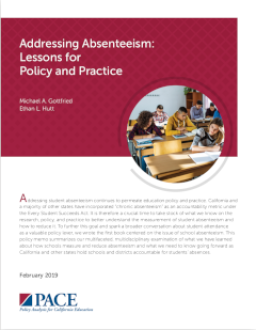
Lessons for Policy and Practice
Policy brief
Published
Summary
This "policy memo" highlights the importance of addressing student absenteeism, now incorporated as an accountability metric under the Every Student Succeeds Act. The first book on the issue of school absenteeism summarizes what we know about measuring and reducing absenteeism and calls for a broader conversation on this policy lever as schools and districts are held accountable for students’ absences.
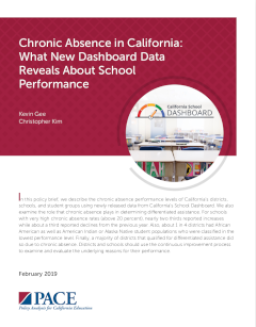
What New Dashboard Data Reveals About School Performance
Policy brief
Published
Summary
This policy brief analyzes chronic absence data of California's districts, schools, and student groups using California's School Dashboard. It shows that chronic absence is a major factor in determining differentiated assistance, with many districts having low-performing African American and American Indian or Alaska Native student populations. Schools with high chronic absence rates should evaluate their underlying reasons for poor performance through continuous improvement processes.
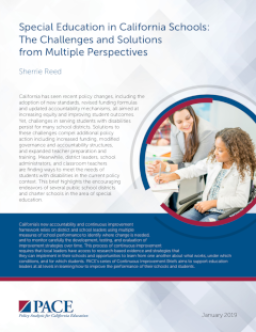
The Challenges and Solutions from Multiple Perspectives
Practice brief
Published
Summary
This brief identifies persistent challenges in serving students with disabilities in California despite recent policy changes. It highlights the need for additional policy action such as increased funding, modified governance, and accountability structures, and expanded teacher preparation and training. The brief also showcases several public school districts and charter schools finding ways to meet the needs of students with disabilities in the current policy context.