Policy brief
Published
Summary
This brief examines a three-year pilot of the California Collaborative for Education Excellence’s Intensive Assistance Model in five districts. It finds stronger educator collaboration and promising school-level gains, though achievement effects were not statistically significant and districtwide scaling remained uneven. The brief recommends sustained instructional coaching, protected teacher collaboration time, and a sharper focus on core academic outcomes to build district capacity and support lasting improvements in teaching and learning.
Getting Down to Facts III Policy Recommendations
Policy brief
Published
Summary
This brief draws on Getting Down to Facts III to recommend three priorities for strengthening California’s education system: clear student goals, reliable instructional support for every district, and stronger, more affordable teacher preparation. It calls for aligned policy and funding, reduced compliance burdens, sustained support for improving teaching, and expanded four-year preparation pathways to help promising reforms reach more classrooms.
A Governance Case Study in Accountability, Balance, and Capacity
Policy brief
Published
Summary
This brief examines the first phase of California’s Community Schools Partnership Program. It finds that unclear roles, limited statewide guidance, and a lack of shared measures made it difficult to coordinate support and assess progress. As California commits $1 billion in ongoing funding, the brief calls for clearer responsibilities, quality standards developed with practitioners and communities, and stronger evidence to guide statewide certification.
Strengthening California’s Support for Districts
Policy brief
Published
Summary
This brief examines the capacity of California’s instructional support system to help districts improve TK–8 mathematics. Drawing on interviews with district, state, county, provider, and policy leaders, it finds that competing priorities, uneven teacher preparation, limited sustained professional learning, inadequate curricular guidance, and fragmented regional and statewide assistance weaken local improvement efforts.
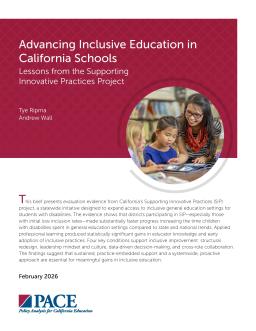
Lessons from the Supporting Innovative Practices Project
Policy brief
Published
Summary
This brief presents evaluation findings from California’s Supporting Innovative Practices (SIP) project, a statewide effort to expand inclusive general education access for students with disabilities. SIP participation is associated with faster growth in least restrictive environment indicators than statewide trends. Cross-case analyses identify four enabling conditions: structural redesign, leadership mindset and culture, data-driven continuous improvement, and cross-role collaboration. Findings suggest inclusive gains are achievable when districts receive sustained, practice-embedded support...
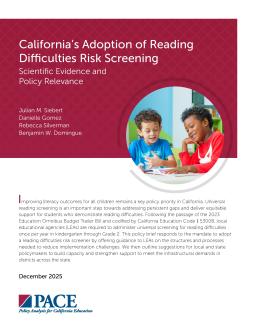
Scientific Evidence and Policy Relevance
Policy brief
Published
Summary
California now requires annual K–2 screening for reading difficulties to identify students early and guide support. This brief outlines key policy elements, considerations for multilingual learners, and implementation steps for districts, emphasizing training, coherent MTSS systems, and state investment to ensure effective, equitable literacy improvement. It cites persistent literacy gaps as motivation and urges continuous evaluation of screeners and district capacity over time.
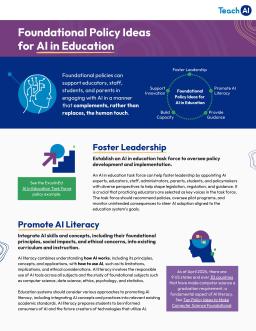
TeachAI Informational Briefs
Policy brief
Published
Summary
Within the TeachAI Policy Workgroup, PACE has facilitated the development of AI policy informational briefs aimed at ensuring the effective, safe, and responsible integration of AI in education. These briefs offer guidance to education leaders and policymakers, emphasizing the importance of crafting policies that prioritize teaching and learning. The briefs provide insights derived from current research and landscape analysis of AI use in TK–12 educational settings, addressing common questions and centering around five guiding principles for developing responsible AI policies in education.
Policy brief
Published
Summary
Declining student enrollment is leading to a loss of revenue in many California school districts. To address ongoing budget shortfalls, many districts have consolidated or shuttered schools,and others are contemplating doing so. A new report and working paper, summarized in this brief, explore the racial dimensions of school closures and how to address them.
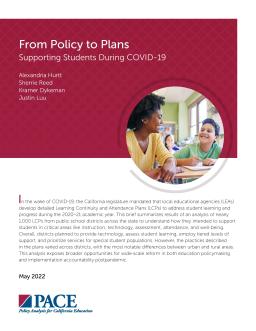
Supporting Students During COVID-19
Policy brief
Published
Summary
An analysis of Learning Continuity and Attendance Plans (LCPs) developed by local educational agencies in California during the 2020-21 academic year showed variations in practices across districts, particularly between urban and rural areas. While districts planned to provide technology, assess student learning, and offer tiered levels of support, broader opportunities for reform and implementation accountability in education policymaking are needed post-pandemic.
Policy brief
Published
Summary
Community schools are gaining attention as a promising solution for students from low-income families who have suffered economic trauma during the COVID-19 pandemic. Policymakers are investing in their expansion, and effective use of data will be crucial. This report discusses findings of a research project led by the Los Angeles County Office of Education and the USC Center on Education, Policy, Equity, and Governance and provides recommendations for implementing a data system to address community-specific needs.
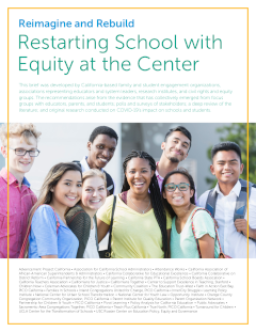
Restarting School with Equity at the Center
Report
Published
Summary
This brief was developed by California-based family and student engagement organizations, associations representing educators and system leaders, research institutes, and civil rights and equity groups. The recommendations arise from the evidence that has collectively emerged from focus groups with educators, parents, and students; polls and surveys of stakeholders; a deep review of the literature; and original research conducted on COVID-19’s impact on schools and students.
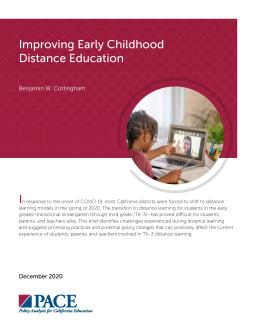
Policy brief
Published
Summary
This brief addresses the challenges that have arisen in California's transitional kindergarten through third grade distance learning during the pandemic. It offers promising practices and policy changes that can benefit students, parents, and teachers involved in distance learning.
Policy brief
Published
Summary
This brief highlights the need and ways to transform—systematically—how schools address the overlapping learning, behavioral, and emotional problems that can interfere with learning and teaching. The aim is to provide a blueprint to enable the state, Local Education Agencies (LEAs), and schools to play a greater role in providing student and learning supports, and to do so in ways that enhance equity of opportunity.
Lessons for Improving Network Collaboration
Policy brief
Published
Summary
Collaborative networks using continuous improvement principles can accelerate and spread learning. This brief highlights the importance of understanding the benefits of collaboration, building a culture of trust and vulnerability, and engaging in true collaborative work, not just "show and tell." These lessons can help network members work together effectively to improve outcomes for students in changing conditions.
Report
Published
Summary
The brief summarizes the PACE report "Enabling Conditions and Capacities for Continuous Improvement," which provides a framework for supporting teaching and learning during the COVID-19 pandemic. The framework emphasizes the importance of rapid cycles of improvement and the enabling organizational conditions for continuous improvement, including shared purpose, mutual trust, and resources for collaborative work. Examples of this approach in practice can be found in a related PACE brief "Ayer Elementary School's Resilient Conditions for Improvement: Pivoting Amid COVID-19."
Policy brief
Published
Summary
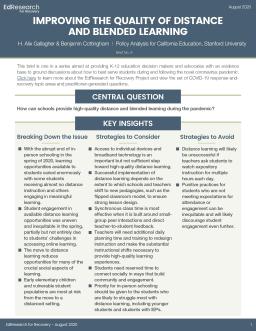
How can schools provide high-quality distance and blended learning during the pandemic? This brief includes a mix of rigorous evidence from extant studies, data from interviews with practitioners who described their learnings from informal experimentation during the spring of 2020, and expert researchers who thought about how to apply research to the current context.
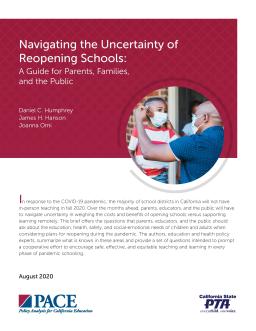
A Guide for Parents, Families, and the Public
Guide
Published
Summary
This brief provides questions for parents, educators, and the public to consider when deciding whether to reopen schools or support remote learning during the COVID-19 pandemic. Education and health policy experts summarize what is known in these areas and provide a set of questions to encourage safe, effective, and equitable teaching and learning during every phase of pandemic schooling.
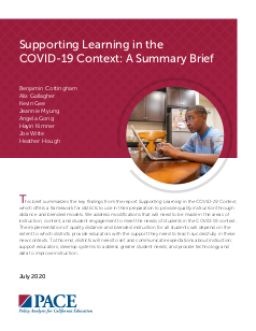
Research to Guide Distance and Blended Instruction
Report
Published
Summary
This suite of publications provides 10 recommendations based on the PACE report to help educators and district leaders provide high-quality instruction through distance and blended learning models in the 2020-21 school year. Despite the challenges of COVID-19, research can guide decisions about student learning and engagement. These recommendations can be used as a framework to prioritize quality instruction.
What California’s Leaders Must Do Next to Advance Student Learning During COVID-19
Policy brief
Published
Summary
On July 17th, 2020, Governor Newsom announced that all K–12 schools in California counties with rising COVID-19 infections would be required to teach remotely. Without a strong focus on improving the quality of remote education at scale, students could lose up to a year’s worth of learning, and as many as 1.1 million students could fail to graduate high school. That academic impact would be felt most acutely by low-income, Black, and Latinx students. California’s leaders must act now to prioritize equity and ensure quality across all of the state’s districts. New policies do establish baseline...
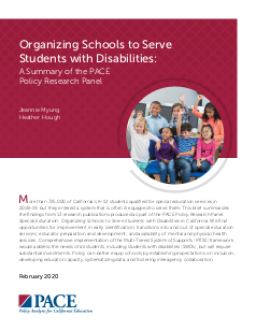
A Summary of the PACE Policy Research Panel
Policy brief
Published
Summary
Over 725,000 California K-12 students received special education services in 2018-19, but the system is not always equipped to serve them. Early screening, identification, and intervention, as well as better transitions, educator support, and mental/physical health services, need improvement. A Multi-Tiered System of Supports (MTSS) framework in schools could address SWDs' needs, but it requires additional resources and policy support to improve educator capacity and collaboration between agencies while systematizing data on SWDs.
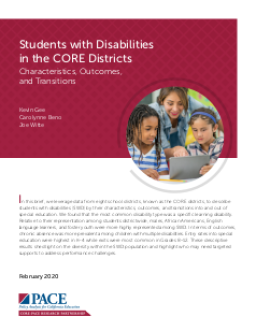
Characteristics, Outcomes, and Transitions
Policy brief
Published
Summary
The CORE districts studied characteristics, outcomes, and transitions of students with disabilities (SWDs). Specific learning disability was the most common type. Males, African Americans, English learners, and foster youth were overrepresented. Chronic absence was higher for SWDs with multiple disabilities. Most SWDs entered special education in K-4 and exited in grades 8-12. These results help identify who may need targeted support.
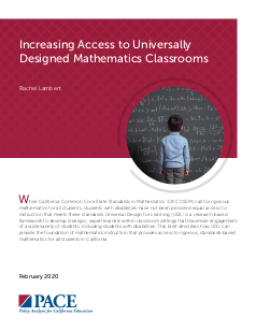
Policy brief
Published
Summary
This brief explains that while the California Common Core State Standards in Mathematics require rigorous instruction for all students, those with disabilities do not always have equal access to this instruction. It recommends the use of Universal Design for Learning (UDL), a research-based framework that enables expert learners within classroom settings and maximizes engagement for all students, including those with disabilities, to provide access to rigorous, standards-based mathematics instruction for all students in California.
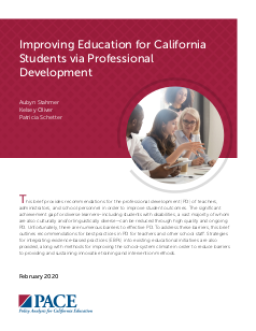
Policy brief
Published
Summary
This brief suggests recommendations for improving student outcomes by providing high quality and ongoing professional development to teachers, administrators, and school personnel. It identifies the achievement gap for diverse learners, including culturally and linguistically diverse students with disabilities, and offers strategies for integrating evidence-based practices into existing educational initiatives. Additionally, it outlines methods for improving the school-system climate to reduce barriers to providing and sustaining innovative training and intervention methods.
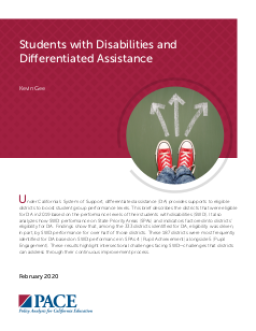
Policy brief
Published
Summary
This brief discusses how California's System of Support uses differentiated assistance (DA) to provide support to districts and boost student group performance levels. It analyzes the districts eligible for DA in 2019 based on their students with disabilities' (SWD) performance on State Priority Areas (SPAs) and indicators. The findings show that over half of the 333 eligible districts were driven by SWD performance in SPAs 4 (Pupil Achievement) and 5 (Pupil Engagement), highlighting intersectional challenges facing SWD that districts can address through their continuous improvement process.
Policy brief
Published
Summary
This brief highlights California's Multi-Tiered System of Supports (MTSS), which assists struggling students. The inadequate resourcing of Tier 2 services is nevertheless preventing progress in reading and math, as California ranks 38th in the nation. Categorical funding is necessary to provide additional personnel, such as instructional aides and clerical staff, to assist teachers with implementing MTSS effectively.