Charting Their Experiences and Mapping Their Futures in California Schools
Policy brief
Published
Summary
California's 1.3 million English learner (EL) students have diverse needs, and many lack access to grade-level content instruction, with English language development falling short. Bilingual and dual immersion programs benefit ELs' academic, linguistic, social, and life outcomes, but reclassification policies are currently in flux. Early-career teachers may not be adequately prepared to teach ELs, and funding mechanisms are weak. EL outcomes are complex to interpret as students move in and out of the subgroup, and education sectors are not aligned to address ELs' needs.
Policy brief
Published
Summary
Charter schools serve 620,000 students in California, but their impact on traditional public schools is unknown. Charter schools have significantly better academic growth in urban areas and lower-performing groups. California's charter school authorization is decentralized with limited accountability and oversight capacity. Renewal processes are unclear, and the standards for renewal are low.
Policy brief
Published
Summary
California has over 3 million children ages 5 and under, with a large proportion living in poverty or with non-English-speaking parents. Quality early childhood education is important for future success, but the state system is marked by low wages, inconsistent standards, and insufficient monitoring. Child care is expensive and doesn't meet the needs of nonstandard schedules. California has a large proportion of children in care with no standards, and identifying young children with disabilities is inadequate. There is no centralized data collection system for evaluating improvement efforts.
Policy brief
Published
Summary
Public education in California shows progress, yet challenges remain in providing equal opportunities for all students. Poverty rates persist, and schools are highly segregated by race, ethnicity, family income, and language. While student outcomes are improving, significant achievement gaps exist, and California students perform worse than their peers in other states. Career technical education programs provide opportunities for diverse students, but there are gaps in tracking students' educational trajectories.
Report
Published
Summary
CA is shifting the responsibility for school improvement to local school districts with County Offices of Education playing a supportive role. The focus is on local leaders driving educational improvement and ensuring quality. Strategic data use is central to the implementation of this policy, with questions remaining about what data is needed, by whom, and for what purpose. This paper provides a framework for how data use for improvement is different from data use for accountability and shares lessons from the CORE Data Collaborative on how to use data for improvement in networked structures.

Promising Practices From the Field
Practice brief
Published
Summary
California needs a longitudinal data system to improve student outcomes. Meanwhile, regional partnerships between education institutions and community organizations are using data to improve outcomes. A guide was created to help leaders with data sharing and use, and presents the components of effective regional efforts around data sharing and use, with tools to dive deeper into specific factors within each component. The guide aims to serve as a framework, tool for reflection, and networking resource for intersegmental leaders.
Practice brief
Published
Summary
California's K-12 public school districts, institutions of higher education, and community organizations are collaborating to improve educational and labor market outcomes. This Resource Guide, based on a qualitative research project, provides intersegmental partnerships with tools to support the development, planning, and monitoring of their data practices. The guide includes critical components of effective strategies for data sharing and use, and can be used as a framework, reflection tool, and networking resource.
Implementing the Local Control Funding Formula
Report
Published
Summary
The Local Control Funding Formula (LCFF) provides base funding and grants for low-income students, English learners, and foster youth, and allows local school systems to allocate resources as they see fit. The LCFFRC conducted a survey of 350 California superintendents to understand their experiences with and views of the law. Results inform policymakers and indicate areas where changes may be needed. The survey sample included districts of varying sizes and proportions of unduplicated students.
A Pragmatic Approach to Validity and Reliability
Report
Published
Summary
This report discusses the validity and reliability of CORE Districts’ social-emotional learning (SEL) student-report surveys. Through a pragmatic approach, the report answers four guiding questions that explain different facets of validity for school leaders. The aim is to provide guidance around the use of SEL surveys within and outside of the CORE districts to facilitate decision-making for educational leaders.

Evidence from the CORE Districts
Report
Published
Summary
This study examines how social-emotional skills develop from Grade 4 to Grade 12 and vary by gender, socioeconomic status, and race/ethnicity. Based on self-report student surveys administered to around 400,000 students in California, the study finds that social-emotional skills do not increase uniformly and vary across subgroups. Females have higher social awareness but lower self-efficacy than males. Economically disadvantaged students show improvement in high school. White students report higher social-emotional skills than African American and Latinx students.
An IRT Modeling Approach
Case study
Published
Summary
This study examines the properties of California's CORE Districts' SEL survey, which measures social-emotional learning in students. The survey was given to over 400,000 students in grades 3-12. The study uses both classical test theory and item response theory frameworks to analyze the data and make recommendations for modeling and scaling SEL survey data. Policy implications are discussed for educators, administrators, policy makers, and other stakeholders.
Findings from the First Large-Scale Panel Survey of Students
Working paper
Published
Summary
This paper examines the use of social-emotional learning (SEL) measures to evaluate school-level growth in student outcomes. The study finds substantial differences across schools in SEL growth, suggesting that schools may contribute to students' SEL. However, caution is recommended in interpreting measures as the causal impacts of schools on SEL due to potential measurement error and omitted variables bias.
Practices and Supports Employed in CORE Districts and Schools
Report
Published
Summary
This study explores ten "outlier schools" in California's CORE districts that have strong social-emotional learning outcomes. The brief and infographic summarize the various practices found in these schools and the common implementation challenges faced. The findings offer lessons that can help other schools and districts implement social-emotional learning at scale.
A Multidistrict Analysis of Statewide Mandated Democratic Engagement
Article
Published
Summary
This article examines the democratic participation in the first-year implementation of California's Local Control Funding Formula (LCFF) by analyzing data from 10 districts. It finds that power imbalances, institutional habits, and limited capacity constrain stakeholder involvement, while trust, support, and homogeneity foster deeper democratic engagement. The article concludes with implications for policy, practice, and future research.
How Do Different High School Assessments Measure Up?
Report
Published
Summary
This report analyzes the predictive value of the Smarter Balanced Assessment, high school GPA, and SAT scores on early college outcomes for California State University and University of California, Davis students. The study examines differences among student subgroups, including race/ethnicity and socioeconomic disadvantage, and provides insights into how well the Smarter Balanced Assessment measures up to other commonly used assessments for predicting college success.
Case study
Published
Summary
States and school districts across the U.S. are seeking to expand their definition of student success to include social-emotional learning. The CORE Districts, a collaborative of California districts that has developed a system of school accountability and continuous improvement that includes measures of social-emotional skills based on student self-reports, exemplify this trend. In this case study, we provide an overview of CORE's School Quality Improvement System, which was implemented in the 2015–16 school year across six districts serving roughly one million students.
Report
Published
Summary
California's LCFF is a significant change in education finance and governance that sends funds to districts based on student need and eliminates most categorical funding. The LCFF requires districts to engage with stakeholders and develop a Local Control and Accountability Plan (LCAP). The LCFF Research Collaborative identified districts with innovative implementation efforts in stakeholder engagement, implementation of California State Standards, and resource allocation decision-making. These positive examples can serve as models for others to learn and improve from.
Practice brief
Published
Summary
Teacher recruitment and retention are critical responsibilities of school districts. The challenge of finding, supporting and retaining good teachers requires innovative solutions collaboratively developed by diverse stakeholders. This brief highlights the efforts of four Northern California school districts to address human resource challenges and hire, develop and retain high quality teachers, which represent promising strategies for other districts across California.

A Smart Investment for California School Districts
Practice brief
Published
Summary
Flexible funding formulas have made high-quality summer learning programs more accessible for school districts seeking to close the achievement gap. Programs that combine engaging summer camp activities with intentional learning goals can help students develop a love of learning and prevent summer learning loss. These programs incorporate lesson plans and evaluations of learning into a fun and engaging environment.
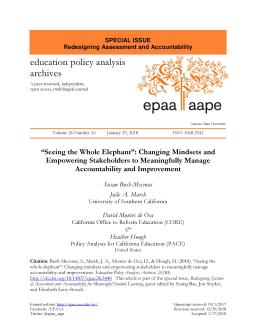
Changing Mindsets and Empowering Stakeholders to Meaningfully Manage Accountability and Improvement
Article
Published
Summary
The shift towards multiple-measure dashboard accountability has potential for promoting more meaningful learning, but also comes with challenges. Lessons learned from research on CORE Districts show that a shift to flexibility and capacity building efforts has challenges. Oakland Unified School District's approach suggests that districts have agency to modify mindsets by modeling inquiry, openness, and flexibility, giving stakeholders space and authority to manage accountability and improvement.
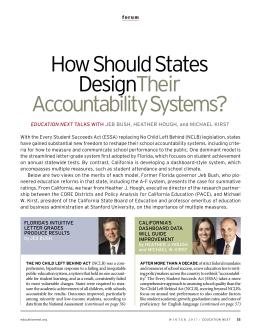
Article
Published
Summary
The Every Student Succeeds Act (ESSA) allows states to reshape their school accountability systems. One dominant model is the letter-grade system first adopted by Florida, while California is developing a dashboard-style system that encompasses multiple measures such as student attendance and school climate. Former Florida Governor Jeb Bush presents the case for summative ratings, while Heather J. Hough and Michael W. Kirst of PACE stress the importance of multiple measures.
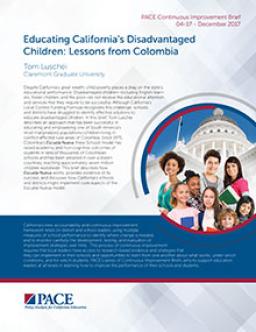
Lessons from Colombia
Practice brief
Published
Summary
Child poverty in California limits educational success for disadvantaged children, but schools struggle to identify effective solutions. Colombia's Escuela Nueva model has successfully educated marginalized rural children since 1975, raising academic and non-cognitive outcomes in tens of thousands of schools worldwide. This brief describes how Escuela Nueva works and discusses how California's schools might implement core aspects of the model to better serve disadvantaged students.
Report
Published
Summary
This report explores the concept of "continuous improvement" in California's K-12 education system, defining it as a shared, evidence-based process that requires a change in culture and a substantial investment of time and resources. Interviews with education leaders reveal the need for capacity building and data use, as well as barriers including a lack of clarity and resources. Implementing continuous improvement system-wide requires a shift in mindset and culture, persistent effort, and a focus on student outcomes.
Early lessons from the CORE Districts
Report
Published
Summary
California policy shifts gave school districts more control, but many lack expertise and capacity for improvement. The CORE districts applied continuous improvement in a Networked Improvement Community to close the math achievement gap for African American and Hispanic/Latino students. The four lessons learned were: create an improvement team, refine theories through systems analysis, interpret different data, and benefit from expert facilitation. Investment in continuous improvement can lead to powerful insights and reform.

A Powerful Strategy for Equity
Practice brief
Published
Summary
Achievement gaps in education cannot be solved by looking at the school day alone, as young people also have varied experiences outside of school. Free and affordable learning experiences after school and in the summer are essential strategies for equalizing student outcomes. California districts have greater regulatory and financial flexibility to address achievement gaps under the Local Control Funding Formula. This brief describes how local education leaders are mobilizing expanded learning to close the opportunity gap and recommends key steps for districts.