Lessons from Other States
Report
Published
Summary
This report examines how California can implement Assembly Bill 181’s restructuring of state education leadership to provide clearer guidance and dependable support for districts and schools. Drawing on document reviews and interviews across six other states, it identifies five key findings on shared goals, capable leadership, clear responsibilities, responsive services, and public engagement. The report offers nine recommendations for managing the transition, with priorities for immediate action, the first 100 days, and the first year.
Policy brief
Published
Summary
This brief examines a three-year pilot of the California Collaborative for Education Excellence’s Intensive Assistance Model in five districts. It finds stronger educator collaboration and promising school-level gains, though achievement effects were not statistically significant and districtwide scaling remained uneven. The brief recommends sustained instructional coaching, protected teacher collaboration time, and a sharper focus on core academic outcomes to build district capacity and support lasting improvements in teaching and learning.
A Governance Case Study in Accountability, Balance, and Capacity
Policy brief
Published
Summary
This brief examines the first phase of California’s Community Schools Partnership Program. It finds that unclear roles, limited statewide guidance, and a lack of shared measures made it difficult to coordinate support and assess progress. As California commits $1 billion in ongoing funding, the brief calls for clearer responsibilities, quality standards developed with practitioners and communities, and stronger evidence to guide statewide certification.
Report
Published
Summary
This report examines the fiscal pressures facing California’s K–12 education system despite substantial funding growth. It explains how volatile state revenues, declining enrollment, rising costs, and reliance on one-time spending complicate long-term planning for districts. The report identifies three central policy questions involving per-pupil spending, more predictable funding for sustained priorities, and educator compensation that benefits employees while protecting district finances.
Past, Present, and Future
Report
Published
Summary
The report TK–12 Education Governance in California: Past, Present, and Future examines the history of California’s education governance system, analyzes the state of the current system and its effectiveness across six key dimensions, and offers recommendations for realigning roles and responsibilities to create a more coherent education governance system in California. Education governance encompasses the mechanisms through which decisions are made, responsibilities are distributed, and accountability is maintained within the public education system.
Revisiting Basic Aid in the LCFF Era
Report
Published
Summary
This report analyzes how California’s school finance system—built to promote equity through the Local Control Funding Formula (LCFF)—continues to produce unequal opportunities due to property wealth disparities. It explores how “basic aid” districts, which generate more local tax revenue than the state funding formula provides, have accumulated growing advantages over other districts. Drawing on fiscal and demographic analysis, the report highlights how these patterns shape resource gaps and teacher labor markets across the state and offers policy options to promote greater funding equity.
The Technology Is New, but the Challenges Are Familiar
Article
Published
Summary
Optimists believe AI will partner with teachers to provide customized learning resources, digital tutors, and innovative experiences tailored to individual students’ needs. Pessimists express concerns about the potential dehumanization of education, arguing that AI could increase students' reliance on digital tools, reduce meaningful human interactions, and perpetuate biases and misinformation. In this article, the authors highlight the need for education leaders and policymakers to navigate the use of AI with care, balancing its transformative potential with its inherent risks.
An Update on Dual Enrollment Participation Among Public High School Graduates
Infographic
Published
Summary
California policymakers and educators are promoting dual enrollment to boost educational attainment and equal access to postsecondary opportunities. Assembly Bill 288, enacted in 2016, encouraged high school-community college collaboration, and funding for dual enrollment has increased. Local educators are working to expand programs and support student success. Participation grew steadily from 2015–16 to 2019–20, but stalled in 2020–21 and 2021–22, likely due to the COVID-19 pandemic's impact on dual enrollment opportunities.
Policy brief
Published
Summary
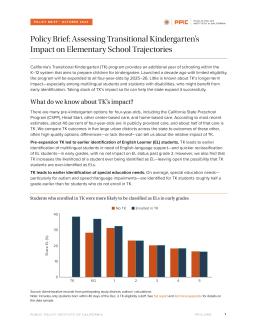
California’s Transitional Kindergarten (TK) program provides an additional year of schooling within the K–12 system that aims to prepare children for kindergarten. Launched a decade ago with limited eligibility, the program will be expanded to all four-year-olds by 2025–26. Little is known about TK’s longer-term impact—especially among multilingual students and students with disabilities, who might benefit from early identification. Taking stock of TK’s impact so far can help the state expand it successfully.

A TeachAI Toolkit
Guide
Published
Summary
TeachAI—in collaboration with Code.org, CoSN, Digital Promise, the European EdTech Alliance, James Larimore, and PACE—has launched an AI Guidance for Schools Toolkit to help school systems worldwide meet the urgent need for guidance on the safe, effective, and responsible use of artificial intelligence.It helps education authorities, school leaders, teachers, and others create thoughtful guidance to help their communities realize the potential benefits of incorporating artificial intelligence (AI) in education while understanding and mitigating the potential risks.
Policy brief
Published
Summary
Declining student enrollment is leading to a loss of revenue in many California school districts. To address ongoing budget shortfalls, many districts have consolidated or shuttered schools,and others are contemplating doing so. A new report and working paper, summarized in this brief, explore the racial dimensions of school closures and how to address them.
Report
Published
Summary
Enrollment in California public schools has been declining and is projected to fall even more steeply during the next decade. Because funding for school districts is largely based on average daily attendance rates, a decline in enrollment results in a loss of funding. To address budget shortfalls and align services with student counts, many districts have consolidated or closed schools, or they are contemplating doing so.
Working paper
Published
Summary
This study investigates racial disparities in school closures both within California and nationally. Findings highlight an alarming pattern: Schools enrolling higher proportions of Black students are at significantly increased risk of closure relative to those enrolling fewer Black students, a pattern that is more pronounced in California than elsewhere in the United States. The findings underscore that school closures in California and elsewhere reflect racial inequalities that require adequate policymaking to ensure equitable and fair school-closure proceedings.
Policy brief
Published
Summary
Newcomers represent a large and understudied subgroup of students in California. The Oakland Unified School District has been disaggregating data on newcomer status for the last 7 years, providing a basis for analyzing graduation outcomes for newcomer compared to non-newcomer students. The data highlight the variance in outcomes based on program placement and design. Drawing from analysis of Oakland Unified’s data and practices, the authors make programmatic recommendations for districts with newcomer students.
Promising Practices
Case study
Published
Summary
This case study identifies promising practices for newcomer education implemented in San Juan Unified School District (SJUSD), one of 12 local educational agencies (LEAs) funded under the California Newcomer Education and Well-Being (CalNEW) project between 2018 and 2021. This report was developed through a partnership between PACE and the Center for Equity for English Learners (CEEL) at Loyola Marymount University (LMU).
Insights and Strategies From Exemplar School Districts
Guide
Published
Summary
This resource guide addresses a key problem that many district and school leaders in California face: how to increase student enrollment and success in A–G courses to reduce equity gaps in college eligibility. Developed from a qualitative research study that examined the policies and practices of nine school districts in California with A–G completion rates surpassing the overall statewide rate, the guide presents strategies, tools, and resources to address challenges with A–G course alignment, counseling, and scheduling.
What Districts Need to Fulfill Its Promise
Policy brief
Published
Summary
California's Universal Transitional Kindergarten (UTK) faces challenges as districts prioritize meeting state requirements, hindering focus on quality. To address this, the state can incentivize districts by setting a vision, establishing goals, and measuring progress based on enrollment, implementation features, and student outcomes. It should align resources and support for widespread high-quality UTK implementation, while ensuring public communication of key aspects and outcomes to empower communities to monitor district performance.
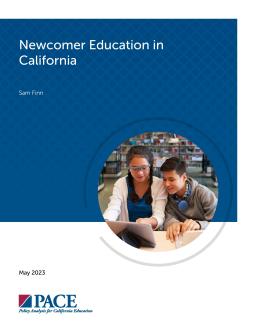
Report
Published
Summary
Every year, 150k-200k new immigrant students in California need specialized instruction and social services to succeed, but many districts struggle to provide them, resulting in dropouts and poor outcomes. Inaccessible instruction and lack of basic necessities hinder progress. The PACE report recommends developing data, instruction, and social support services to improve newcomer outcomes in California.
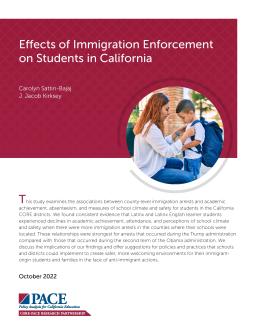
Policy brief
Published
Summary
This study explores the impact of county-level immigration arrests on the academic achievement, attendance, and perceptions of school climate and safety for Latinx and Latinx English learner students in California's CORE districts. The research found that there is a negative relationship between immigration arrests and these students' academic performance and school experiences. The study recommends policies and practices that can help schools and districts create safer, more welcoming environments for immigrant-origin students and families in the face of anti-immigrant actions.
The 2022 PACE/USC Rossier Poll
Report
Published
Summary
The 2021-22 academic year in California was challenging for public education due to eight issues that threaten student learning, schools, and public education itself, including gun violence, declining enrollment, and long-term funding inadequacy. These issues also have a disproportionate impact on marginalized communities and highlight long-standing systemic inequities. In July 2022, PACE and USC Rossier School of Education conducted a poll of California voters to determine their views and priorities on public education.
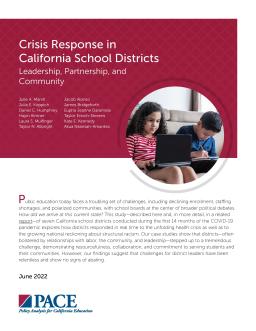
Leadership, Partnership, and Community
Case study
Published
Summary
This study of seven California school districts during the COVID-19 pandemic shows how districts responded in real-time to the crisis and structural racism. Districts showed resourcefulness, collaboration, and commitment to serving students and communities. However, challenges remain, including declining enrollment, staffing shortages, and polarized communities, with school boards at the center of broader political debates.
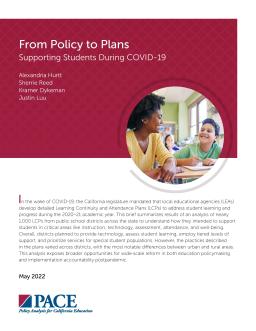
Supporting Students During COVID-19
Policy brief
Published
Summary
An analysis of Learning Continuity and Attendance Plans (LCPs) developed by local educational agencies in California during the 2020-21 academic year showed variations in practices across districts, particularly between urban and rural areas. While districts planned to provide technology, assess student learning, and offer tiered levels of support, broader opportunities for reform and implementation accountability in education policymaking are needed post-pandemic.
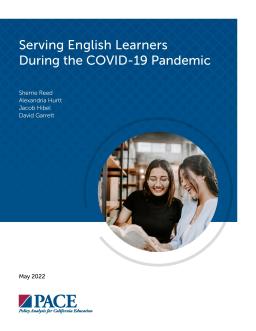
Report
Published
Summary
The COVID-19 pandemic has made it difficult for English learners (ELs) to receive the services and support they need for academic success. This report highlights how K–12 public school districts planned to support ELs during the pandemic. While many districts communicated plans to assess student progress and provide services for ELs, details on the sufficiency of these plans were lacking. The legislation mandating the plans did not include measures for adherence or monitoring student outcomes, leaving questions about the actual strategies implemented by districts and how ELs were affected.
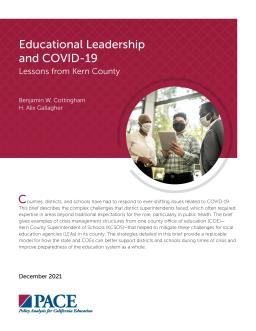
Lessons from Kern County
Policy brief
Published
Summary
This brief examines the challenges that district superintendents faced in responding to COVID-19, often requiring expertise beyond traditional expectations. It discusses crisis management structures implemented by Kern County Superintendent of Schools as a model for how COEs can support districts and schools during times of crisis and improve the preparedness of the education system.
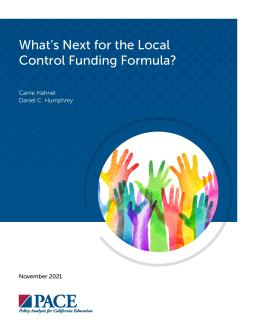
Report
Published
Summary
This report examines California's Local Control Funding Formula (LCFF) after eight years and suggests refinements to improve equitable funding, opportunities, and outcomes. Based on interviews, research, and data analysis, the report identifies four areas for improvement: revisiting and refining the funding formula, modernizing funding for students with disabilities, equitably distributing effective teachers, and strengthening transparency, engagement, and accountability. LCFF has been viewed as an improvement over the previous system yet gaps between equity goals and local outcomes remain.