A Progress Report One Year After Getting Down to Facts II
Report
Published
Summary
The 2018 Getting Down to Facts II research project drew attention to California’s continued need to focus on the achievement gap, strengthen the capacity of educators in support of continuous improvement, and attend to both the adequacy and stability of funding for schools. Based on the nature of the issues and the progress made in 2019, some clear next steps deserve attention as 2020 unfolds.
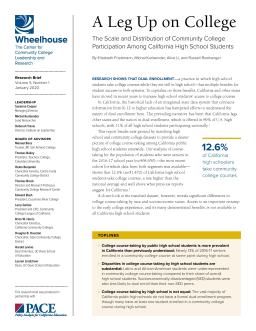
The Scale and Distribution of Community College Participation Among California High School Students
Policy brief
Published
Summary
California has sought to increase high school students’ access to college courses through dual enrollment. This brief matches high school and community college datasets, revealing that 12.6% of state high school students take college courses, higher than the national average. However, Latinx and African American students, as well as socioeconomically disadvantaged students, were underrepresented in community college course-taking. The vast majority of California public high schools lack formal dual enrollment programs, limiting access to an important onramp to the early college experience.
Implementation Challenges and Successes from Two District Cases
Report
Published
Summary
The Local Control Funding Formula (LCFF) in California was designed to increase flexibility, transparency, and equity in school districts. This report examines how Los Banos Unified School District and Chino Valley Unified School District used the LCFF to serve English Language Learners (ELLs). Both districts used the LCFF to create advocacy spaces and develop internal coherence to benefit ELLs with locally devised mechanisms and structures.
Challenges and Opportunities in California
Report
Published
Summary
California Governor Gavin Newsom prioritized early childhood education with new funding. However, sustaining and building on preK progress remains challenging. PreK–3 alignment has shown to be effective in coordinating standards, curricula, instruction, assessments, and professional development. This study examines California’s preK–3 alignment landscape to better understand the challenges and recommends policy implications to prioritize alignment, offer training, and streamline licensing requirements.
Conditions Shaping Educators’ Use of Social-Emotional Learning Indicators
Article
Published
Summary
This article explores the use of nonacademic indicators such as social and emotional well-being in educational improvement. The authors suggest that while there is little guidance on using these indicators, understanding the conditions that shape the use of academic data can help develop a framework for using social-emotional learning (SEL) indicators to inform practice. The article draws from sensemaking theory and research from a study of early adopter districts in California to develop this framework.
Counties, Differentiated Assistance, and the New School Dashboard
Report
Published
Summary
This report examines the early implementation of California's Statewide System of Support, which is designed to empower local educators in determining the best approaches to improvement. While COEs and district officials hold positive views of the system's emphasis on support over compliance, they have concerns about under-resourcing and the effectiveness of the Dashboard measurement tool. The report provides five recommendations to make the System of Support a more comprehensive system aligned with the Local Control Funding Formula.
California’s College Readiness Standards and Lessons from District Leaders
Report
Published
Summary
This report summarizes efforts to align California's K-12 and postsecondary education systems to address disparities in educational attainment. Based on district leaders' interviews and quantitative data, the report finds that rigorous academic preparation is crucial to college success, and that participation and performance on college admissions exams are key indicators of college readiness. However, substantial inequality exists across all measures of readiness, and district leaders emphasize the importance of engaging families and the community in supporting postsecondary success.
The Vision for County Offices of Education
Policy brief
Published
Summary
County offices of education (COEs) must support districts to drive continuous improvement in California's education system while building their own capacity for improvement. This policy brief highlights three major shifts that COE superintendents identified, in partnership with CCSESA and PACE, including developing the necessary mindsets, skills, structures, and processes to build capacity for continuous improvement within their own offices and the districts they serve.
Survey Results
Case study
Published
Summary
This brief summarizes findings from three surveys on county offices of education's (COEs) response to Local Control Funding Formula (LCFF) and Statewide System of Support (SSS) implementation. Most county superintendents are supportive of the state's policy direction, recognize the scale of change needed to implement LCFF and SSS, and acknowledge that full implementation is still in progress. They are also aware of the need for changes in their COEs' organization and operation, as well as in their relationships with other agencies.
The Implications of Marin’s Rising Pension Costs and Tax Revolt for Increasing Education Funding
Case study
Published
Summary
Marin County's schools face rising costs, particularly for pensions and declining enrollment, which is not sustainable. Teacher salaries and recruitment are affected, with limited public awareness of district flexibility to respond to rising pension costs. Parcel taxes have faced opposition, and a statewide funding solution is necessary to support student success and stop financial distress. Building awareness of pension costs' impact is essential, and benefits and salaries are necessary to retain teachers.
Case study
Published
Summary
This case study examines the looming deficit faced by Sacramento City Unified School District and the challenges it poses for students, including declining enrollment, increasing special education and pension costs. It also highlights the impact of SCUSD's budget practices and labor-management relations on its current budget situation. The report offers considerations for policymakers, including addressing unaffordable teacher benefits and increasing funding. Although the district's fiscal crisis cannot be solved overnight, stabilizing the situation and restoring public confidence are crucial.
The Impact of Unmotivated Questionnaire Respondents on Data Quality
Article
Published
Summary
This paper investigates the effect of student satisficing, the act of providing suboptimal survey responses, on data quality in a large-scale social-emotional learning survey. The study examines the prevalence and impact of satisficing among 409,721 students and finds that its effect on data quality is less significant than expected. The paper offers a practical approach to defining and calculating satisficing, useful for researchers, policymakers, and practitioners working with large-scale datasets.
Evidence from California’s CORE School Districts
Working paper
Published
Summary
This paper examines which social-emotional skills are most important for student success and how they vary among student subgroups. It uses longitudinal data from over 200,000 fourth through seventh grade students in California to explore growth mindset gaps across student groups and shows the significant predictive power of growth mindset for academic achievement gains, even when controlling for other social-emotional skills and background characteristics.
Article
Published
Summary
This paper uses mixture IRT models to evaluate whether students experience confusion due to negative wording of items on a social-emotional learning assessment. It examines the consequences of confusion on student- and school-level scores and correlations with student-level variables, finding that confusion is present and most prevalent in lower grades, and is related to reading proficiency and ELL status. The study recommends the use of positively oriented items in future SEL measures, and suggests bias corrections based on the studied mixture model to maintain measurement continuity.
Consistent Gender Differences in Students’ Self-Efficacy
Policy brief
Published
Summary
This brief examines the consistency of the drop in academic self-efficacy during middle school across various student groups, such as demographics, achievement level, and school of attendance. The study finds that the drop is essentially universal across all groups, despite some showing lower self-efficacy than others. Additionally, schools vary in their students' level of self-efficacy, but do not differ much in this trend. The drop in academic self-efficacy is steeper for female students, resulting in lower self-efficacy for girls than boys throughout middle and high school.
Policy brief
Published
Summary
This study uses value-added models to explore whether social-emotional learning (SEL) surveys can measure effective classroom-level supports for SEL. Results show that classrooms differ in their effect on students' growth in self-reported SEL, suggesting that classroom-level effects may be larger than school-level effects. However, the low explanatory power of the SEL models means it's unclear if these are causal effects. The SEL measures also capture growth not measured by academic test scores, indicating that classrooms within schools may impact measurable student growth in SEL.
Findings From the First Large-Scale Panel Survey of Students
Article
Published
Summary
This article discusses the use of standardized tests as the primary tool for assessing school-level growth in student outcomes, despite the emerging importance of social-emotional learning (SEL). It presents results from large-scale surveys of students on SEL constructs, and finds significant differences across schools in SEL growth, with magnitudes of differences similar to those for academic achievement. However, caution is recommended in interpreting measures as causal impacts of schools on SEL, as the goodness of fit of the value-added model was considerably lower for SEL measures.
The Case of Garden Grove Unified School District
Report
Published
Summary
This case study explores the Garden Grove Unified School District's culture of improvement through four key structures and processes, including consistent goals, data-driven reform, vertical and horizontal structures, and prioritization of people. The district's culture prioritizes student outcomes, commitment, and high-quality teaching. Lessons from GGUSD are broadly applicable to other California districts seeking to foster a culture of improvement.
The Case of Long Beach Unified School District
Report
Published
Summary
The CORE-PACE Research Partnership's report on Long Beach Unified School District highlights lessons learned from their continuous improvement approach to improving classroom instruction. This report describes four key practices that have led to improvements in organizational function, including shared clarity of purpose, structures for shared learning, differentiated support for instructional leaders, and deepening understanding of implementation. LBUSD's efforts offer valuable insights for other systems and leaders seeking to support continuous improvement.
The Case of Ayer Elementary
Report
Published
Summary
A case study of Ayer Elementary School in Fresno, California, reveals leadership practices that foster continuous improvement in education. The report identifies three lessons for supporting improvement in other schools: access to district resources, a culture of continuous improvement, and teacher agency. The study highlights the importance of leadership skills in promoting a culture of risk-taking, teacher agency, and collective efficacy to improve student outcomes in California schools.
Lessons from the CORE Districts
Report
Published
Summary
This report examines how California's education sector is embracing continuous improvement over standards-based reform. The study presents six lessons learned from PACE and CORE Districts' collaboration on the topic, including the complexity of embedding continuous improvement processes into school norms and the need for deliberate steps to build a culture conducive to continuous improvement. The report provides implications for broader continuous work in California and beyond, with three case studies providing more detail on exemplary practices in two districts and one school.
Policy brief
Published
Summary
California does not use a student-level growth model to measure school performance, which is uncommon among states. This brief refutes common beliefs about growth models and provides evidence that they are inaccurate or unsupported. It suggests that California should adopt a growth model to replace the current "change" metric in the California School Dashboard, with student-growth percentiles and residual-gain growth models as two specific models that would more accurately identify schools that require support.
Evidence from the CORE Districts and the PACE/USC Rossier Poll
Policy brief
Published
Summary
The increase in students opting out of standardized tests is a threat to accurately measuring student achievement. This brief examines the effects of opting out in the CORE districts and models how it could affect accountability measures. More opt-outs could significantly impact some metrics, but the growth measure is largely unaffected. Metrics tracking achievement by cohort are at risk of bias, even with low levels of opting out. Adjusting for characteristics of students who take the tests could be a solution.
Evidence from California’s CORE Districts
Working paper
Published
Summary
This paper uses a large dataset to confirm that self-management skills predict student success and are a better predictor of student learning than other socio-emotional skills. Students with higher levels of self-management experience almost 80 days of additional learning. The paper also describes self-management gaps across student groups.
Report
Published
Summary
In this report we explore the patterns in mathematics course-taking among California public high school seniors. We describe what courses students are enrolled in and how course participation varies by key student characteristics, such as race/ethnicity, socioeconomic status, and performance level on the state’s 11th grade assessments. We also explore course-taking patterns for students eligible for California’s public four-year colleges—California State University (CSU) and the University of California (UC), and for applicants and admitted students at the CSU and UC.