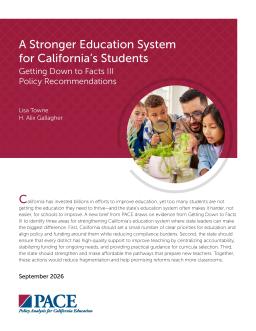
Getting Down to Facts III Policy Recommendations
Policy brief
Published
Summary
This brief draws on Getting Down to Facts III to recommend three priorities for strengthening California’s education system: clear student goals, reliable instructional support for every district, and stronger, more affordable teacher preparation. It calls for aligned policy and funding, reduced compliance burdens, sustained support for improving teaching, and expanded four-year preparation pathways to help promising reforms reach more classrooms.
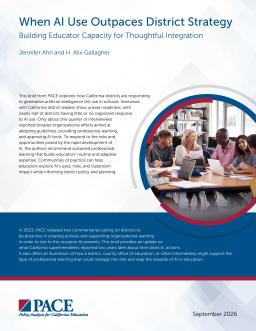
Building Educator Capacity for Thoughtful Integration
Practice brief
Published
Summary
This brief examines California districts’ responses to generative AI, finding that individual use often outpaces coordinated policy and support. Drawing on district interviews and a Lead by Learning example, it recommends sustained, collaborative professional learning to help educators assess AI’s risks and classroom impact, inform district guidance, and align AI use with instructional and equity goals.
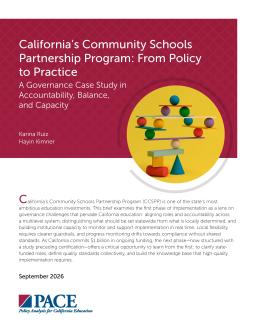
A Governance Case Study in Accountability, Balance, and Capacity
Policy brief
Published
Summary
This brief examines the first phase of California’s Community Schools Partnership Program. It finds that unclear roles, limited statewide guidance, and a lack of shared measures made it difficult to coordinate support and assess progress. As California commits $1 billion in ongoing funding, the brief calls for clearer responsibilities, quality standards developed with practitioners and communities, and stronger evidence to guide statewide certification.
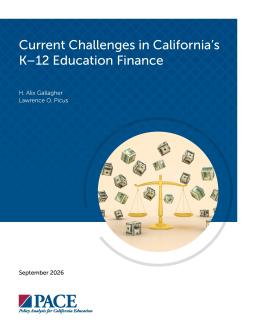
Report
Published
Summary
This report examines the fiscal pressures facing California’s K–12 education system despite substantial funding growth. It explains how volatile state revenues, declining enrollment, rising costs, and reliance on one-time spending complicate long-term planning for districts. The report identifies three central policy questions involving per-pupil spending, more predictable funding for sustained priorities, and educator compensation that benefits employees while protecting district finances.
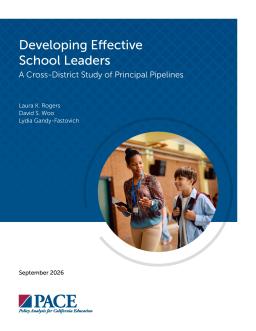
A Cross-District Study of Principal Pipelines
Report
Published
Summary
This report examines how five California CORE member districts built principal pipelines to develop effective school leaders. The study, a collaborative effort between CORE-PACE and university researchers, aims to describe the policies, procedures, and practices that make up participating districts’ efforts to establish and maintain principal pipelines and understand the role of principal pipelines in attaining key objectives, including diversifying school leadership, retaining excellent school leaders, and improving student outcomes.
Strengthening California’s Support for Districts
Policy brief
Published
Summary
This brief examines the capacity of California’s instructional support system to help districts improve TK–8 mathematics. Drawing on interviews with district, state, county, provider, and policy leaders, it finds that competing priorities, uneven teacher preparation, limited sustained professional learning, inadequate curricular guidance, and fragmented regional and statewide assistance weaken local improvement efforts.
The Role of Schools in Math Course-Taking
Policy brief
Published
Summary
This brief examines how schools shape math course-taking among California high school students. It finds that 12th-grade math enrollment has declined in about two thirds of high schools in recent years, with differences tied to school size and student demographics. Students in smaller schools and in schools serving higher shares of socioeconomically disadvantaged students are less likely to take advanced math courses. The findings highlight how variation in course offerings and access contributes to unequal opportunities in math preparation for college.
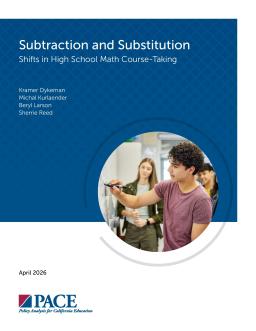
Shifts in High School Math Course-Taking
Report
Published
Summary
This report examines trends in high school math course-taking among California students over the past decade. It finds that after increasing prior to 2020, 12th-grade math enrollment has declined to earlier levels, alongside shifts in the types of courses students take. Students are less likely to enroll in Algebra 2, precalculus, and calculus, and more likely to take statistics. While the share of students reaching Algebra 2 has remained stable, fewer are progressing to higher-level math, raising concerns about college and career readiness.
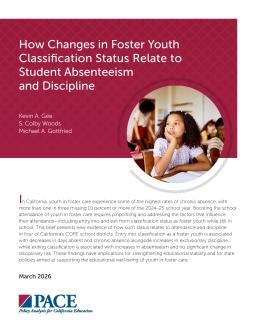
Policy brief
Published
Summary
This brief examines how changes in foster youth classification status relate to student absenteeism and discipline in four California CORE districts. Drawing on longitudinal data, it finds that entering foster care is associated with reduced absenteeism but increased exclusionary discipline, while exiting foster care is linked to increased absenteeism with no significant change in disciplinary risk. These findings highlight critical transition points where targeted supports and stronger policy alignment can improve educational stability and outcomes for youth in foster care.
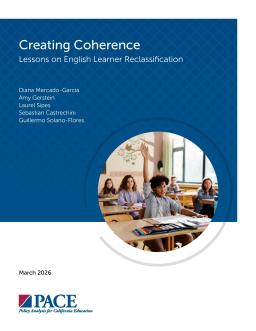
Lessons on English Learner Reclassification
Report
Published
Summary
This report examines how California’s policies and local practices shape the reclassification of students designated as English learners. Drawing on a nine-year research–practice partnership, it analyzes how locally determined criteria—particularly the “basic skills” requirement—and administrative processes can delay or prevent reclassification. The findings highlight how variation across districts contributes to unequal opportunities, especially in nonunified systems.
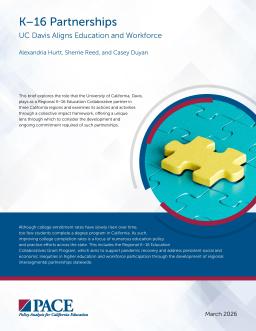
UC Davis Aligns Education and Workforce
Practice brief
Published
Summary
This brief examines the role of the University of California, Davis, in the Regional K–16 Education Collaboratives Grant Program, a statewide initiative designed to support pandemic recovery and address persistent inequities in higher education and workforce participation through regional partnerships. Focusing on UC Davis’ work in three California regions, the brief explores how intersegmental collaboration is structured and sustained across institutions.
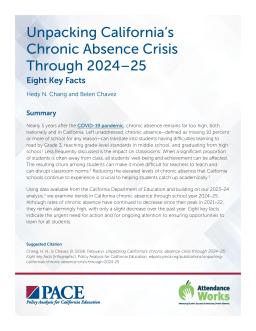
Eight Key Facts
Infographic
Published
Summary
This infographic examines chronic absence trends in California through 2024–25, nearly five years after the COVID-19 pandemic. Although rates have declined from their 2021–22 peak, nearly one in five students remains chronically absent—well above prepandemic levels—and progress has slowed. Eight key facts highlight persistent disparities and the urgent need for sustained, data-informed action to reengage students and reduce barriers to attendance.
Lessons from the Supporting Innovative Practices Project
Policy brief
Published
Summary
This brief presents evaluation findings from California’s Supporting Innovative Practices (SIP) project, a statewide effort to expand inclusive general education access for students with disabilities. SIP participation is associated with faster growth in least restrictive environment indicators than statewide trends. Cross-case analyses identify four enabling conditions: structural redesign, leadership mindset and culture, data-driven continuous improvement, and cross-role collaboration. Findings suggest inclusive gains are achievable when districts receive sustained, practice-embedded support...
Practice brief
Published
Summary
Many districts struggle to scale lasting instructional improvement; their systems—structures and processes—are key to successfully scaling improvement initiatives. Drawing on data from districts’ work with California Education Partners, this brief contrasts effective district system engagement with common pitfalls: delegating leadership, relying on informal networks, and maintaining too many priorities. District leaders play a pivotal role as only they have the authority to repurpose existing system resources, create new structures, and monitor systemwide progress.
Scientific Evidence and Policy Relevance
Policy brief
Published
Summary
California now requires annual K–2 screening for reading difficulties to identify students early and guide support. This brief outlines key policy elements, considerations for multilingual learners, and implementation steps for districts, emphasizing training, coherent MTSS systems, and state investment to ensure effective, equitable literacy improvement. It cites persistent literacy gaps as motivation and urges continuous evaluation of screeners and district capacity over time.
Past, Present, and Future
Report
Published
Summary
The report TK–12 Education Governance in California: Past, Present, and Future examines the history of California’s education governance system, analyzes the state of the current system and its effectiveness across six key dimensions, and offers recommendations for realigning roles and responsibilities to create a more coherent education governance system in California. Education governance encompasses the mechanisms through which decisions are made, responsibilities are distributed, and accountability is maintained within the public education system.
Revisiting Basic Aid in the LCFF Era
Report
Published
Summary
This report analyzes how California’s school finance system—built to promote equity through the Local Control Funding Formula (LCFF)—continues to produce unequal opportunities due to property wealth disparities. It explores how “basic aid” districts, which generate more local tax revenue than the state funding formula provides, have accumulated growing advantages over other districts. Drawing on fiscal and demographic analysis, the report highlights how these patterns shape resource gaps and teacher labor markets across the state and offers policy options to promote greater funding equity.
A Case Study of Chino Valley Unified School District
Report
Published
Summary
This case study examines how Chino Valley Unified School District scaled the Professional Learning Community (PLC) at Work model across all schools to strengthen teacher collaboration, leadership, and use of student data. Over eight years, the district built coherent systems—scheduled collaboration time, coaching, and consistent leadership—while partnering with the teachers’ union to sustain focus despite COVID-19 and political challenges. Guided by framework for scaling effective practice, CVUSD institutionalized continuous improvement, contributing to notable gains in student achievement.
2019–20 Through 2022–23
Report
Published
Summary
This report examines the CORE Districts’ Breakthrough Success Community (BTSC), which focused on improving ninth-grade on-track rates through evidence-based changes in daily practice. Some schools effectively adapted BTSC strategies, fostering strong relationships and engagement. While implementation varied and overall impact on student outcomes was not detected, schools valued key BTSC measures, and later adjustments may strengthen results. This report highlights promising practices and offers recommendations to enhance future education improvement efforts.
Seven Key Facts
Infographic
Published
Summary
Absenteeism soared in California and nationally in the wake of the pandemic, and addressing this extraordinary increase is crucial to helping students catch up academically. Using data available from the California Department of Education and building on prior analysis, we examine trends in chronic absence (students missing school more than 10 percent of the time) through school year 2023–24. Although rates of chronic absence have continued to decrease since their peak in 2021–22, they remain alarmingly high. Ensuring equitable opportunities to learn will require ongoing attention and action.
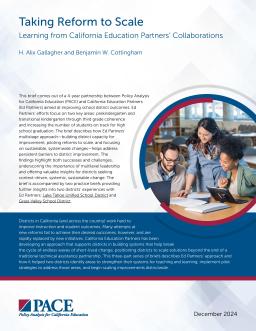
Learning from California Education Partners’ Collaborations
Practice brief
Published
Summary
This brief introduces a three-part series describing California Education Partners’ multistage approach to supporting school districts with improving their students’ outcomes in literacy and mathematics. The approach addresses persistent barriers to improvement by building capacity in the district, piloting reforms, and focusing on scaling changes systemwide in sustainable ways. PACE authors highlight the successes and challenges of Ed Partners’ approach, emphasizing the fundamental importance of leadership at the teacher, school, and district levels to drive change throughout the district.
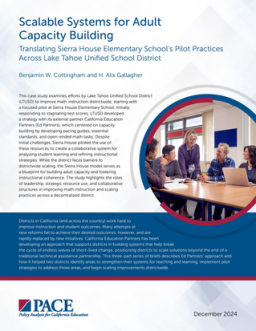
Translating Sierra House Elementary School’s Pilot Practices Across Lake Tahoe Unified School District
Practice brief
Published
Summary
This case study explores how Lake Tahoe Unified School District worked to improve math instruction, starting a pilot at Sierra House Elementary School. Partnering with California Education Partners, LTUSD addressed stagnant test scores by developing pacing guides, essential standards, and open-ended math tasks. Sierra House used these tools to create a collaborative system for analyzing student learning and refining instruction. While scaling districtwide remains a challenge, the Sierra House model highlights leadership and resource use with collaboration in advancing instructional coherence.
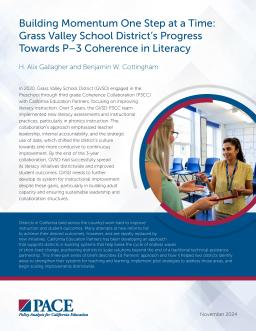
Grass Valley School District’s Progress Towards P–3 Coherence in Literacy
Practice brief
Published
Summary
Grass Valley School District (GVSD) partnered with California Education Partners through an initiative to improve literacy instruction. Over three years, GVSD implemented new literacy assessments and phonics practices, emphasizing teacher leadership, data use, and accountability. That shifted the district’s culture toward continuous improvement, enabling districtwide adoption of literacy initiatives and improved student outcomes. This case study highlights the need for stronger systems to build adult capacity and sustain leadership and collaboration.
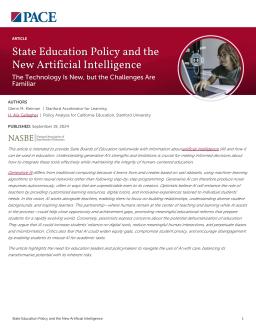
The Technology Is New, but the Challenges Are Familiar
Article
Published
Summary
Optimists believe AI will partner with teachers to provide customized learning resources, digital tutors, and innovative experiences tailored to individual students’ needs. Pessimists express concerns about the potential dehumanization of education, arguing that AI could increase students' reliance on digital tools, reduce meaningful human interactions, and perpetuate biases and misinformation. In this article, the authors highlight the need for education leaders and policymakers to navigate the use of AI with care, balancing its transformative potential with its inherent risks.
An Update on Dual Enrollment Participation Among Public High School Graduates
Infographic
Published
Summary
California policymakers and educators are promoting dual enrollment to boost educational attainment and equal access to postsecondary opportunities. Assembly Bill 288, enacted in 2016, encouraged high school-community college collaboration, and funding for dual enrollment has increased. Local educators are working to expand programs and support student success. Participation grew steadily from 2015–16 to 2019–20, but stalled in 2020–21 and 2021–22, likely due to the COVID-19 pandemic's impact on dual enrollment opportunities.