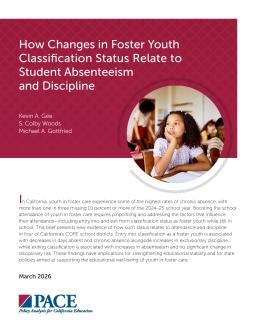
Policy brief
Published
Summary
This brief examines how changes in foster youth classification status relate to student absenteeism and discipline in four California CORE districts. Drawing on longitudinal data, it finds that entering foster care is associated with reduced absenteeism but increased exclusionary discipline, while exiting foster care is linked to increased absenteeism with no significant change in disciplinary risk. These findings highlight critical transition points where targeted supports and stronger policy alignment can improve educational stability and outcomes for youth in foster care.
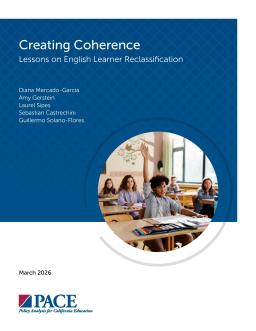
Lessons on English Learner Reclassification
Report
Published
Summary
This report examines how California’s policies and local practices shape the reclassification of students designated as English learners. Drawing on a nine-year research–practice partnership, it analyzes how locally determined criteria—particularly the “basic skills” requirement—and administrative processes can delay or prevent reclassification. The findings highlight how variation across districts contributes to unequal opportunities, especially in nonunified systems.
Eight Key Facts
Infographic
Published
Summary
This infographic examines chronic absence trends in California through 2024–25, nearly five years after the COVID-19 pandemic. Although rates have declined from their 2021–22 peak, nearly one in five students remains chronically absent—well above prepandemic levels—and progress has slowed. Eight key facts highlight persistent disparities and the urgent need for sustained, data-informed action to reengage students and reduce barriers to attendance.
Seven Key Facts
Infographic
Published
Summary
Absenteeism soared in California and nationally in the wake of the pandemic, and addressing this extraordinary increase is crucial to helping students catch up academically. Using data available from the California Department of Education and building on prior analysis, we examine trends in chronic absence (students missing school more than 10 percent of the time) through school year 2023–24. Although rates of chronic absence have continued to decrease since their peak in 2021–22, they remain alarmingly high. Ensuring equitable opportunities to learn will require ongoing attention and action.
Seven Key Facts
Infographic
Published
Summary
Chronic absenteeism has soared in California and nationally in the wake of the COVID-19 pandemic, and addressing this extraordinary increase is crucial to helping students catch up academically. Using data available from the California Department of Education, this analysis examines trends in chronic absenteeism through school year 2022–23.3 Although rates of chronic absence have begun to decrease, they remain alarmingly high. Ensuring equitable opportunities to learn will require ongoing attention and action, including taking into account these seven key facts.
Policy brief
Published
Summary
Declining student enrollment is leading to a loss of revenue in many California school districts. To address ongoing budget shortfalls, many districts have consolidated or shuttered schools,and others are contemplating doing so. A new report and working paper, summarized in this brief, explore the racial dimensions of school closures and how to address them.
Report
Published
Summary
Enrollment in California public schools has been declining and is projected to fall even more steeply during the next decade. Because funding for school districts is largely based on average daily attendance rates, a decline in enrollment results in a loss of funding. To address budget shortfalls and align services with student counts, many districts have consolidated or closed schools, or they are contemplating doing so.
Working paper
Published
Summary
This study investigates racial disparities in school closures both within California and nationally. Findings highlight an alarming pattern: Schools enrolling higher proportions of Black students are at significantly increased risk of closure relative to those enrolling fewer Black students, a pattern that is more pronounced in California than elsewhere in the United States. The findings underscore that school closures in California and elsewhere reflect racial inequalities that require adequate policymaking to ensure equitable and fair school-closure proceedings.
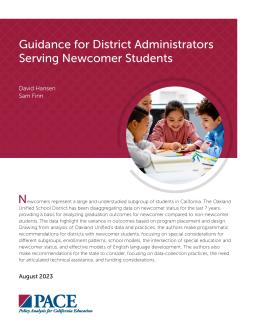
Policy brief
Published
Summary
Newcomers represent a large and understudied subgroup of students in California. The Oakland Unified School District has been disaggregating data on newcomer status for the last 7 years, providing a basis for analyzing graduation outcomes for newcomer compared to non-newcomer students. The data highlight the variance in outcomes based on program placement and design. Drawing from analysis of Oakland Unified’s data and practices, the authors make programmatic recommendations for districts with newcomer students.
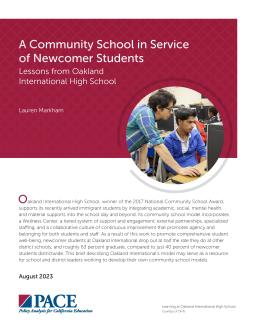
Lessons From Oakland International High School
Policy brief
Published
Summary
Oakland International High School, winner of the 2017 National Community School Award, supports its recently arrived immigrant students by integrating academic, social, mental health,and material supports into the school day and beyond. Its community school model incorporates a Wellness Center, a tiered system of support and engagement, external partnerships, specialized staffing, and a collaborative culture of continuous improvement that promotes agency and belonging for both students and staff.
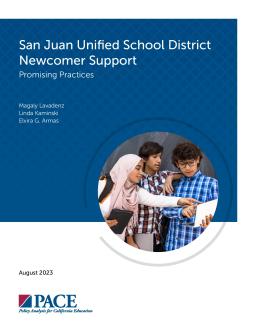
Promising Practices
Case study
Published
Summary
This case study identifies promising practices for newcomer education implemented in San Juan Unified School District (SJUSD), one of 12 local educational agencies (LEAs) funded under the California Newcomer Education and Well-Being (CalNEW) project between 2018 and 2021. This report was developed through a partnership between PACE and the Center for Equity for English Learners (CEEL) at Loyola Marymount University (LMU).
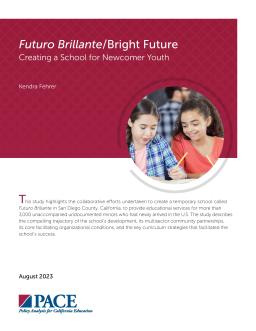
Creating a School for Newcomer Youth
Policy brief
Published
Summary
This study highlights the collaborative efforts undertaken to create a temporary school called Futuro Brillante in San Diego County, California, to provide educational services for more than 3,000 unaccompanied undocumented minors who had newly arrived in the U.S. The study describes the compelling trajectory of the school’s development, its multisector community partnerships, its core facilitating organizational conditions, and the key curriculum strategies that facilitated the school’s success.
Report
Published
Summary
Every year, 150k-200k new immigrant students in California need specialized instruction and social services to succeed, but many districts struggle to provide them, resulting in dropouts and poor outcomes. Inaccessible instruction and lack of basic necessities hinder progress. The PACE report recommends developing data, instruction, and social support services to improve newcomer outcomes in California.
Report
Published
Summary
This report finds that improving school attendance is crucial, especially with the increase in chronic absence. Data on unexcused absences should be used to create a more preventive, problem-solving, and equitable response to poor attendance. Labeling absences as unexcused affects how students and families are treated and can lead to punitive measures that may not improve attendance. Overuse of the unexcused-absence label could undermine efforts to partner with students and families to improve attendance.
Policy brief
Published
Summary
This study explores the impact of reclassification on social-emotional learning skills (SEL) of English learners (ELs) in grades 4 to 8. Using a regression discontinuity design, the study found that reclassification improved academic self-efficacy by 0.2 standard deviations for students near the cutoff threshold. The results suggest that reclassification can positively influence the academic beliefs of ELs and the authors provide recommendations for districts to create practices that foster such positive beliefs.
Evidence from the CORE Districts
Report
Published
Summary
The CORE Districts in California conducted a survey to measure K-12 students’ social-emotional well-being during the pandemic. Results indicate that students’ personal and interpersonal well-being rated lower than their learning environments. Interpersonal well-being was most correlated with academic achievement. Home/online learning environment improved, but Grades 5-12 students reported not liking school as much in winter 2020-21. Stakeholders should focus on meeting the pressing needs of each group of students.
The Path Towards Reimagining and Rebuilding Schools
Report
Published
Summary
The COVID-19 pandemic has affected all students; however, its impact has been particularly devastating for students of color, students from low-income families, English learners, and other marginalized children and youth. As transmission rates decline and vaccination rates increase in California, many are eager to return to normalcy, but we must all recognize that even the prepandemic normal was not working for all students. The 2021–22 school year, therefore, constitutes a critical opportunity for schools to offer students, families, and educators a restorative restart.
A Foundation for Rebuilding to Support the Whole Child
Policy brief
Published
Summary
The partnership between schools and expanded learning programs is crucial to build equitable support systems for children and their families. California's school reopening guidance encourages coordination between these entities to meet the students' needs during the pandemic. This brief provides key principles for building successful partnerships informed by insights from California leaders and practitioners. It is part of a series on how expanded learning programs can support students during pandemic recovery.
Practice brief
Published
Summary
This brief is one in a series aimed at providing K–12 education decision makers and advocates with an evidence base to ground discussions about how to best serve students during and following the novel coronavirus pandemic. Learn more about the EdResearch for Recovery Project and view the set of COVID-19 response-and-recovery topic areas and practitioner-generated questions here. The central question of this brief is: How can schools and districts monitor students’ social and emotional well-being across the year?
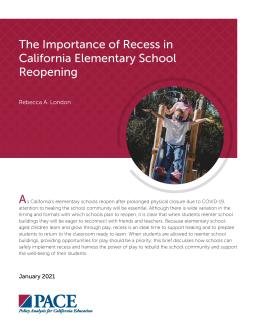
Policy brief
Published
Summary
As California's elementary schools reopen, attention to healing the school community is crucial. When students return, they will need to reconnect with friends and teachers. Recess provides an ideal opportunity for play and can support healing and prepare students to return to learning. Schools should prioritize providing safe opportunities for play to rebuild the school community and support students' well-being.
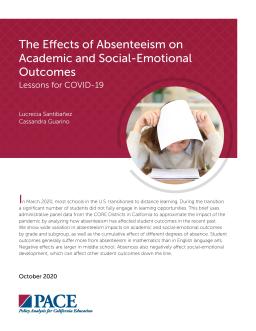
Lessons for COVID-19
Policy brief
Published
Summary
This brief discusses the impact of the COVID-19 pandemic on student absenteeism and academic and social-emotional outcomes using panel data from California's CORE Districts. Absenteeism has a negative effect on student outcomes, with math being more affected than English language arts, and middle school students suffering more than elementary or high school students. The study also shows that absenteeism negatively impacts social-emotional development, which can have further implications for student outcomes.
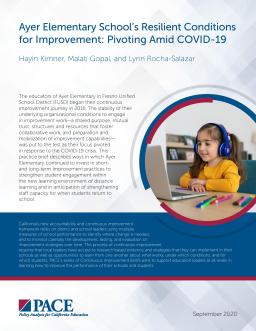
Pivoting Amid COVID-19
Case study
Published
Summary
This brief outlines Ayer Elementary's journey of continuous improvement since 2016 and how their organizational conditions were tested during the COVID-19 crisis. Despite the challenges, the school invested in improvement practices to strengthen student engagement in distance learning and build staff capacity for when students return to school.
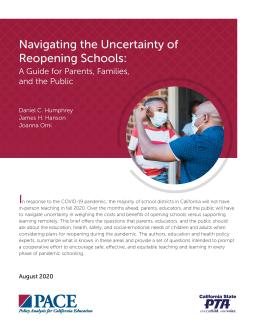
A Guide for Parents, Families, and the Public
Guide
Published
Summary
This brief provides questions for parents, educators, and the public to consider when deciding whether to reopen schools or support remote learning during the COVID-19 pandemic. Education and health policy experts summarize what is known in these areas and provide a set of questions to encourage safe, effective, and equitable teaching and learning during every phase of pandemic schooling.
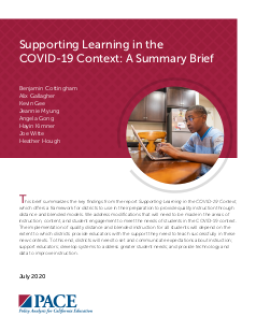
Research to Guide Distance and Blended Instruction
Report
Published
Summary
This suite of publications provides 10 recommendations based on the PACE report to help educators and district leaders provide high-quality instruction through distance and blended learning models in the 2020-21 school year. Despite the challenges of COVID-19, research can guide decisions about student learning and engagement. These recommendations can be used as a framework to prioritize quality instruction.
A Rural District’s Response to COVID-19
Practice brief
Published
Summary
COVID-19 has disrupted California’s education system in fundamental ways. Districts across the state are quickly creating strategies to serve all students, and many are designing their response around the needs of their most vulnerable students. This brief highlights the response of Mother Lode Union School District (MLUSD) to the COVID-19 pandemic, in which district staff and teachers were able to collaborate—despite the unprecedented crisis—to meet student needs.