Policy brief
Published
Summary
California high schools face challenges in expanding computer science (CS) programs due to staffing issues, curricular capacity, school accountability pressure, and equitable access to CS coursework. This report discusses potential solutions based on research for each challenge.
Supporting Students During COVID-19
Policy brief
Published
Summary
An analysis of Learning Continuity and Attendance Plans (LCPs) developed by local educational agencies in California during the 2020-21 academic year showed variations in practices across districts, particularly between urban and rural areas. While districts planned to provide technology, assess student learning, and offer tiered levels of support, broader opportunities for reform and implementation accountability in education policymaking are needed post-pandemic.
Report
Published
Summary
The COVID-19 pandemic has made it difficult for English learners (ELs) to receive the services and support they need for academic success. This report highlights how K–12 public school districts planned to support ELs during the pandemic. While many districts communicated plans to assess student progress and provide services for ELs, details on the sufficiency of these plans were lacking. The legislation mandating the plans did not include measures for adherence or monitoring student outcomes, leaving questions about the actual strategies implemented by districts and how ELs were affected.
Policy brief
Published
Summary
Community schools are gaining attention as a promising solution for students from low-income families who have suffered economic trauma during the COVID-19 pandemic. Policymakers are investing in their expansion, and effective use of data will be crucial. This report discusses findings of a research project led by the Los Angeles County Office of Education and the USC Center on Education, Policy, Equity, and Governance and provides recommendations for implementing a data system to address community-specific needs.
A Case Study of Two High-Poverty School Districts
Report
Published
Summary
A report examines two CA districts that have shifted their structures, policies, and culture to improve student outcomes. Both districts worked with California Education Partners to refine their continuous improvement approach and spread practices. PACE identified three key lessons for leading impactful improvement efforts: anchor work in outcome measures, invest in an aligned system of instructional learning, and use cross-role and cross-site structures. These lessons contributed to positive trends for student achievement, empowered practitioners, and built internal capacity for improvement.
Evidence From Interim Assessments in California
Report
Published
Summary
At the first anniversary of school closures due to COVID-19, nearly half of the K–12 students in the U.S. were attending schools that were either fully remote or offering hybrid instruction, with more than 70 percent of California students attending schools remotely. For this reason, continued efforts to unpack the effects of COVID-19 on student outcomes are especially important for California students, who may be experiencing larger-than-average effects of continued school closures relative to the nation overall.
Evidence from the CORE Districts
Report
Published
Summary
The CORE Districts in California conducted a survey to measure K-12 students’ social-emotional well-being during the pandemic. Results indicate that students’ personal and interpersonal well-being rated lower than their learning environments. Interpersonal well-being was most correlated with academic achievement. Home/online learning environment improved, but Grades 5-12 students reported not liking school as much in winter 2020-21. Stakeholders should focus on meeting the pressing needs of each group of students.
The Path Towards Reimagining and Rebuilding Schools
Report
Published
Summary
The COVID-19 pandemic has affected all students; however, its impact has been particularly devastating for students of color, students from low-income families, English learners, and other marginalized children and youth. As transmission rates decline and vaccination rates increase in California, many are eager to return to normalcy, but we must all recognize that even the prepandemic normal was not working for all students. The 2021–22 school year, therefore, constitutes a critical opportunity for schools to offer students, families, and educators a restorative restart.
Policy brief
Published
Summary
The COVID-19 pandemic had a significant negative effect on the oral reading fluency (ORF) of US students in grades 2-3 in over 100 school districts, with students falling 30% behind expectations. While there was some recovery in the fall, it was insufficient to make up for the spring losses. The impact is particularly inequitable, with lower achieving schools being hit harder, and 10% of students not being assessed. Addressing accumulated learning losses and supporting struggling students is necessary.
A Foundation for Rebuilding to Support the Whole Child
Policy brief
Published
Summary
The partnership between schools and expanded learning programs is crucial to build equitable support systems for children and their families. California's school reopening guidance encourages coordination between these entities to meet the students' needs during the pandemic. This brief provides key principles for building successful partnerships informed by insights from California leaders and practitioners. It is part of a series on how expanded learning programs can support students during pandemic recovery.
Practice brief
Published
Summary
This brief is one in a series aimed at providing K–12 education decision makers and advocates with an evidence base to ground discussions about how to best serve students during and following the novel coronavirus pandemic. Learn more about the EdResearch for Recovery Project and view the set of COVID-19 response-and-recovery topic areas and practitioner-generated questions here. The central question of this brief is: How can schools and districts monitor students’ social and emotional well-being across the year?
Policy brief
Published
Summary
As California's elementary schools reopen, attention to healing the school community is crucial. When students return, they will need to reconnect with friends and teachers. Recess provides an ideal opportunity for play and can support healing and prepare students to return to learning. Schools should prioritize providing safe opportunities for play to rebuild the school community and support students' well-being.
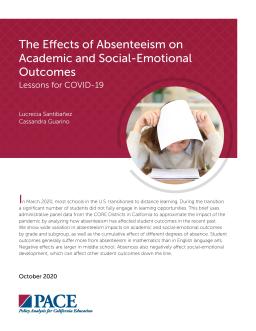
Lessons for COVID-19
Policy brief
Published
Summary
This brief discusses the impact of the COVID-19 pandemic on student absenteeism and academic and social-emotional outcomes using panel data from California's CORE Districts. Absenteeism has a negative effect on student outcomes, with math being more affected than English language arts, and middle school students suffering more than elementary or high school students. The study also shows that absenteeism negatively impacts social-emotional development, which can have further implications for student outcomes.
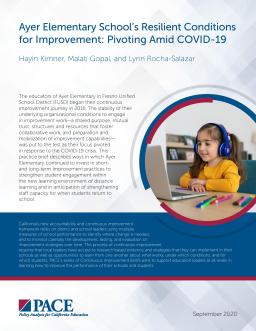
Pivoting Amid COVID-19
Case study
Published
Summary
This brief outlines Ayer Elementary's journey of continuous improvement since 2016 and how their organizational conditions were tested during the COVID-19 crisis. Despite the challenges, the school invested in improvement practices to strengthen student engagement in distance learning and build staff capacity for when students return to school.
Practice brief
Published
Summary
This brief discusses how traditional methods of grading have been disrupted due to the pandemic and suggests flexible grading and assessment practices that can support student learning and measure it meaningfully. The goal is to improve both learning and reporting during this time of disruption.
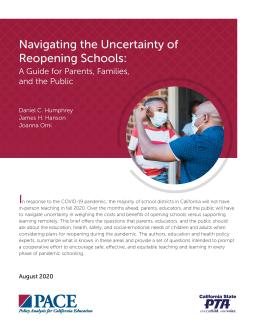
A Guide for Parents, Families, and the Public
Guide
Published
Summary
This brief provides questions for parents, educators, and the public to consider when deciding whether to reopen schools or support remote learning during the COVID-19 pandemic. Education and health policy experts summarize what is known in these areas and provide a set of questions to encourage safe, effective, and equitable teaching and learning during every phase of pandemic schooling.
Sanger Unified and the Pivot–Sanger Multi-Tiered System of Supports Project
Case study
Published
Summary
Equity has been a key focus of California education policies, which aim to reduce disparities in learning outcomes. The Multi-Tiered System of Supports (MTSS) can help identify struggling students and offer support. Pivot Learning's demonstration project with Sanger, Monterey Peninsula, and Lancaster school districts sought to make MTSS implementation more accessible. Lessons learned from Sanger's implementation can guide the state's continued expansion of MTSS.
Research to Guide Distance and Blended Instruction
Report
Published
Summary
This suite of publications provides 10 recommendations based on the PACE report to help educators and district leaders provide high-quality instruction through distance and blended learning models in the 2020-21 school year. Despite the challenges of COVID-19, research can guide decisions about student learning and engagement. These recommendations can be used as a framework to prioritize quality instruction.
A Rural District’s Response to COVID-19
Practice brief
Published
Summary
COVID-19 has disrupted California’s education system in fundamental ways. Districts across the state are quickly creating strategies to serve all students, and many are designing their response around the needs of their most vulnerable students. This brief highlights the response of Mother Lode Union School District (MLUSD) to the COVID-19 pandemic, in which district staff and teachers were able to collaborate—despite the unprecedented crisis—to meet student needs.
Practice brief
Published
Summary
COVID-19 school closures may intensify the typical academic "slide" observed in math and reading over the summer break. Schools can consider online summer programs, ramped-up assessment, targeted instruction, and one-to-one tutoring to mitigate learning losses.
Policy brief
Published
Summary
Governor Newsom suggested a staggered calendar for the fall to get students back in school. While multi-track calendars have shown slight negative effects on learning, the current situation would have clear learning benefits and help parents and teachers. However, there is no evidence that multi-track calendars can control COVID-19 transmission. Schools should look at evidence from other countries and partner with local communities to test aggressively for the virus if implementing this approach.
Case study
Published
Summary
This brief discusses how the Pajaro Valley Unified School District (PVUSD) in California is addressing the challenges of COVID-19 through family engagement and instructional access for English learners. The district has a history of serving all students through bilingual programming and a whole-child approach, and over 40% of its population are classified as English learners. PVUSD is a member of the national League of Innovative Schools and is known for its inclusive, data-driven decision-making.
Article
Published
Summary
California's CORE districts have been collecting data since 2014 on social and emotional learning (SEL) and school climate and culture to improve K-12 schools' holistic approach to student development. Advocates argue that a focus on SEL and school culture will lead to higher academic achievement and better well-being for students. The CORE districts developed survey instruments for SEL competencies and school climate perceptions involving students, staff, and parents. Many states and districts have adopted SEL-specific curricula and disciplinary reforms.

Evidence from the 2020 PACE/USC Rossier Annual Poll
Policy brief
Published
Summary
We use data from the 2020 PACE/USC Rossier annual voter poll to report on California voters’ attitudes towards educational equity policy initiatives, specifically: (a) increasing the number of public school teachers of color in California and (b) requiring all high school students in California to complete an ethnic studies course. A majority of voters supported these initiatives. Respondents showed higher levels of support for increasing the number of teachers of color when informed about the positive academic impact this would likely have for students of color. Support varied depending on...
A Summary of the PACE Policy Research Panel
Policy brief
Published
Summary
Over 725,000 California K-12 students received special education services in 2018-19, but the system is not always equipped to serve them. Early screening, identification, and intervention, as well as better transitions, educator support, and mental/physical health services, need improvement. A Multi-Tiered System of Supports (MTSS) framework in schools could address SWDs' needs, but it requires additional resources and policy support to improve educator capacity and collaboration between agencies while systematizing data on SWDs.