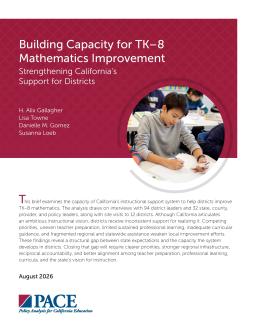
Strengthening California’s Support for Districts
Policy brief
Published
Summary
This brief examines the capacity of California’s instructional support system to help districts improve TK–8 mathematics. Drawing on interviews with district, state, county, provider, and policy leaders, it finds that competing priorities, uneven teacher preparation, limited sustained professional learning, inadequate curricular guidance, and fragmented regional and statewide assistance weaken local improvement efforts.
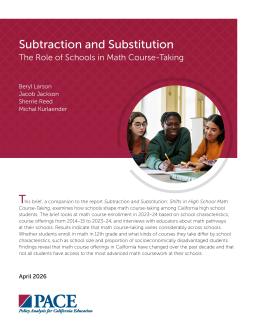
The Role of Schools in Math Course-Taking
Policy brief
Published
Summary
This brief examines how schools shape math course-taking among California high school students. It finds that 12th-grade math enrollment has declined in about two thirds of high schools in recent years, with differences tied to school size and student demographics. Students in smaller schools and in schools serving higher shares of socioeconomically disadvantaged students are less likely to take advanced math courses. The findings highlight how variation in course offerings and access contributes to unequal opportunities in math preparation for college.
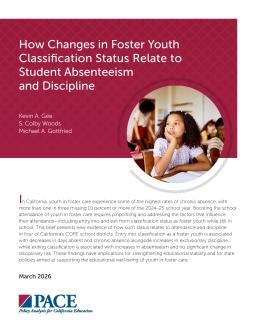
Policy brief
Published
Summary
This brief examines how changes in foster youth classification status relate to student absenteeism and discipline in four California CORE districts. Drawing on longitudinal data, it finds that entering foster care is associated with reduced absenteeism but increased exclusionary discipline, while exiting foster care is linked to increased absenteeism with no significant change in disciplinary risk. These findings highlight critical transition points where targeted supports and stronger policy alignment can improve educational stability and outcomes for youth in foster care.
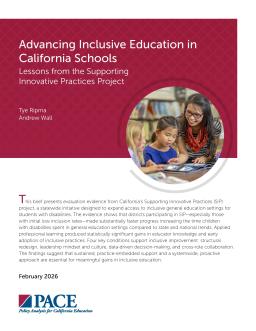
Lessons from the Supporting Innovative Practices Project
Policy brief
Published
Summary
This brief presents evaluation findings from California’s Supporting Innovative Practices (SIP) project, a statewide effort to expand inclusive general education access for students with disabilities. SIP participation is associated with faster growth in least restrictive environment indicators than statewide trends. Cross-case analyses identify four enabling conditions: structural redesign, leadership mindset and culture, data-driven continuous improvement, and cross-role collaboration. Findings suggest inclusive gains are achievable when districts receive sustained, practice-embedded support...
Scientific Evidence and Policy Relevance
Policy brief
Published
Summary
California now requires annual K–2 screening for reading difficulties to identify students early and guide support. This brief outlines key policy elements, considerations for multilingual learners, and implementation steps for districts, emphasizing training, coherent MTSS systems, and state investment to ensure effective, equitable literacy improvement. It cites persistent literacy gaps as motivation and urges continuous evaluation of screeners and district capacity over time.
TeachAI Informational Briefs
Policy brief
Published
Summary
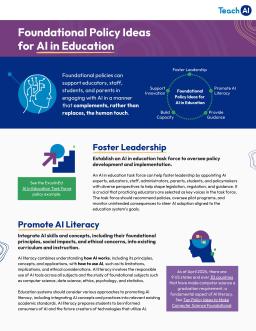
Within the TeachAI Policy Workgroup, PACE has facilitated the development of AI policy informational briefs aimed at ensuring the effective, safe, and responsible integration of AI in education. These briefs offer guidance to education leaders and policymakers, emphasizing the importance of crafting policies that prioritize teaching and learning. The briefs provide insights derived from current research and landscape analysis of AI use in TK–12 educational settings, addressing common questions and centering around five guiding principles for developing responsible AI policies in education.
Voices From the Class of 2023
Policy brief
Published
Summary
This brief examines the experiences of California high school seniors from the graduating class of 2023, offering insights into their preparation, plans, and concerns for college prior to enrollment. Drawing on results from a large-scale survey of seniors, the findings reveal important variation in students’ secondary school experiences and their plans for college, particularly by race/ethnicity and gender identity. As students’ experiences in high school influence concerns about their college futures.
Policy brief
Published
Summary
In October 2023, the California Department of Education released test scores for all students in Grades 3–8 and 11 for the 2022–23 school year. These results represent an opportunity to analyze whether and to what extent student learning has rebounded after the dramatic declines in scores resulting from the COVID-19 pandemic and related school closures. Despite marginal improvements from 2021–22, student cohorts in 2022–23 remain very far behind prepandemic levels.
Policy brief
Published
Summary
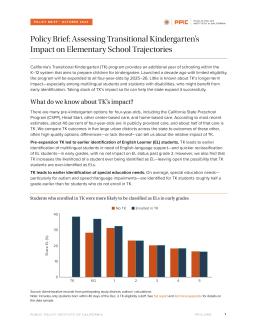
California’s Transitional Kindergarten (TK) program provides an additional year of schooling within the K–12 system that aims to prepare children for kindergarten. Launched a decade ago with limited eligibility, the program will be expanded to all four-year-olds by 2025–26. Little is known about TK’s longer-term impact—especially among multilingual students and students with disabilities, who might benefit from early identification. Taking stock of TK’s impact so far can help the state expand it successfully.
Policy brief
Published
Summary
Declining student enrollment is leading to a loss of revenue in many California school districts. To address ongoing budget shortfalls, many districts have consolidated or shuttered schools,and others are contemplating doing so. A new report and working paper, summarized in this brief, explore the racial dimensions of school closures and how to address them.
Policy brief
Published
Summary
Newcomers represent a large and understudied subgroup of students in California. The Oakland Unified School District has been disaggregating data on newcomer status for the last 7 years, providing a basis for analyzing graduation outcomes for newcomer compared to non-newcomer students. The data highlight the variance in outcomes based on program placement and design. Drawing from analysis of Oakland Unified’s data and practices, the authors make programmatic recommendations for districts with newcomer students.
Lessons From Oakland International High School
Policy brief
Published
Summary
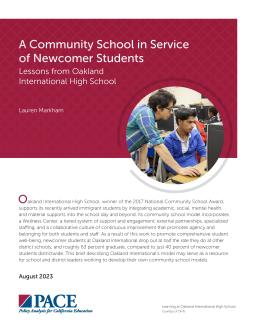
Oakland International High School, winner of the 2017 National Community School Award, supports its recently arrived immigrant students by integrating academic, social, mental health,and material supports into the school day and beyond. Its community school model incorporates a Wellness Center, a tiered system of support and engagement, external partnerships, specialized staffing, and a collaborative culture of continuous improvement that promotes agency and belonging for both students and staff.
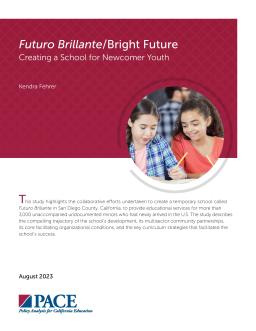
Creating a School for Newcomer Youth
Policy brief
Published
Summary
This study highlights the collaborative efforts undertaken to create a temporary school called Futuro Brillante in San Diego County, California, to provide educational services for more than 3,000 unaccompanied undocumented minors who had newly arrived in the U.S. The study describes the compelling trajectory of the school’s development, its multisector community partnerships, its core facilitating organizational conditions, and the key curriculum strategies that facilitated the school’s success.
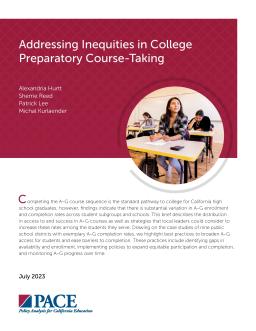
Report
Published
Summary
Completing the A–G course sequence is the standard pathway to college for CA high school graduates; however, findings indicate substantial variation in A–G enrollment and completion rates across student subgroups and schools. This brief describes the distribution in access to and success in A–G courses as well as strategies local leaders could consider to increase these rates among the students they serve. Drawing on case studies of nine public school districts with exemplary A–G completion rates, we highlight best practices to broaden A–G access for students and ease barriers to completion.
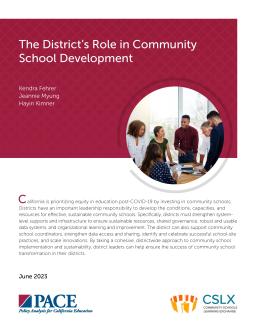
Policy brief
Published
Summary
California prioritizes post-COVID-19 education equity through investments in community schools. Districts must lead by strengthening system-level support, infrastructure, and sustainable resources. They should foster shared governance, robust data systems, and organizational learning. Supporting coordinators, improving data access, recognizing successful practices, and scaling innovations are crucial. A cohesive, districtwide approach ensures the success of community school transformation.
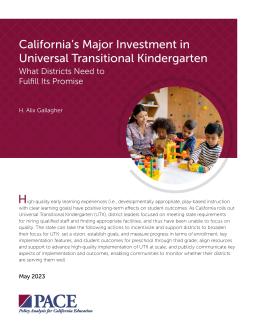
What Districts Need to Fulfill Its Promise
Policy brief
Published
Summary
California's Universal Transitional Kindergarten (UTK) faces challenges as districts prioritize meeting state requirements, hindering focus on quality. To address this, the state can incentivize districts by setting a vision, establishing goals, and measuring progress based on enrollment, implementation features, and student outcomes. It should align resources and support for widespread high-quality UTK implementation, while ensuring public communication of key aspects and outcomes to empower communities to monitor district performance.

A Summary Brief
Policy brief
Published
Summary
This brief outlines findings from a study that examines the English proficiency levels and growth of newcomer English learner students in comparison to their non-newcomer peers. It was found that while newcomer students tend to have lower initial English proficiency levels, their English proficiency develops quickly. There is, however, wide variation in newcomer English level and growth patterns, and schools play an important role in fostering growth. Additionally, newcomers enter school at earlier stages of English proficiency than non-newcomer English learner peers.
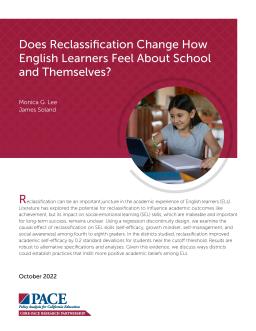
Policy brief
Published
Summary
This study explores the impact of reclassification on social-emotional learning skills (SEL) of English learners (ELs) in grades 4 to 8. Using a regression discontinuity design, the study found that reclassification improved academic self-efficacy by 0.2 standard deviations for students near the cutoff threshold. The results suggest that reclassification can positively influence the academic beliefs of ELs and the authors provide recommendations for districts to create practices that foster such positive beliefs.
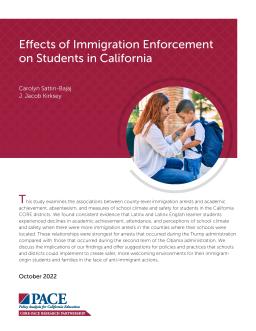
Policy brief
Published
Summary
This study explores the impact of county-level immigration arrests on the academic achievement, attendance, and perceptions of school climate and safety for Latinx and Latinx English learner students in California's CORE districts. The research found that there is a negative relationship between immigration arrests and these students' academic performance and school experiences. The study recommends policies and practices that can help schools and districts create safer, more welcoming environments for immigrant-origin students and families in the face of anti-immigrant actions.
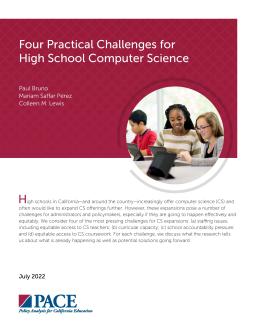
Policy brief
Published
Summary
California high schools face challenges in expanding computer science (CS) programs due to staffing issues, curricular capacity, school accountability pressure, and equitable access to CS coursework. This report discusses potential solutions based on research for each challenge.
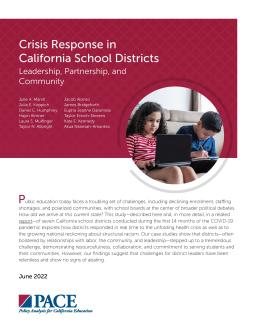
Leadership, Partnership, and Community
Case study
Published
Summary
This study of seven California school districts during the COVID-19 pandemic shows how districts responded in real-time to the crisis and structural racism. Districts showed resourcefulness, collaboration, and commitment to serving students and communities. However, challenges remain, including declining enrollment, staffing shortages, and polarized communities, with school boards at the center of broader political debates.
Policy brief
Published
Summary
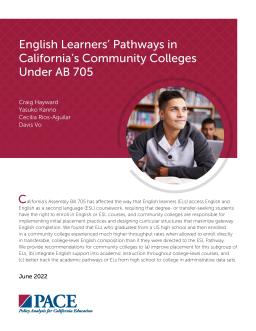
Assembly Bill 705 in California allows ELs to enroll in college-level English composition, and colleges must design curricula and placement practices that maximize English completion. ELs who graduated from US high schools and enrolled directly in college-level English had higher throughput rates than those directed to ESL Pathway. Recommendations include improving EL placement, integrating English support in academic instruction, and better tracking EL academic pathways in administrative data sets.
Supporting Students During COVID-19
Policy brief
Published
Summary
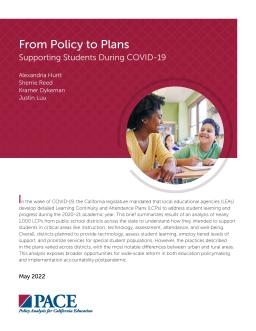
An analysis of Learning Continuity and Attendance Plans (LCPs) developed by local educational agencies in California during the 2020-21 academic year showed variations in practices across districts, particularly between urban and rural areas. While districts planned to provide technology, assess student learning, and offer tiered levels of support, broader opportunities for reform and implementation accountability in education policymaking are needed post-pandemic.
Policy brief
Published
Summary
Community schools are gaining attention as a promising solution for students from low-income families who have suffered economic trauma during the COVID-19 pandemic. Policymakers are investing in their expansion, and effective use of data will be crucial. This report discusses findings of a research project led by the Los Angeles County Office of Education and the USC Center on Education, Policy, Equity, and Governance and provides recommendations for implementing a data system to address community-specific needs.
Lessons from Kern County
Policy brief
Published
Summary
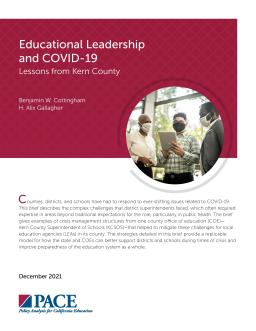
This brief examines the challenges that district superintendents faced in responding to COVID-19, often requiring expertise beyond traditional expectations. It discusses crisis management structures implemented by Kern County Superintendent of Schools as a model for how COEs can support districts and schools during times of crisis and improve the preparedness of the education system.