
A Promise to What, for Whom, and Where?
Policy brief
Published
Summary
This brief describes the types of college promises that exist in the state of California. In doing so, we summarize existing research on this topic. Furthermore, we provide a framework to study the California Promise Program in community colleges in California. We use publicly available data to highlight key aspects of our proposed framework: What are we promising, to whom, and where? We end our brief by providing key recommendations to ensure that the promise extends to the most vulnerable groups of students to help in closing equity gaps in college degree and completion in California.
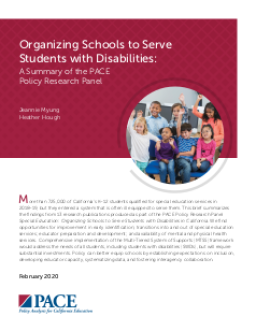
A Summary of the PACE Policy Research Panel
Policy brief
Published
Summary
Over 725,000 California K-12 students received special education services in 2018-19, but the system is not always equipped to serve them. Early screening, identification, and intervention, as well as better transitions, educator support, and mental/physical health services, need improvement. A Multi-Tiered System of Supports (MTSS) framework in schools could address SWDs' needs, but it requires additional resources and policy support to improve educator capacity and collaboration between agencies while systematizing data on SWDs.
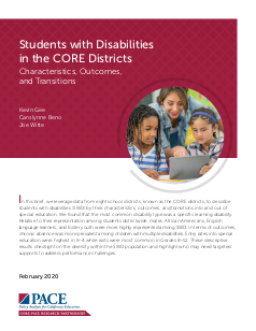
Characteristics, Outcomes, and Transitions
Policy brief
Published
Summary
The CORE districts studied characteristics, outcomes, and transitions of students with disabilities (SWDs). Specific learning disability was the most common type. Males, African Americans, English learners, and foster youth were overrepresented. Chronic absence was higher for SWDs with multiple disabilities. Most SWDs entered special education in K-4 and exited in grades 8-12. These results help identify who may need targeted support.
Policy brief
Published
Summary
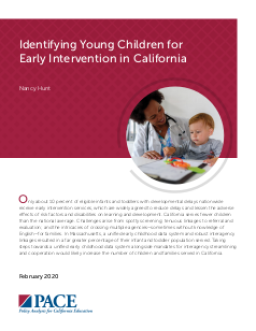
Only 10% of eligible infants and toddlers with developmental delays nationwide receive early intervention services, and CA serves fewer children than the national average. This is due to challenges such as spotty screening, tenuous linkages to referral and evaluation, and crossing multiple agencies. Massachusetts has a unified early childhood data system and robust interagency linkages, resulting in a greater percentage of their infant and toddler population served. Implementing a unified data system and interagency streamlining in CA could increase the number of children and families served.
Policy brief
Published
Summary
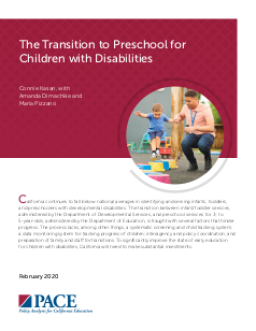
California is failing to identify and serve infants, toddlers, and preschoolers with developmental disabilities compared to national averages. The transition from infant/toddler services to preschool services is hindered by various factors such as the lack of a systematic screening and child tracking system, interagency coordination, and family/staff preparation for transitions. Significant investments are required to improve the state of early education for children with disabilities in California.
Policy brief
Published
Summary
This brief explains that while the California Common Core State Standards in Mathematics require rigorous instruction for all students, those with disabilities do not always have equal access to this instruction. It recommends the use of Universal Design for Learning (UDL), a research-based framework that enables expert learners within classroom settings and maximizes engagement for all students, including those with disabilities, to provide access to rigorous, standards-based mathematics instruction for all students in California.
Policy brief
Published
Summary
Students with disabilities should be included in programs that prepare them for life after high school. This can be achieved through a K-14 work-based learning model, which involves strengthening expectations, leveraging opportunities, and integrating supports. Early implementation of these actions is encouraged, along with specific policy recommendations for California.
Policy brief
Published
Summary
Preparing youth with disabilities for adulthood can be challenging, requiring additional supports and coordinated planning. Effective practices, such as family involvement, inclusion in general education, and interagency collaboration, can facilitate successful transitions to employment, postsecondary education, and community living. School districts must work with families, employers, and community agencies to implement these practices.
Report
Published
Summary
The Learning Policy Institute analyzed the special education teacher workforce in California and found a severe teacher shortage that could harm students with disabilities who need expert teachers the most. The report identifies the causes of the shortage and potential reasons for teacher attrition. Evidence-based policy strategies are suggested to address the issue.
Policy brief
Published
Summary
This brief suggests recommendations for improving student outcomes by providing high quality and ongoing professional development to teachers, administrators, and school personnel. It identifies the achievement gap for diverse learners, including culturally and linguistically diverse students with disabilities, and offers strategies for integrating evidence-based practices into existing educational initiatives. Additionally, it outlines methods for improving the school-system climate to reduce barriers to providing and sustaining innovative training and intervention methods.
Policy brief
Published
Summary
This brief discusses how California's System of Support uses differentiated assistance (DA) to provide support to districts and boost student group performance levels. It analyzes the districts eligible for DA in 2019 based on their students with disabilities' (SWD) performance on State Priority Areas (SPAs) and indicators. The findings show that over half of the 333 eligible districts were driven by SWD performance in SPAs 4 (Pupil Achievement) and 5 (Pupil Engagement), highlighting intersectional challenges facing SWD that districts can address through their continuous improvement process.
Policy brief
Published
Summary
This brief highlights California's Multi-Tiered System of Supports (MTSS), which assists struggling students. The inadequate resourcing of Tier 2 services is nevertheless preventing progress in reading and math, as California ranks 38th in the nation. Categorical funding is necessary to provide additional personnel, such as instructional aides and clerical staff, to assist teachers with implementing MTSS effectively.
Policy brief
Published
Summary
This brief outlines the necessary steps to integrate care systems and improve outcomes for California's children. It suggests forming a statewide interagency leadership council and recommends policy reforms to promote collaboration, integration, and service delivery. The goal is to create a "Whole System" approach that integrates child-serving agencies and organizations. A full commitment from the state administration is needed to achieve these solutions at scale.
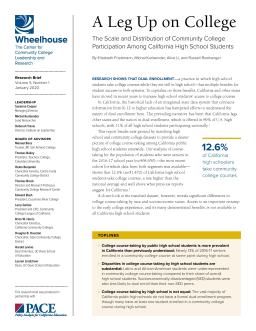
The Scale and Distribution of Community College Participation Among California High School Students
Policy brief
Published
Summary
California has sought to increase high school students’ access to college courses through dual enrollment. This brief matches high school and community college datasets, revealing that 12.6% of state high school students take college courses, higher than the national average. However, Latinx and African American students, as well as socioeconomically disadvantaged students, were underrepresented in community college course-taking. The vast majority of California public high schools lack formal dual enrollment programs, limiting access to an important onramp to the early college experience.
The Vision for County Offices of Education
Policy brief
Published
Summary
County offices of education (COEs) must support districts to drive continuous improvement in California's education system while building their own capacity for improvement. This policy brief highlights three major shifts that COE superintendents identified, in partnership with CCSESA and PACE, including developing the necessary mindsets, skills, structures, and processes to build capacity for continuous improvement within their own offices and the districts they serve.
Survey Results
Case study
Published
Summary
This brief summarizes findings from three surveys on county offices of education's (COEs) response to Local Control Funding Formula (LCFF) and Statewide System of Support (SSS) implementation. Most county superintendents are supportive of the state's policy direction, recognize the scale of change needed to implement LCFF and SSS, and acknowledge that full implementation is still in progress. They are also aware of the need for changes in their COEs' organization and operation, as well as in their relationships with other agencies.
Consistent Gender Differences in Students’ Self-Efficacy
Policy brief
Published
Summary
This brief examines the consistency of the drop in academic self-efficacy during middle school across various student groups, such as demographics, achievement level, and school of attendance. The study finds that the drop is essentially universal across all groups, despite some showing lower self-efficacy than others. Additionally, schools vary in their students' level of self-efficacy, but do not differ much in this trend. The drop in academic self-efficacy is steeper for female students, resulting in lower self-efficacy for girls than boys throughout middle and high school.
Policy brief
Published
Summary
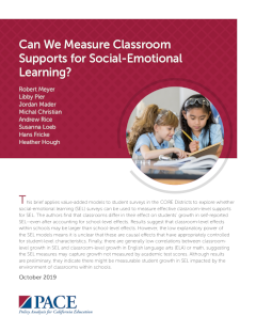
This study uses value-added models to explore whether social-emotional learning (SEL) surveys can measure effective classroom-level supports for SEL. Results show that classrooms differ in their effect on students' growth in self-reported SEL, suggesting that classroom-level effects may be larger than school-level effects. However, the low explanatory power of the SEL models means it's unclear if these are causal effects. The SEL measures also capture growth not measured by academic test scores, indicating that classrooms within schools may impact measurable student growth in SEL.
Lessons from the CORE Districts
Report
Published
Summary
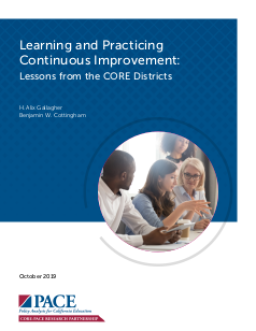
This report examines how California's education sector is embracing continuous improvement over standards-based reform. The study presents six lessons learned from PACE and CORE Districts' collaboration on the topic, including the complexity of embedding continuous improvement processes into school norms and the need for deliberate steps to build a culture conducive to continuous improvement. The report provides implications for broader continuous work in California and beyond, with three case studies providing more detail on exemplary practices in two districts and one school.
Policy brief
Published
Summary
California does not use a student-level growth model to measure school performance, which is uncommon among states. This brief refutes common beliefs about growth models and provides evidence that they are inaccurate or unsupported. It suggests that California should adopt a growth model to replace the current "change" metric in the California School Dashboard, with student-growth percentiles and residual-gain growth models as two specific models that would more accurately identify schools that require support.
Evidence from the CORE Districts and the PACE/USC Rossier Poll
Policy brief
Published
Summary
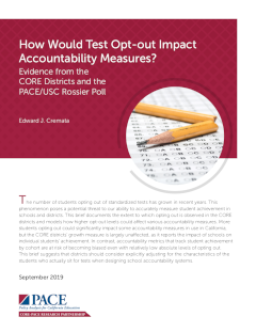
The increase in students opting out of standardized tests is a threat to accurately measuring student achievement. This brief examines the effects of opting out in the CORE districts and models how it could affect accountability measures. More opt-outs could significantly impact some metrics, but the growth measure is largely unaffected. Metrics tracking achievement by cohort are at risk of bias, even with low levels of opting out. Adjusting for characteristics of students who take the tests could be a solution.
A Research Summary and Implications for Practice
Policy brief
Published
Summary
Given the importance of a college degree for both individual and societal economic prosperity, policymakers and educators are focused on strengthening the path to college beyond college entry. In this report, we synthesize the existing literature on four factors key to educational attainment—aspirations and beliefs, academic preparation, knowledge and information, and fortitude and resilience—and the implications of each.
Evidence from the 2019 PACE/USC Rossier Voter Poll
Policy brief
Published
Summary
Governor Newsom has proposed initiatives to support children under 5, but California voters prioritize K-12 education and college affordability over early education. Despite evidence that high-quality early education has a powerful impact on children’s future success, more active engagement by the Governor and his allies may be necessary to build public support for expanding access and improving the quality of early education programs.
Perspectives from the 2019 PACE/USC Rossier Poll
Policy brief
Published
Summary
College affordability was ranked as the second most important education policy issue in the 2019 PACE/USC Rossier poll. Governor Newsom’s budget proposal and several bills in the state legislature reflect this concern. The diverse geography and socioeconomic status in CA demand local context consideration for designing effective reforms. Variation in concern over college costs is discussed by county and income and racial/ethnic groups. Proper evaluation and implementation of college promise programs and equity initiatives are suggested as fruitful avenues for addressing college affordability.
Policy brief
Published
Summary
Continuous improvement is a holistic and research-based approach to education grounded in the belief that every system is designed to achieve the results it gets; therefore, change must be systemwide, not piecemeal. California is a national leader in the continuous improvement movement that is spreading throughout local school districts as well as state and county offices of education. At its annual conference in February 2019, PACE convened a panel of California educators working on the cutting edge of continuous improvement. In this brief, they share their stories and lessons learned.